
United States Healthcare Advertising Market Size Growth & Industry Demands Report 2034
United States healthcare advertising market is evolving as healthcare providers, pharmaceutical companies, insurers, and digital health.

United States Healthcare Advertising Market Overview: Size, Demand, and Industry Outlook
The United States healthcare advertising market is evolving as healthcare providers, pharmaceutical companies, insurers, and digital health platforms compete for patient attention in a crowded media environment. Advertising in this industry is no longer limited to traditional television campaigns or print placements in medical publications. It now includes search marketing, social media outreach, connected TV, patient education content, healthcare influencer partnerships, and targeted campaigns across digital channels. As a result, the market has become an important part of the broader healthcare ecosystem, especially for businesses trying to improve patient acquisition, strengthen brand visibility, and support long-term engagement.
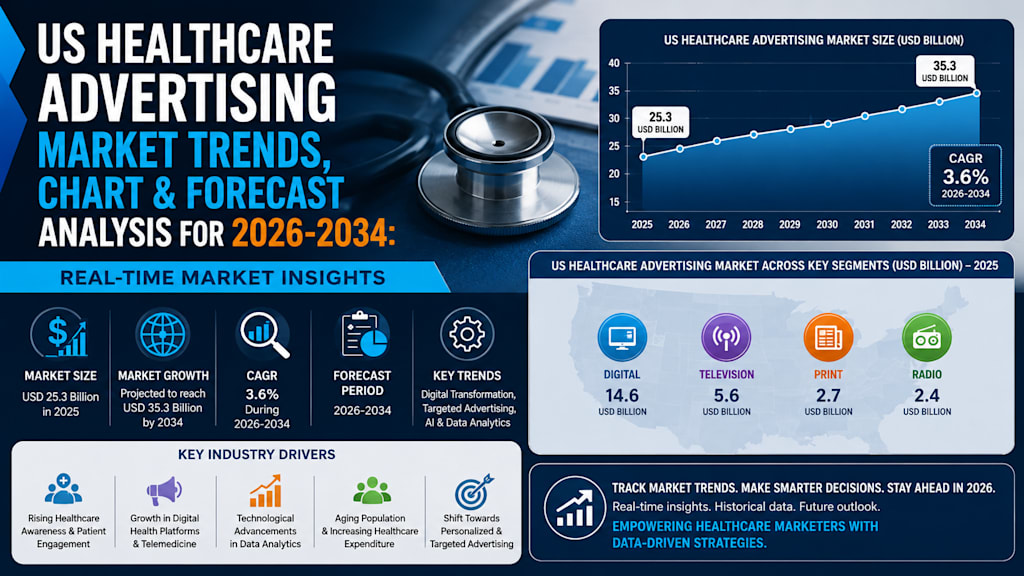
The US healthcare advertising market size was valued at USD 25.3 billion in 2025 and is projected to reach USD 35.3 billion by 2034, expanding at a CAGR of 3.6% during 2026–2034. This growth reflects a healthcare sector that is becoming more consumer-facing. Patients today often compare providers, research treatment options online, read reviews, and engage with healthcare brands long before they schedule an appointment or fill a prescription. That shift is pushing healthcare organizations to invest more in communication strategies that are measurable, personalized, and compliant with strict industry rules.
Key Trends Shaping the United States Healthcare Advertising Market
- Shift toward digital-first campaigns: Healthcare advertisers are increasing spending on paid search, social media, online video, programmatic ads, and patient-focused digital content.
- Patients are using digital channels more: Growing online research for healthcare information and provider comparisons is pushing organizations to strengthen digital advertising strategies.
- Rising use of data-driven targeting: Advertisers are using audience segmentation, behavioral insights, and analytics to reach specific patient groups more effectively.
- Better campaign measurement and relevance: Data-based targeting helps healthcare marketers improve campaign performance, optimize spending, and track return on investment more accurately.
- Greater focus on educational content: Healthcare advertising is increasingly centered on trust-building content that explains symptoms, treatment options, preventive care, and service availability clearly.
What Is Driving Growth in the United States Healthcare Advertising Market?
The growth of the healthcare advertising market in the United States is linked to both industry competition and changes in consumer behavior. One of the biggest drivers is the increasing pressure on healthcare businesses to attract and retain patients in a more competitive care environment. Hospitals, specialty clinics, urgent care networks, dental groups, fertility centers, and telehealth providers all need stronger visibility in order to differentiate their services.
Pharmaceutical advertising also remains a major contributor to market demand. Drug manufacturers continue to invest in direct-to-consumer campaigns, disease awareness initiatives, and physician-facing promotion, especially in therapeutic areas where patient awareness plays a role in treatment uptake. At the same time, over-the-counter healthcare brands are competing aggressively for consumer attention through omnichannel campaigns.
Advertising Demand Across Pharma, Hospitals, and Health Services in the United States Healthcare Advertising Market
Demand for healthcare advertising is not coming from one single part of the industry. Pharmaceutical companies remain among the largest advertisers, particularly in categories where brand recognition and patient education are important. These campaigns often focus on awareness, treatment options, and conversations between patients and physicians.
Hospitals and health systems represent another major source of advertising demand. Large hospital groups often promote specialty departments such as oncology, orthopedics, cardiology, maternity care, and emergency services. Their campaigns are designed not only to increase patient volumes but also to strengthen local market presence and improve public perception.
Health services businesses are also spending more on advertising. This includes urgent care providers, diagnostic laboratories, home healthcare companies, rehabilitation centers, dental networks, mental health platforms, and telemedicine providers. Many of these organizations operate in highly competitive local or regional markets, where digital advertising plays a direct role in lead generation and patient acquisition.
This broad advertiser base is one reason the US healthcare advertising market share is spread across multiple service categories rather than being concentrated only in pharmaceutical promotion. The market is supported by a wide range of healthcare businesses that need to communicate with patients, caregivers, employers, and healthcare professionals.
How Digital Engagement Is Reshaping the United States Healthcare Advertising Market
Digital engagement is changing not only where healthcare advertising appears, but also how campaigns are designed and measured. Search advertising has become especially important because many healthcare journeys begin online. Patients search for symptoms, nearby specialists, treatment options, or insurance-related information before they make a healthcare decision. This gives providers and brands a chance to connect with users at an early stage of the decision process.
Social media has also become a more important communication channel, especially for wellness campaigns, preventive care awareness, service announcements, and brand-building efforts. Healthcare marketers are using short videos, patient stories, doctor-led content, and educational posts to improve visibility and engagement.
At the same time, connected TV, streaming platforms, podcasts, and health-focused digital publications are creating new ways to reach targeted audiences. For advertisers, the appeal of digital channels lies in flexibility, audience targeting, and performance measurement. Campaigns can be optimized more quickly, messaging can be adjusted by audience type, and marketers can track results more closely than in traditional media environments.
Challenges Affecting the United States Healthcare Advertising Market
Despite steady demand, the healthcare advertising market also faces a number of constraints. Regulation is one of the most important. Healthcare advertising must operate within strict rules related to patient privacy, clinical claims, drug promotion, and disclosure requirements. Campaigns that involve prescription drugs, medical devices, or health outcomes require especially careful review.
Trust is another challenge. Healthcare advertising carries more reputational risk than many other industries because consumers are making decisions that affect health, treatment, and financial well-being. Overly aggressive messaging or unclear claims can damage credibility quickly. As a result, advertisers must balance persuasive communication with transparency and patient education.
Fragmentation is also a challenge for marketers. The healthcare sector includes hospitals, insurers, pharmaceutical firms, wellness brands, and digital health providers, all with different audiences, budgets, and compliance needs. Reaching the right patient or decision-maker at the right time often requires a more complex media strategy than in other consumer sectors.
Competitive Landscape of the United States Healthcare Advertising Market
The competitive landscape of the healthcare advertising market includes full-service agencies, healthcare-focused marketing firms, media buying companies, pharmaceutical advertising specialists, digital consultancies, and in-house marketing teams within major healthcare organizations. Competition is based on sector expertise, creative quality, data capabilities, compliance knowledge, and the ability to deliver measurable results.
Some agencies focus heavily on pharmaceutical and life sciences advertising, while others specialize in hospital marketing, health system branding, or digital patient acquisition. Technology is also shaping the competitive environment, as analytics tools, customer data platforms, and marketing automation systems become more integrated into campaign planning and execution.
About the Creator
Kim Soo hyun
My name is Kim Soo hyun, and I am a research analyst at IMARC Group, specializing in market trends and data analysis to provide insights and support strategic decision-making.
Enjoyed the story? Support the Creator.
Subscribe for free to receive all their stories in your feed.
Comments
There are no comments for this story
Be the first to respond and start the conversation.