
United States Fertilizer Market Size to Hit USD 85.00 Billion by 2034
The United States fertilizer market size was valued at USD 49.46 Billion in 2025 and is projected to reach USD 85.00 Billion by 2034, growing at a compound annual growth rate of 6.20% from 2026-2034.

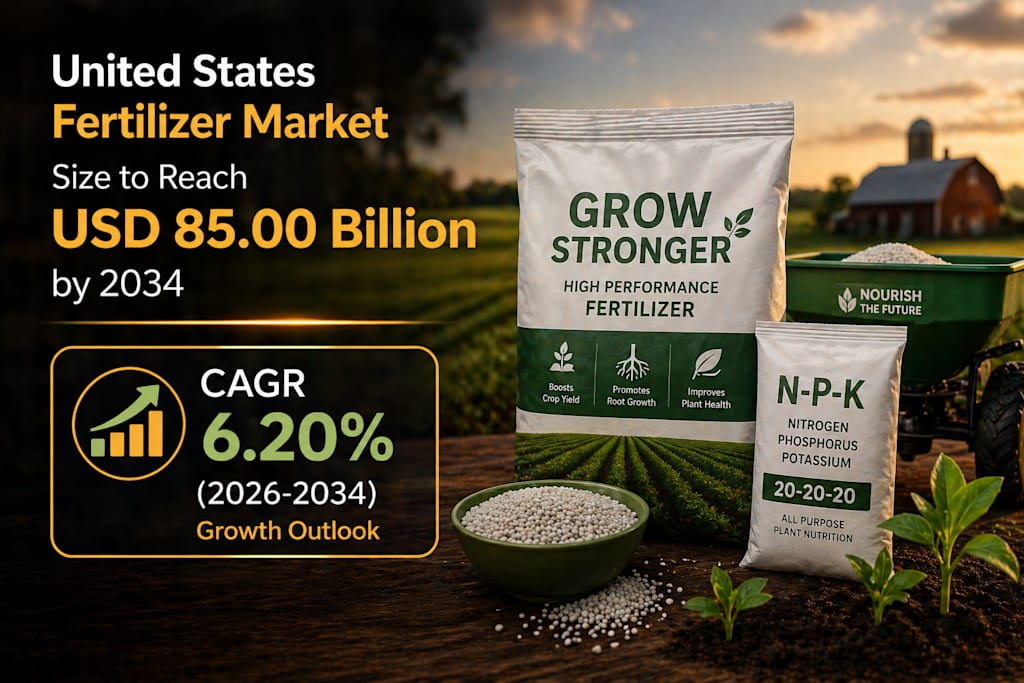
United States Fertilizer Market Size, Growth, and Forecast (2026–2034)
The United States fertilizer market is evolving steadily as agriculture continues to adapt to changing environmental conditions and food demand. In 2026, the market reflects a growing emphasis on productivity, efficiency, and sustainable farming practices.
The market was valued at USD 49.46 billion in 2025 and is projected to reach USD 85.00 billion by 2034, expanding at a compound annual growth rate (CAGR) of 6.20% during 2026–2034. This growth highlights the increasing importance of fertilizers in supporting agricultural output and food security.
Fertilizers are essential inputs in farming, providing nutrients that enhance soil fertility and crop yields. They are widely used across different types of crops, including grains, fruits, and vegetables.
Request a Sample Report with Latest 2026 Data & Forecasts:
Key Trends Shaping the United States Fertilizer Market
Several important trends are influencing the development of the fertilizer industry:
• Increasing demand for efficient and high-yield farming solutions
• Growing focus on sustainable and environmentally friendly fertilizers
• Rising adoption of precision agriculture technologies
• Expansion of organic and bio-based fertilizers
• Increasing integration of digital tools in farming practices
These trends reflect a shift toward more sustainable and technology-driven agriculture.
Major Growth Drivers in the United States Fertilizer Industry
The growth of the market is supported by several key factors.
One of the primary drivers is the increasing demand for food production, driven by population growth and changing consumption patterns.
Another important factor is the need to improve crop yields and soil productivity, which encourages the use of advanced fertilizers.
The adoption of precision farming techniques is also contributing to market growth, allowing farmers to optimize fertilizer use.
Additionally, government initiatives promoting sustainable agriculture are supporting the use of eco-friendly products.
The expansion of commercial farming and agribusiness activities further drives demand.
Role of Technology in Fertilizer Application
Technology plays a central role in shaping the fertilizer market.
Precision agriculture tools, such as sensors and data analytics, help farmers apply fertilizers more efficiently.
Digital platforms provide insights into soil conditions and nutrient requirements.
Automation and advanced equipment improve application accuracy and reduce waste.
Innovations in fertilizer composition are enhancing nutrient efficiency and environmental performance.
These technological advancements are improving both productivity and sustainability.
Investment Opportunities in the United States Fertilizer Market
The strong growth of the market is creating various investment opportunities.
Companies are investing in research and development, sustainable products, and advanced agricultural technologies to remain competitive. There is also growing interest in bio-based and specialty fertilizers.
Investments in supply chain infrastructure and distribution networks are improving accessibility.
Collaborations between agricultural firms, technology providers, and research institutions are driving innovation.
With continued growth expected through 2034, the market offers significant long-term potential.
Challenges Impacting the United States Fertilizer Industry
Despite strong growth, the market faces several challenges.
One of the key issues is fluctuating raw material prices, which can impact production costs and pricing.
Another challenge is environmental concerns related to fertilizer usage, including soil and water management.
Regulatory requirements and sustainability standards are also influencing product development.
Additionally, supply chain disruptions may affect availability and distribution.
Future Outlook (2026–2034)
Looking ahead, the United States fertilizer market is expected to continue its steady expansion as agricultural demand increases.
Between 2026 and 2034, the demand for efficient, sustainable, and technologically advanced fertilizers is likely to grow significantly. Farmers will increasingly adopt solutions that enhance productivity while minimizing environmental impact.
Technological advancements will further shape the market. The integration of precision agriculture, digital tools, and innovative fertilizer formulations will improve efficiency.
The continued focus on sustainability and resource optimization will influence market development.
Overall, the market is poised for strong growth, driven by agricultural demand, innovation, and evolving farming practices.
Conclusion
The United States fertilizer market is evolving steadily, supported by increasing food demand, technological advancements, and a growing focus on sustainable agriculture. With projected growth from 2026 to 2034, the market is expected to remain a key component of the agricultural sector.
While challenges such as cost fluctuations and environmental concerns persist, ongoing innovation and investment are likely to support long-term growth. As farming practices continue to evolve, fertilizers will play a crucial role in ensuring productivity and sustainability.
About the Creator
Jackson Watson
I'm a market research analyst at Imarc group company delivering data-driven insights, industry analysis, and customized research solutions. We support businesses with market sizing, competitive analysis, and strategic decision-making.
Enjoyed the story? Support the Creator.
Subscribe for free to receive all their stories in your feed.
Comments
There are no comments for this story
Be the first to respond and start the conversation.