
United States Epilepsy Drugs Market Set to Reach US$ 3.45 Billion by 2033 as Innovation and Awareness Transform Patient Care
New-generation anti-epileptic drugs, growing disease prevalence, and regulatory support are reshaping the future of epilepsy treatment across the United States.

A New Era in Epilepsy Treatment is Emerging in the United States
Epilepsy remains one of the most common neurological disorders worldwide, affecting millions of individuals and families. In the United States, the condition continues to present significant healthcare challenges, creating a growing demand for advanced treatment solutions and innovative anti-epileptic drugs (AEDs).
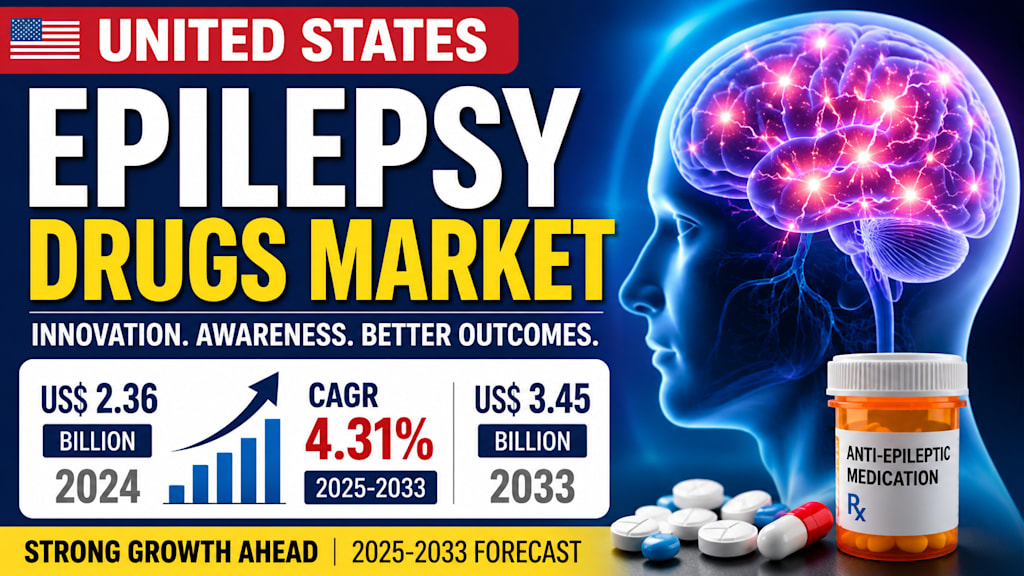
According to Renub Research, the United States Epilepsy Drugs Market is projected to increase from US$ 2.36 billion in 2024 to US$ 3.45 billion by 2033, expanding at a CAGR of 4.31% during the forecast period from 2025 to 2033.
The market's growth reflects a combination of factors including rising epilepsy prevalence, continuous pharmaceutical innovation, favorable regulatory support, and increasing public awareness regarding neurological disorders. As healthcare providers strive to improve patient outcomes, the demand for safer and more effective epilepsy therapies is accelerating across the country.
Understanding Epilepsy and Its Growing Burden
Epilepsy is a chronic neurological disorder characterized by recurrent seizures caused by abnormal electrical activity in the brain. The condition can affect people of all ages and may significantly impact daily life, employment, education, and social interactions.
In the United States, epilepsy affects approximately 3.4 million people. Experts estimate that one in every 26 Americans will be diagnosed with epilepsy during their lifetime, while more than 150,000 new cases are diagnosed annually.
The increasing prevalence of epilepsy has become one of the strongest drivers of market growth. As diagnosis rates improve and awareness campaigns continue to educate the public, more patients are seeking treatment and long-term disease management solutions.
Healthcare systems are responding by investing heavily in specialized neurology services and advanced pharmaceutical treatments designed to improve seizure control while minimizing side effects.
Market Forecast Signals Strong Growth Ahead
The epilepsy drugs market has evolved considerably over the past decade. Earlier treatment options often came with substantial side effects and limited effectiveness for certain seizure types. Today's pharmaceutical landscape is far more sophisticated.
The projected growth to US$ 3.45 billion by 2033 highlights the increasing confidence in advanced therapies and next-generation treatment options.
Several market forces are contributing to this positive outlook:
Rising patient population
Greater awareness and diagnosis rates
Expanding pharmaceutical research
Introduction of novel therapies
Strong regulatory support
Growing investment in rare epilepsy treatments
Improved healthcare access
Together, these factors are creating an environment that encourages both innovation and market expansion.
New-Generation Drugs Are Changing the Treatment Landscape
One of the most important developments in epilepsy treatment has been the emergence of second-generation and third-generation anti-epileptic drugs.
These newer therapies offer several advantages compared to traditional medications:
Improved seizure control
Reduced side effects
Better patient adherence
Enhanced safety profiles
Greater effectiveness in difficult-to-treat epilepsy cases
As a result, second-generation AEDs are currently among the fastest-growing segments of the U.S. epilepsy drug market.
Patients increasingly prefer treatments that allow them to maintain a normal lifestyle while effectively managing seizures. Pharmaceutical companies are responding by developing therapies that focus not only on efficacy but also on quality of life.
FDA Approvals Continue to Fuel Market Momentum
Regulatory support has become a major catalyst for growth.
The U.S. Food and Drug Administration (FDA) has accelerated approvals for several innovative epilepsy treatments in recent years. These approvals provide physicians with additional therapeutic options while encouraging pharmaceutical companies to continue investing in neurological research.
A significant milestone occurred when ganaxolone (Ztalmy) received FDA approval for treating seizures associated with CDKL5 deficiency disorder, a rare and severe form of epilepsy.
Similarly, FINTEPLA (fenfluramine) gained approval for the treatment of seizures associated with Lennox-Gastaut syndrome, providing new hope for patients with difficult-to-manage epilepsy syndromes.
These developments demonstrate the growing commitment of healthcare stakeholders to address unmet medical needs within the epilepsy community.
Growing Focus on Rare and Complex Epilepsy Disorders
Historically, treatment options for rare epilepsy syndromes were limited.
Today, pharmaceutical companies are increasingly targeting specialized patient populations with precision therapies designed to address specific genetic and neurological causes of epilepsy.
This trend reflects the broader movement toward personalized medicine.
Rather than using a one-size-fits-all approach, researchers are developing treatments tailored to individual patient profiles and disease characteristics. Such advancements are expected to significantly improve treatment outcomes and reduce seizure frequency among patients suffering from complex forms of epilepsy.
The increasing focus on rare disorders also creates substantial commercial opportunities for pharmaceutical innovators.
Strategic Investments Are Driving Innovation
Investment activity within the epilepsy sector remains strong.
One of the most notable industry transactions involved Lundbeck's acquisition of Longboard Pharmaceuticals for approximately US$ 2.6 billion. The acquisition strengthens Lundbeck's position in neurological disorders and supports the development of innovative therapies such as bexicaserin for developmental and epileptic encephalopathies.
Large-scale investments like this illustrate the confidence that industry leaders have in the future of epilepsy therapeutics.
Biotechnology firms, pharmaceutical giants, and healthcare investors continue to view epilepsy as a high-potential therapeutic area capable of delivering both clinical and commercial value.
Challenges Continue to Impact Market Growth
Despite positive growth prospects, several challenges remain.
High Treatment Costs
Many modern anti-epileptic drugs remain expensive, creating affordability concerns for patients.
Brand-name medications can cost thousands of dollars each month, particularly when generic alternatives are unavailable. Even insured patients often face substantial co-payments, deductibles, and coverage limitations.
As a result, some individuals struggle to maintain consistent treatment, increasing the risk of seizure recurrence and hospitalization.
Regulatory Complexity
Developing new epilepsy medications requires extensive clinical trials, lengthy approval processes, and significant financial investment.
While these regulations help ensure safety and efficacy, they can delay market entry and increase development costs.
Smaller pharmaceutical companies may face additional challenges navigating these complex regulatory pathways.
Distribution Channels Continue to Evolve
The U.S. epilepsy drugs market benefits from multiple distribution channels that ensure medication accessibility across diverse patient populations.
Hospital Pharmacies
Hospital pharmacies remain a critical distribution channel, particularly for newly diagnosed patients and those requiring specialized neurological care.
Retail Pharmacies
Drug stores and retail pharmacies continue to dominate prescription fulfillment, offering widespread access and convenience.
Online Providers
Digital healthcare platforms and online pharmacies are rapidly expanding their role in epilepsy treatment. Telemedicine adoption and home delivery services have improved medication accessibility, particularly for patients living in rural areas.
As digital health technologies continue to evolve, online providers are expected to gain an increasingly important role within the market.
Competitive Landscape Remains Highly Dynamic
The United States epilepsy drugs market is characterized by intense competition among global pharmaceutical companies.
Leading players continue to invest in research, acquisitions, partnerships, and product development initiatives designed to strengthen their market position.
Major companies operating in the market include:
Eisai Co., Ltd.
UCB Inc.
H. Lundbeck A/S
GW Pharmaceuticals Plc.
Abbott Laboratories
Alkem Laboratories Limited
Bausch Health Companies Inc.
GSK plc.
These organizations are actively pursuing innovative therapies that address both common and rare forms of epilepsy.
10 Recent Developments by Key Companies
1. H. Lundbeck A/S
Acquired Longboard Pharmaceuticals in a US$ 2.6 billion transaction to strengthen its epilepsy and neurological disorders portfolio.
2. UCB Inc.
Expanded the clinical presence of FINTEPLA for severe epilepsy syndromes, reinforcing its leadership in rare neurological conditions.
3. Eisai Co., Ltd.
Continued investment in seizure management therapies while expanding global neurological treatment programs.
4. GW Pharmaceuticals Plc.
Advanced cannabinoid-based epilepsy therapies aimed at treatment-resistant seizure disorders.
5. Abbott Laboratories
Enhanced neurological diagnostic capabilities supporting earlier epilepsy detection and treatment planning.
6. Alkem Laboratories Limited
Strengthened its neurology product portfolio with expanded access initiatives and specialty medicine development.
7. Bausch Health Companies Inc.
Increased focus on central nervous system therapies through strategic product expansion efforts.
8. GSK plc.
Continued investment in neuroscience research and collaborative pharmaceutical innovation programs.
9. Marinus Pharmaceuticals
Advanced commercialization efforts for Ztalmy following FDA approval for CDKL5 deficiency disorder-associated seizures.
10. Longboard Pharmaceuticals
Accelerated development of bexicaserin targeting developmental and epileptic encephalopathies prior to its acquisition by Lundbeck.
Final Thoughts
The United States Epilepsy Drugs Market stands at the intersection of innovation, patient need, and scientific advancement. As epilepsy diagnoses continue to rise and treatment expectations evolve, pharmaceutical companies are responding with safer, more effective, and increasingly personalized therapies.
With market value expected to climb from US$ 2.36 billion in 2024 to US$ 3.45 billion by 2033, the future appears promising for both industry stakeholders and patients. Continued investment in research, regulatory support, and awareness initiatives will play a critical role in shaping the next generation of epilepsy care.
For millions of Americans living with epilepsy, these advancements represent more than market growth—they signify improved quality of life, greater treatment options, and renewed hope for a healthier future.
About the Creator
Enjoyed the story? Support the Creator.
Subscribe for free to receive all their stories in your feed.
Comments
There are no comments for this story
Be the first to respond and start the conversation.