
United States Endoscopy Devices Market Set for Strong Growth Through 2034
As minimally invasive care becomes the standard across hospitals and ambulatory centers, the United States endoscopy devices market is moving into a new phase of expansion, innovation, and clinical importance.

Overview
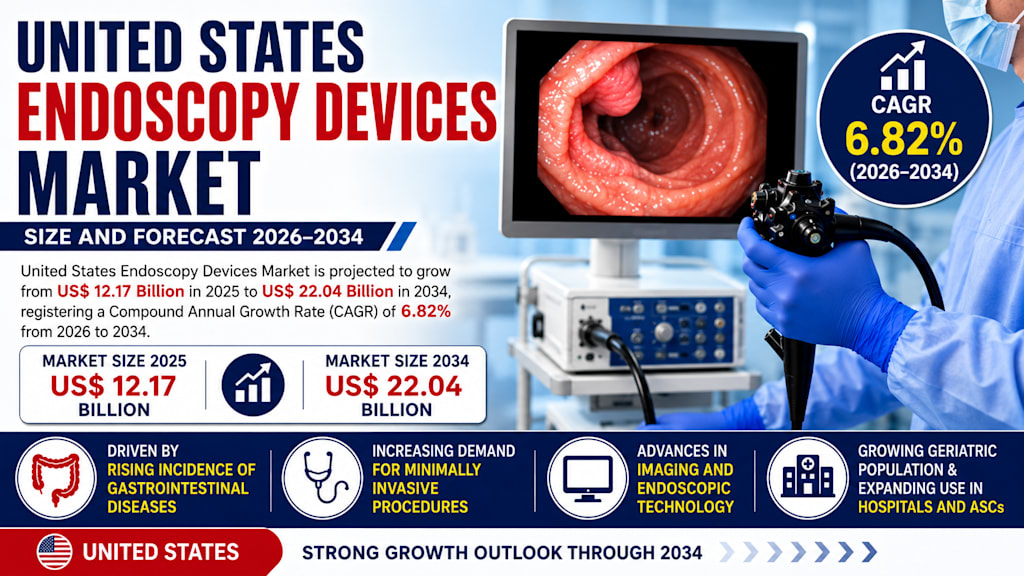
The United States endoscopy devices market is gaining momentum at a steady and meaningful pace, supported by the country’s high burden of gastrointestinal disorders, cancer screening needs, and rising preference for minimally invasive procedures. According to the provided Renub Research brief, the market is projected to grow from US$ 12.17 Billion in 2025 to US$ 22.04 Billion in 2034, registering a CAGR of 6.82% from 2026 to 2034. That kind of growth signals more than a routine market increase. It points to a broader shift in how diagnosis and treatment are being delivered across the American healthcare system.
Endoscopy has become central to modern medicine because it allows physicians to look inside the body without large surgical cuts. In many cases, it helps doctors diagnose, monitor, and even treat disease in the same procedure. That efficiency matters in a healthcare environment that is trying to improve outcomes while also reducing costs, procedure time, and patient recovery periods.
The market is not just expanding because of one driver. It is being shaped by multiple forces at the same time: rising cases of gastrointestinal disease, stronger cancer screening awareness, advances in imaging, a growing elderly population, and the continued shift from inpatient procedures to outpatient settings. Together, these trends are making endoscopy devices more essential than ever.
Why the Market Is Growing
One of the strongest growth drivers is the rising prevalence of gastrointestinal diseases and cancers in the United States. Conditions such as colorectal cancer, GERD, inflammatory bowel disease, ulcers, and other digestive disorders often require endoscopic diagnosis for early detection and treatment. Endoscopy allows doctors to visually inspect the digestive tract, take biopsies, remove polyps, and detect abnormal tissue before disease progresses. That early intervention can dramatically improve patient outcomes.
Cancer screening is especially important. Colonoscopy remains one of the most widely used tools for colorectal cancer screening, and screening programs have expanded awareness of preventive care across the country. As more Americans undergo regular screening, demand for endoscopic procedures naturally rises. In a healthcare system where early detection can reduce both mortality and long-term treatment costs, endoscopy is no longer a niche procedure. It is becoming part of routine care.
The burden of disease is substantial. The provided brief notes that in 2025, 2,041,910 new cancer cases and 618,120 cancer deaths are expected in the United States. That scale reinforces why diagnostic tools like endoscopes, colonoscopes, and bronchoscope systems remain highly relevant. Rising disease prevalence is not a temporary trend, and that gives the market durable growth support.
Minimally Invasive Care Is Changing the Standard
Another major reason for market expansion is the growing demand for minimally invasive procedures. Patients and physicians increasingly prefer procedures that involve smaller incisions, less pain, shorter hospital stays, and quicker return to normal life. Endoscopic surgery fits that expectation well.
In practical terms, endoscopic tools are used for a wide range of diagnostic and therapeutic applications. These include polyp removal, biopsy collection, tissue examination, tumor ablation, and control of internal bleeding. Compared with open surgery, endoscopic procedures often reduce complications and lower the overall burden on healthcare facilities.
This preference is especially visible in outpatient and ambulatory surgery settings. Procedures that once required longer hospital admission are now being shifted to outpatient facilities whenever possible. That change improves efficiency for providers and convenience for patients. It also expands the demand for smaller, more portable, and more sophisticated endoscopy systems that can handle high procedure volumes without sacrificing precision.
The market’s growth is also being supported by broader care delivery trends. Health systems are under pressure to reduce costs, hospitals are trying to improve workflow efficiency, and patients increasingly want faster recovery. Endoscopic intervention addresses all three.
Technology Is Reshaping the Market
Technological improvement is one of the most exciting parts of this market’s story. Endoscopy devices are no longer limited to basic imaging and simple visualization. The latest systems include high-definition optics, 4K imaging, advanced illumination, improved flexibility, digital documentation, and even AI-supported analysis in some applications.
These innovations are changing what clinicians can detect and how accurately they can act. Better image quality means clearer views of tissue structure and abnormalities. Advanced documentation systems improve recordkeeping and procedure review. Capsule endoscopy has expanded access to parts of the digestive tract that are difficult to reach with traditional tools. Robotic-assisted endoscopy is increasing precision in certain complex procedures. Artificial intelligence is beginning to support detection and workflow optimization.
The result is a market where product performance matters more than ever. Healthcare providers do not just want an endoscope that works; they want one that improves diagnostic confidence, supports safer procedures, and integrates smoothly into modern digital hospital systems.
The brief also points to meaningful recent developments. For example, January 2025 brought FDA clearance for AnX Robotica’s NaviCam capsule endoscopy system, while May 2025 saw Olympus receive FDA 510(k) clearance for its EZ1500 endoscopes with Extended Depth of Field technology. These kinds of launches show that innovation is continuing at a healthy pace and that manufacturers are still competing on image quality, access, and clinical usability.
Challenges That Still Need Attention
Even with strong growth, the market faces real constraints. The first is cost. Modern endoscopy systems can be expensive to purchase, maintain, disinfect, and upgrade. Video processors, imaging systems, endoscopes, sterilization equipment, and specialized accessories all add to capital and operational expenses. For healthcare providers, especially smaller facilities, the cost of staying current can be significant.
Patients may also face financial barriers. Although many endoscopy procedures are covered by insurance, out-of-pocket costs can still be burdensome. This can affect procedure uptake in some cases, especially when patients are not sure whether symptoms are serious enough to justify the expense. In a market that depends heavily on screening and early diagnosis, affordability matters.
Infection control is another major issue. Reusable endoscopes require careful reprocessing and sterilization after every use. If cleaning protocols are incomplete or inconsistent, the risk of cross-contamination rises. That makes hygiene a critical part of the market, not just a supporting function. Hospitals and clinics must invest in proper sterilization systems and staff training to maintain patient trust and comply with safety standards.
Regulatory scrutiny also adds complexity. Endoscopy devices must meet rigorous approval and quality standards before they can be widely sold. That is important for safety, but it also increases development time and cost. For manufacturers, this means higher barriers to entry and a longer road to commercialization.
Product and Application Segments
The market is divided across several product types, and each has a role in clinical practice.
Endoscopes remain the core category, as they are the primary tools used for visualization and intervention. Visualization and documentation systems support imaging, recording, and data management. Mechanical endoscopic equipment includes forceps, scissors, snares, dilators, and retrieval baskets, which are essential for tissue handling and therapeutic work. Accessories and other supporting products also contribute to procedure efficiency.
In terms of application, the market covers a wide spectrum. Gastrointestinal endoscopy is one of the biggest areas because of the high burden of digestive diseases and cancer screening. Bronchoscopy serves respiratory diagnosis and treatment. Laparoscopy continues to benefit from the growth of minimally invasive surgery. Other important applications include urology, gynecology, ENT, arthroscopy, and neuroendoscopy.
Each of these areas has different clinical needs, but they share a common expectation: better visualization, greater precision, and lower procedural burden.
End-User Trends
Hospitals remain the largest end-user segment in the United States endoscopy devices market. That makes sense because hospitals manage large volumes of diagnostic and therapeutic procedures across multiple specialties. They also have the infrastructure to support advanced imaging platforms, sterilization systems, and specialized surgical teams.
At the same time, ambulatory surgery centers are becoming increasingly important. Many endoscopic procedures are well suited to outpatient settings because they are minimally invasive and relatively efficient. As more care shifts away from traditional inpatient environments, ambulatory facilities are investing in endoscopy tools that are compact, reliable, and easy to integrate into fast-paced workflows.
This shift supports broader healthcare trends. It helps reduce congestion in hospitals, shortens recovery time, and makes care more accessible. That is one reason the market is expected to remain strong over the forecast period.
State-Level Growth Opportunities
The brief also highlights strong demand across several major U.S. states. California stands out because of its large population, advanced healthcare infrastructure, and high adoption of innovative medical technologies. New York benefits from its dense patient base, strong hospital network, and focus on preventive screening. New Jersey also shows steady momentum due to its healthcare infrastructure and concentration of medical and pharmaceutical companies.
Washington is gaining traction through healthcare innovation, specialty clinics, and the expansion of minimally invasive care. These states illustrate an important point: the market is not growing evenly only because of national trends. Local healthcare systems, hospital investment, and population health needs are also shaping regional demand.
Competitive Landscape
The competitive environment includes leading medical technology companies such as Johnson & Johnson, Stryker, Boston Scientific, CONMED, Medtronic, Fujifilm Holdings, and Smith & Nephew. These companies compete across imaging quality, product durability, procedural efficiency, and integration with digital systems.
Competition in this market is not only about hardware. It is also about service, reprocessing support, product training, and clinical workflow compatibility. Manufacturers that can combine strong technology with practical usability are best positioned to win market share.
Recent partnerships and product clearances further show that the field is active. Companies are building cloud-based endoscopy solutions, improving visualization technologies, and expanding into single-use or advanced imaging platforms. That makes the industry dynamic, innovation-heavy, and highly responsive to clinician needs.
Final Thoughts
The United States endoscopy devices market is entering a promising growth cycle. The core reasons are clear: rising gastrointestinal and cancer-related disease burden, expanding use of minimally invasive procedures, greater screening awareness, and continuous technological advancement. The market’s forecast to move from US$ 12.17 Billion in 2025 to US$ 22.04 Billion by 2034 reflects a healthcare system that increasingly depends on precise, less invasive, and more efficient diagnostic and therapeutic tools.
Challenges remain, especially around cost, infection control, and regulation, but they do not outweigh the long-term opportunity. Instead, they highlight where innovation and investment are still needed. As hospitals, ambulatory centers, and specialty providers continue to modernize, endoscopy devices will remain a critical part of American healthcare.
About the Creator
Enjoyed the story? Support the Creator.
Subscribe for free to receive all their stories in your feed.
Comments
There are no comments for this story
Be the first to respond and start the conversation.