
United States Endoscopy Devices Market Outlook 2026–2034: How Minimally Invasive Technology Is Transforming Modern Healthcare
Growing demand for minimally invasive procedures, rising gastrointestinal disease cases, and continuous innovation in endoscopic imaging technologies are driving strong growth across the United States endoscopy devices market.

The healthcare industry is increasingly moving toward procedures that deliver accurate diagnoses and effective treatments while minimizing patient discomfort and recovery time. Among the technologies leading this transformation are endoscopy devices, which have become indispensable tools in modern medicine.
From detecting gastrointestinal disorders and respiratory diseases to assisting surgeons during complex minimally invasive procedures, endoscopy devices play a critical role in diagnosis, treatment, and disease management. Advances in imaging quality, robotic assistance, artificial intelligence, and single-use technologies are further enhancing the effectiveness of these systems, allowing healthcare professionals to deliver safer and more precise care.
As chronic disease rates continue to rise and healthcare providers focus on improving patient outcomes while reducing hospitalization times, demand for advanced endoscopic technologies is growing rapidly across the United States.
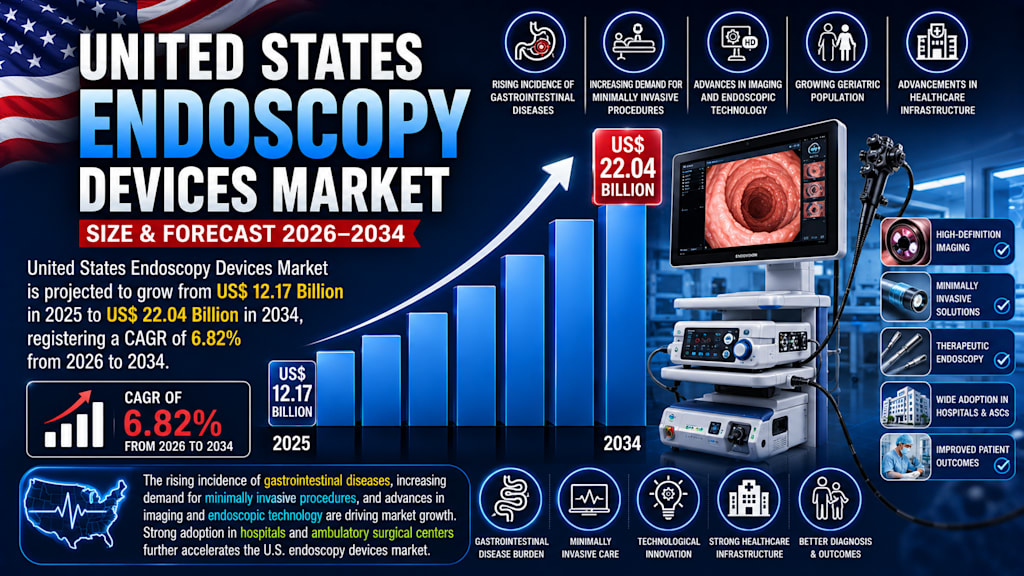
According to Renub Research, the United States Endoscopy Devices Market is expected to grow from US$ 12.17 billion in 2025 to US$ 22.04 billion by 2034, registering a compound annual growth rate (CAGR) of 6.82% between 2026 and 2034. Rising gastrointestinal disease prevalence, increasing adoption of minimally invasive procedures, technological innovation, and growing healthcare investments are among the major factors driving market expansion.
As healthcare systems increasingly prioritize efficiency, patient comfort, and early disease detection, endoscopy devices are becoming more important than ever before.
Understanding Endoscopy Devices and Their Importance
Endoscopy devices are advanced medical instruments designed to allow healthcare professionals to examine internal organs and body structures without performing major surgical procedures.
At the core of these systems is the endoscope, a flexible or rigid tube equipped with a camera, light source, and specialized instruments that can be inserted through natural body openings or small surgical incisions.
Endoscopy technology is used across a wide range of medical specialties, including gastroenterology, pulmonology, urology, gynecology, orthopedics, and general surgery.
Common procedures include colonoscopy, bronchoscopy, laparoscopy, cystoscopy, arthroscopy, and upper gastrointestinal endoscopy. These procedures allow physicians to diagnose diseases, collect tissue samples, remove polyps, control bleeding, and perform minimally invasive surgeries.
Compared with traditional open surgery, endoscopic procedures typically involve less pain, fewer complications, shorter hospital stays, and faster recovery times.
As patient demand for less invasive treatment options continues growing, endoscopy has become one of the most valuable technologies within modern healthcare.
Rising Gastrointestinal Disease Cases Are Fueling Demand
One of the strongest drivers of market growth is the increasing prevalence of gastrointestinal diseases across the United States.
Digestive disorders such as gastroesophageal reflux disease (GERD), inflammatory bowel disease, peptic ulcers, colorectal cancer, and gastrointestinal bleeding affect millions of Americans each year. Accurate diagnosis and monitoring of these conditions frequently require endoscopic procedures.
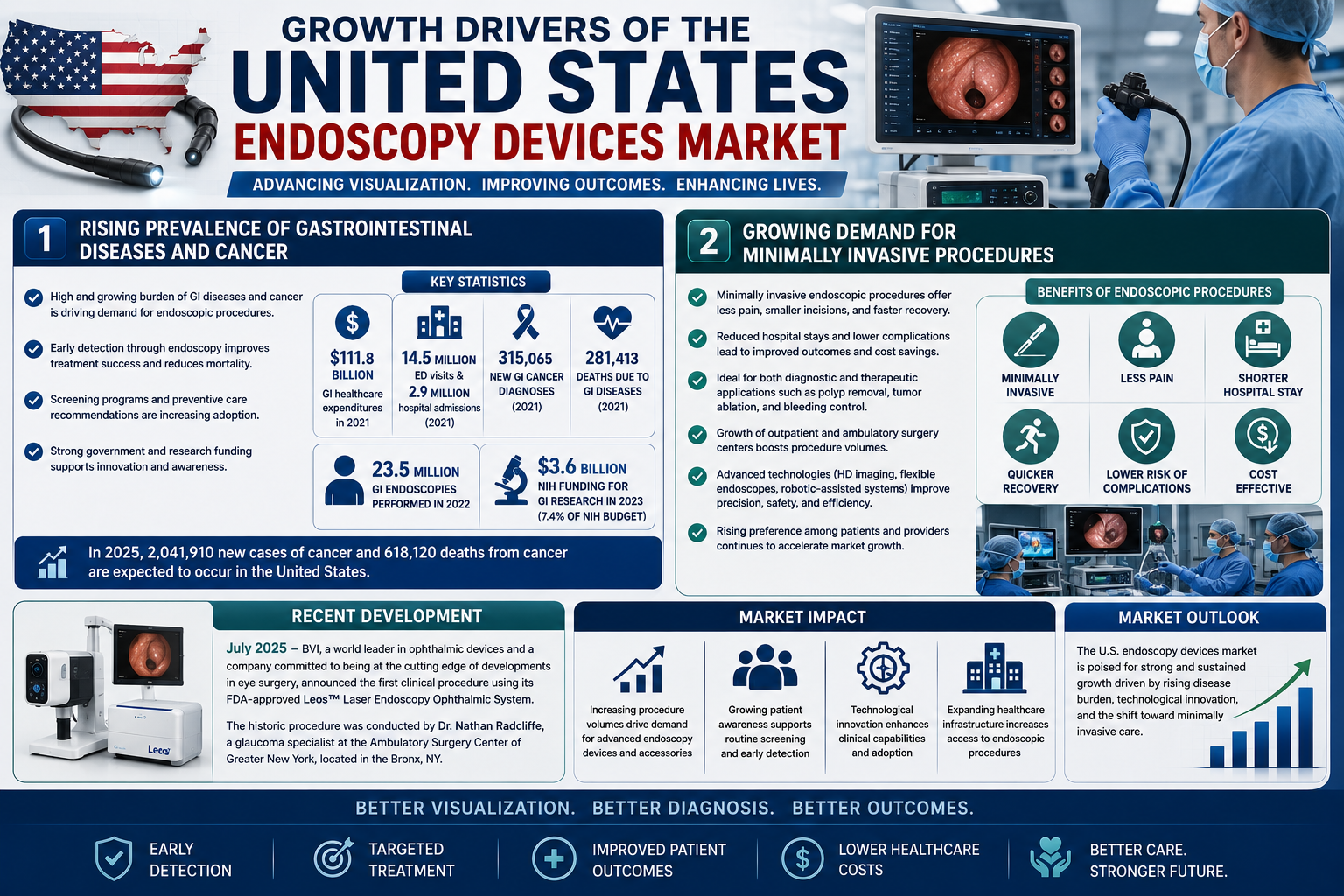
According to industry data, gastrointestinal healthcare expenditures reached approximately US$111.8 billion, while gastrointestinal conditions accounted for millions of emergency department visits and hospital admissions annually. More than 23 million gastrointestinal endoscopy procedures were performed in a single year, highlighting the critical role of endoscopy within digestive healthcare.
Colorectal cancer screening programs have become particularly important contributors to demand. Colonoscopy remains one of the most effective methods for detecting colorectal cancer at an early stage, significantly improving treatment outcomes and survival rates.
Growing awareness regarding preventive healthcare and routine screening is encouraging more patients to undergo endoscopic evaluations, further supporting market expansion.
The Fight Against Cancer Is Increasing Endoscopy Adoption
Cancer diagnosis and treatment represent another major growth area for endoscopy technologies.
Endoscopic procedures enable physicians to detect tumors, collect biopsies, evaluate disease progression, and perform certain therapeutic interventions without major surgery.
The increasing incidence of cancer throughout the United States is creating substantial demand for advanced diagnostic tools. According to projections, more than two million new cancer cases and hundreds of thousands of cancer-related deaths are expected annually in the country.
Early diagnosis remains one of the most effective strategies for improving cancer outcomes. Endoscopy provides physicians with direct visualization capabilities that support earlier detection and more accurate diagnosis.
Advances in imaging technology, including high-definition and 4K visualization systems, are further enhancing the ability to identify abnormalities at earlier stages.
As healthcare providers continue emphasizing early detection and precision medicine, endoscopy will remain an essential component of cancer care.
The Shift Toward Minimally Invasive Procedures
Modern patients increasingly prefer treatment options that minimize physical trauma and allow faster recovery.
This preference has fueled widespread adoption of minimally invasive procedures, making endoscopy one of the fastest-growing areas within medical technology.
Unlike traditional surgery, endoscopic procedures generally require only small incisions or natural body openings. This results in reduced postoperative pain, lower infection risk, shorter hospital stays, and quicker returns to normal activities.
Healthcare providers also benefit from improved efficiency and lower overall treatment costs.
Endoscopy is widely used for procedures such as polyp removal, tumor treatment, internal bleeding management, and diagnostic examinations.
The growing popularity of outpatient care and ambulatory surgery centers has further accelerated demand because minimally invasive procedures are well suited to same-day treatment environments.
As healthcare systems continue seeking ways to improve outcomes while controlling costs, minimally invasive endoscopic techniques are expected to remain a major driver of market growth.
Technological Innovation Is Transforming Endoscopy
Technological advancement remains one of the most important forces shaping the future of the endoscopy devices industry.
Modern systems offer dramatically improved image quality, allowing physicians to identify subtle abnormalities that might previously have gone undetected.
High-definition imaging, 4K visualization, advanced lighting systems, and enhanced optical technologies are improving diagnostic accuracy across numerous specialties.
Artificial intelligence is also beginning to play a larger role in endoscopy. AI-powered software can assist physicians by highlighting suspicious lesions, identifying polyps, and improving procedural efficiency.
Robotic-assisted endoscopy is another exciting development that enhances precision and control during complex procedures.
Capsule endoscopy represents a particularly innovative advancement. These miniature devices allow patients to swallow a small camera that captures detailed images of the digestive tract, providing valuable diagnostic information without traditional invasive procedures.
In January 2025, AnX Robotica received FDA clearance for its NaviCam capsule endoscopy system, highlighting ongoing innovation within the industry.
As technology continues advancing, endoscopic procedures are becoming safer, more accurate, and more comfortable for patients.
Mechanical Endoscopic Equipment Remains Essential
While visualization technologies often receive the most attention, mechanical endoscopic equipment remains fundamental to procedure success.
Devices such as forceps, scissors, snares, retrieval baskets, and dilators enable physicians to perform therapeutic interventions during endoscopic examinations.
These instruments are used for tissue sampling, polyp removal, foreign-object retrieval, and numerous other clinical applications.
Growing demand for minimally invasive therapeutic procedures continues supporting strong growth within this segment.
Manufacturers are focusing on improving durability, flexibility, and precision to enhance procedural effectiveness while improving patient safety.
As endoscopy expands into new clinical applications, mechanical accessories will remain critical components of the broader endoscopic ecosystem.
Bronchoscopy and Respiratory Care Are Expanding
Respiratory disease diagnosis and treatment represent another important application area for endoscopy technologies.
Bronchoscopy devices allow physicians to examine the airways and lungs, helping diagnose conditions such as lung cancer, chronic obstructive pulmonary disease (COPD), infections, and airway obstructions.
The growing prevalence of respiratory diseases, combined with increasing awareness regarding early lung cancer detection, is supporting demand for advanced bronchoscopy systems.
Modern bronchoscopes feature improved flexibility, high-definition imaging, and sophisticated navigation technologies that enhance diagnostic accuracy and treatment effectiveness.
As respiratory healthcare continues evolving, bronchoscopy is expected to remain a key growth segment within the endoscopy market.
Laparoscopy Continues to Gain Popularity
Laparoscopy has become one of the most widely performed minimally invasive surgical techniques in the United States.
The technology enables surgeons to perform abdominal and pelvic procedures through small incisions using cameras and specialized instruments.
Applications include gallbladder removal, hernia repair, gynecological procedures, and various general surgical interventions.
Advancements in robotic-assisted surgery and high-definition visualization systems have further improved laparoscopic precision and patient outcomes.
The growing preference for minimally invasive surgery among both patients and healthcare providers continues driving investment in advanced laparoscopic equipment.
As surgical practices increasingly prioritize efficiency and faster recovery times, laparoscopy is expected to remain a major contributor to endoscopy market growth.
Challenges Facing the Endoscopy Devices Market
Despite strong growth prospects, the industry faces several challenges.
One of the most significant barriers is the high cost of advanced endoscopy equipment. Modern imaging systems, video processors, robotic platforms, and specialized instruments require substantial financial investment.
Hospitals and healthcare facilities must also account for maintenance costs, software updates, and staff training requirements.
For some patients, procedure costs may remain a concern despite insurance coverage.
These financial considerations can slow adoption among smaller healthcare providers and resource-constrained institutions.
Infection Control and Regulatory Requirements
Infection prevention remains a critical concern within endoscopy practice.
Reusable endoscopes require meticulous cleaning, disinfection, and sterilization between procedures to prevent cross-contamination and healthcare-associated infections.
Healthcare facilities must invest in specialized reprocessing systems and maintain strict infection-control protocols.
Regulatory requirements also present challenges for manufacturers. New products must undergo extensive testing and regulatory review before receiving approval for clinical use.
While these standards are essential for patient safety, they can increase development costs and extend product-launch timelines.
Maintaining compliance while continuing to innovate remains a key challenge for industry participants.
Regional Market Insights
California remains one of the largest markets for endoscopy devices due to its extensive healthcare infrastructure, large patient population, and strong adoption of advanced medical technologies. Growing rates of gastrointestinal disorders, obesity, and cancer continue supporting demand for diagnostic and therapeutic endoscopic procedures. Healthcare organizations throughout the state frequently invest in cutting-edge imaging and robotic-assisted systems.
New York also represents a major market driven by its aging population, world-class healthcare institutions, and emphasis on preventive screening programs. Increasing awareness of colorectal cancer screening and early disease detection continues fueling demand for advanced endoscopy technologies. In March 2024, Scivita Medical partnered with Boston Scientific to strengthen collaboration in endoscopic imaging and equipment development.
New Jersey benefits from strong healthcare infrastructure, major pharmaceutical industry presence, and continued investment in medical innovation. Healthcare providers across the state increasingly adopt advanced endoscopy technologies to improve patient outcomes and support minimally invasive care. NTT Corporation and Olympus launched a pilot cloud-based endoscopy initiative in 2024, highlighting ongoing technological advancement within the market.
Washington continues expanding its endoscopy market through healthcare innovation, advanced research capabilities, and growing demand for minimally invasive procedures. In May 2025, Olympus received FDA clearance for its EZ1500 endoscope series featuring Extended Depth of Field technology, further advancing imaging capabilities within the field.
Competitive Landscape
Competition within the United States endoscopy devices market remains strong as manufacturers continue investing in innovation, imaging technology, robotics, and artificial intelligence.
Major companies operating in the market include Johnson & Johnson, Stryker, Boston Scientific, CONMED, Medtronic, Fujifilm Holdings, and Smith & Nephew. These organizations focus on improving visualization quality, enhancing procedural efficiency, reducing infection risks, and expanding minimally invasive treatment options.
Continuous investment in research and development is expected to drive further innovation throughout the forecast period.
Final Thoughts
The United States endoscopy devices market is entering a period of sustained growth driven by rising disease prevalence, increasing demand for minimally invasive procedures, and rapid technological advancement. Endoscopy has become an essential component of modern healthcare, enabling earlier diagnosis, more effective treatment, and improved patient outcomes across a wide range of medical specialties.
As innovations such as artificial intelligence, robotic-assisted systems, capsule endoscopy, and advanced imaging technologies continue reshaping clinical practice, the role of endoscopy is expected to expand even further. With the market projected to grow from US$ 12.17 billion in 2025 to US$ 22.04 billion by 2034, endoscopy devices will remain among the most important technologies supporting the future of American healthcare.
About the Creator
Enjoyed the story? Support the Creator.
Subscribe for free to receive all their stories in your feed.
Comments
There are no comments for this story
Be the first to respond and start the conversation.