
United States Electric Vehicles Market Size Growth Share Trends Demand & Forecast 2034
The United States electric vehicles market reached USD 235.2 billion in 2025 and is projected to grow to USD 1,935.3 billion by 2034.

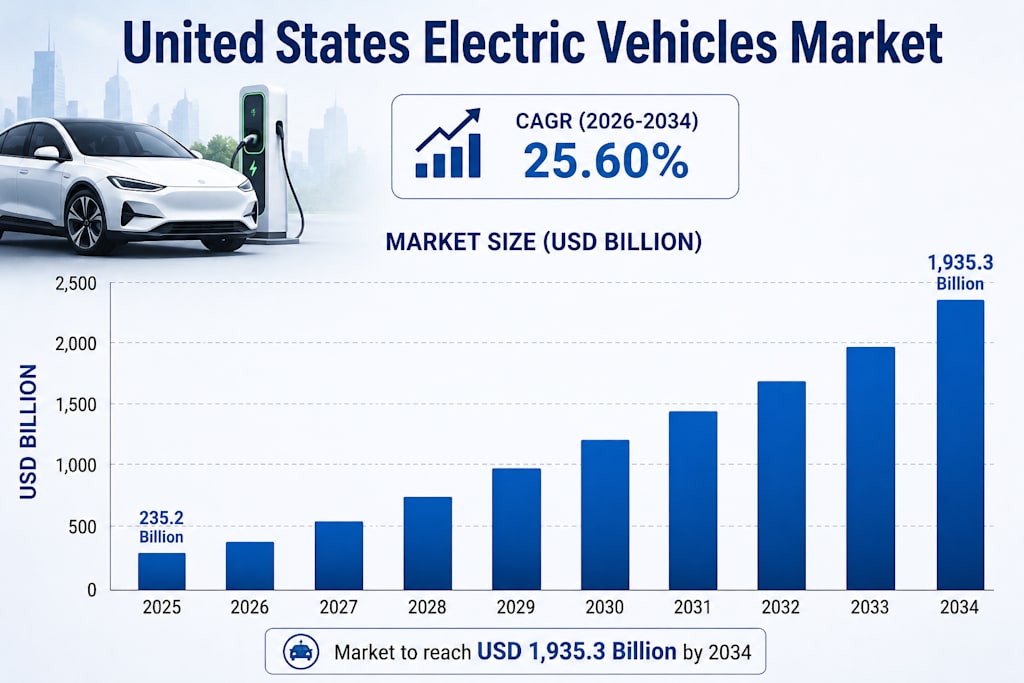
United States Electric Vehicles Market Size, Share, and Growth Forecast (2026–2034)
The United States electric vehicles (EV) market is entering a phase of accelerated expansion, supported by policy support, infrastructure investment, and evolving consumer demand. The market reached USD 235.2 billion in 2025 and is projected to grow to USD 1,935.3 billion by 2034, reflecting a CAGR of 25.60% during 2026–2034.
This growth is not limited to vehicle sales alone. It reflects the development of a broader ecosystem that includes battery manufacturing, charging infrastructure, software integration, and supply chain localization. For B2B stakeholders such as OEMs, suppliers, and investors, the EV market presents a multi-layered opportunity with long-term strategic value.
Request a Sample Report with Latest 2026 Data & Forecasts:
Key Growth Drivers in the U.S. Electric Vehicles Market: Policy Support, OEM Investments, and Demand Shift
Government policies are playing a central role in driving EV adoption across the United States. Incentives, tax credits, and emissions regulations are encouraging both manufacturers and consumers to transition toward electric mobility. These policies are also pushing OEMs to accelerate production timelines and expand EV portfolios.
At the same time, automakers are making significant capital investments in EV platforms, battery technologies, and manufacturing facilities. This includes the development of dedicated EV production lines and partnerships with technology providers.
Consumer demand is also shifting. Increasing awareness of sustainability, combined with improving vehicle performance, is encouraging adoption. Fleet operators and corporate buyers are emerging as key contributors to demand, particularly as organizations align with sustainability goals and cost optimization strategies.
EV Supply Chain in the United States: Batteries, Components, and Manufacturing Ecosystem
The EV supply chain in the United States is undergoing transformation, with a strong focus on localization and resilience. Battery production is a critical component, and investments are being directed toward establishing domestic gigafactories and securing raw material supply.
Component suppliers are also adapting to the shift from internal combustion engines to electric drivetrains. This transition is creating opportunities for companies specializing in power electronics, thermal management systems, and lightweight materials.
Manufacturing ecosystems are evolving to support EV production, with new facilities being developed and existing plants being upgraded. For suppliers, aligning with OEM requirements and ensuring scalability is essential to remain competitive in this changing landscape.
Charging Infrastructure Expansion and Its Impact on EV Adoption in the U.S.
Charging infrastructure is a key enabler of EV adoption. Both public and private investments are driving the expansion of charging networks across urban and highway locations. This includes the development of fast-charging stations that reduce charging time and improve convenience for users.
For businesses, infrastructure development opens opportunities in equipment manufacturing, installation services, and network management. Companies involved in energy distribution and utilities are also playing a role in supporting grid integration and capacity planning.
The availability of reliable charging infrastructure is directly influencing consumer confidence and purchase decisions. As coverage improves, adoption rates are expected to increase across both personal and commercial segments.
Technology Trends in U.S. EV Market: Battery Innovation, Range Improvement, and Software Integration
Technological advancements are shaping the competitiveness of EVs in the U.S. market. Battery innovation is a key focus area, with efforts aimed at increasing energy density, reducing costs, and improving charging speed. These improvements are helping extend vehicle range and enhance overall performance.
Software integration is another important trend. Modern EVs are increasingly defined by their software capabilities, including connectivity, remote diagnostics, and over-the-air updates. These features are enhancing user experience and enabling continuous product improvement.
In addition, integration with autonomous driving technologies is gaining momentum. While still evolving, this trend highlights the convergence of mobility and digital technologies, creating new opportunities for technology providers and system integrators.
Challenges in the U.S. EV Market: Cost, Supply Constraints, and Infrastructure Gaps
Despite strong growth prospects, the EV market faces several challenges. High upfront costs remain a barrier for some consumers, particularly in comparison to traditional vehicles. While total cost of ownership can be competitive, initial pricing continues to influence purchase decisions.
Supply chain constraints are another concern. Dependence on critical raw materials such as lithium, cobalt, and nickel can create volatility in production and pricing. Ensuring stable supply chains is essential for sustained growth.
Infrastructure gaps also persist, especially in rural and less-developed areas. While significant progress is being made, uneven distribution of charging facilities can limit adoption in certain regions.
For businesses, addressing these challenges requires a combination of innovation, strategic partnerships, and long-term investment planning.
Investment Opportunities in the United States Electric Vehicles Market for OEMs, Suppliers, and Investors
The United States electric vehicles (EV) market size offers substantial investment opportunities across multiple segments. OEMs are investing in new vehicle platforms and expanding production capacity, while suppliers are focusing on components such as batteries, electronics, and charging equipment.
Battery manufacturing remains one of the most attractive areas for investment, given its central role in the EV value chain. Companies involved in raw material processing, recycling, and battery technology development are also gaining attention.
Charging infrastructure presents another growth avenue. Businesses can participate in the development, operation, and maintenance of charging networks, as well as in related services such as energy management and software platforms.
Strategic partnerships are becoming increasingly important. Collaboration between automakers, technology firms, and energy providers is enabling faster innovation and market expansion.
For investors and industry participants, the focus is on scalable solutions that combine technology, cost efficiency, and long-term sustainability. As the market continues to evolve, organizations that align with these priorities are likely to capture significant value in the U.S. electric vehicle ecosystem.
About the Creator
Kim Soo hyun
My name is Kim Soo hyun, and I am a research analyst at IMARC Group, specializing in market trends and data analysis to provide insights and support strategic decision-making.
Enjoyed the story? Support the Creator.
Subscribe for free to receive all their stories in your feed.
Comments
There are no comments for this story
Be the first to respond and start the conversation.