
United States E-Commerce Market Size Growth Share Trends Demand & Forecast 2034
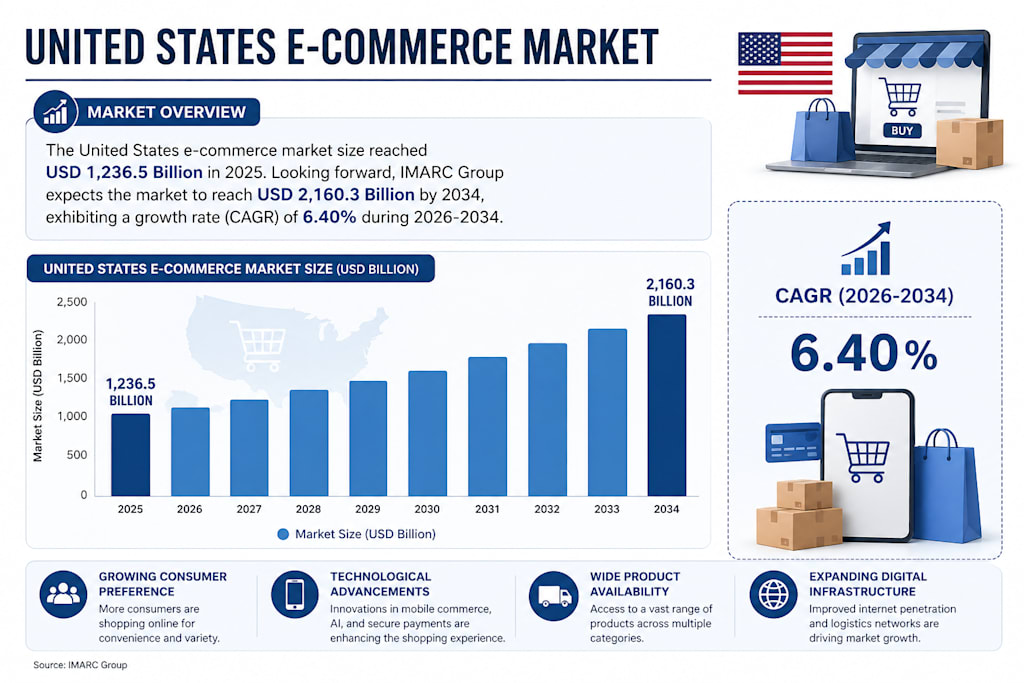
The United States E-commerce market reached USD 1,236.5 billion in 2025 and is projected to grow to USD 2,160.3 billion by 2034

United States E-Commerce Market Size, Share, and Growth Forecast (2026–2034)
E-commerce in the United States continues to expand as digital channels become central to how consumers and businesses buy and sell products. The market reached USD 1,236.5 billion in 2025 and is projected to grow to USD 2,160.3 billion by 2034, at a CAGR of 6.40%.
This growth reflects a structural shift rather than a temporary trend. Online retail is now a core part of the broader commerce ecosystem, supported by high internet penetration, mobile usage, and improved digital payment systems. For businesses, e-commerce is no longer an optional channel—it is a primary route to market. Companies that invest in digital infrastructure, customer experience, and fulfillment capabilities are better positioned to capture long-term value.
Key Growth Drivers in the U.S. E-Commerce Market Digital Adoption and Consumer Behavior
The expansion of e-commerce is closely tied to consumer behavior and digital adoption. Shoppers increasingly prefer the convenience of browsing, comparing, and purchasing products online. Mobile devices play a major role, enabling transactions at any time and from any location.
Another key driver is the shift toward personalized shopping experiences. Consumers expect relevant product recommendations, seamless checkout processes, and fast delivery. Businesses are responding by investing in data analytics and customer engagement tools to meet these expectations.
Competitive pricing and product availability are also influencing demand. Online platforms allow consumers to compare options easily, which pushes retailers to optimize pricing strategies and inventory management.
B2B vs B2C E-Commerce Trends in the United States Opportunities for Businesses
While B2C e-commerce dominates in terms of visibility, B2B e-commerce is growing rapidly and presents significant opportunities. Businesses are adopting digital platforms to streamline procurement, reduce costs, and improve efficiency.
B2C platforms focus on user experience, branding, and fast delivery, while B2B platforms prioritize bulk transactions, pricing flexibility, and integration with enterprise systems. Both segments require different strategies, but they share a common need for reliable digital infrastructure.
For companies, understanding the differences between these segments is critical. Businesses that can tailor their offerings to meet the specific needs of B2B buyers or end consumers are more likely to achieve sustainable growth.
United States E-Commerce Market Key Segmentation Analysis
Breakup by Type:
• Home Appliances
• Apparel, Footwear and Accessories
• Books
• Cosmetics
• Groceries
• Others
Breakup by Transaction:
• Business-to-Consumer
• Business-to-Business
• Consumer-to-Consumer
• Others
Breakup by Region:
• Northeast
• Midwest
• South
• West
Technology Trends in U.S. E-Commerce AI, Personalization, and Omnichannel Retail
Technology is reshaping how e-commerce operates. Artificial intelligence is being used to analyze customer behavior, optimize pricing, and manage inventory. These capabilities help businesses make faster and more informed decisions.
Personalization is another key trend. Retailers are using data to deliver customized product recommendations and marketing messages, improving customer engagement and conversion rates.
Omnichannel retail is also becoming a standard approach. Consumers expect a consistent experience across online and offline channels, including options such as buy online and pick up in-store. Businesses that integrate these channels effectively can improve customer satisfaction and retention.
Logistics, Fulfillment, and Last-Mile Delivery Challenges in the U.S. E-Commerce Market
Logistics remains one of the most critical aspects of e-commerce operations. As order volumes increase, companies must ensure that their supply chains can handle demand efficiently. Warehousing, inventory management, and order processing all play a role in maintaining service levels.
Last-mile delivery is particularly challenging. Customers expect fast and reliable delivery, often within one or two days. Meeting these expectations requires investment in distribution networks and delivery systems.
Costs are another concern. Shipping and fulfillment expenses can impact margins, especially for smaller businesses. Companies are exploring ways to optimize routes, improve efficiency, and reduce costs without compromising service quality.
Investment Opportunities in the United States E-Commerce Market for Retailers and Platforms
The U.S. e-commerce market offers a wide range of investment opportunities across the value chain. Retailers are investing in digital platforms, customer experience tools, and data analytics to stay competitive.
There is also strong demand for logistics and fulfillment solutions. Companies that can provide efficient warehousing, delivery, and supply chain management services are well positioned to benefit from market growth.
Technology providers are another area of opportunity. Solutions that support personalization, automation, and integration are becoming essential for e-commerce operations.
Partnerships are playing a key role in market expansion. Collaboration between retailers, technology companies, and logistics providers is enabling businesses to scale more effectively. For investors and industry participants, the focus is on building scalable, efficient, and customer-centric models that can adapt to changing market conditions.
About the Creator
Kim Soo hyun
My name is Kim Soo hyun, and I am a research analyst at IMARC Group, specializing in market trends and data analysis to provide insights and support strategic decision-making.
Enjoyed the story? Support the Creator.
Subscribe for free to receive all their stories in your feed.
Comments
There are no comments for this story
Be the first to respond and start the conversation.