
United States Digital Payment Market Set to Triple by 2033 as Cashless Transactions Become the New Normal
Rapid smartphone adoption, booming e-commerce, digital wallets, and real-time payment innovations are transforming the U.S. payment landscape, pushing the market toward unprecedented growth.

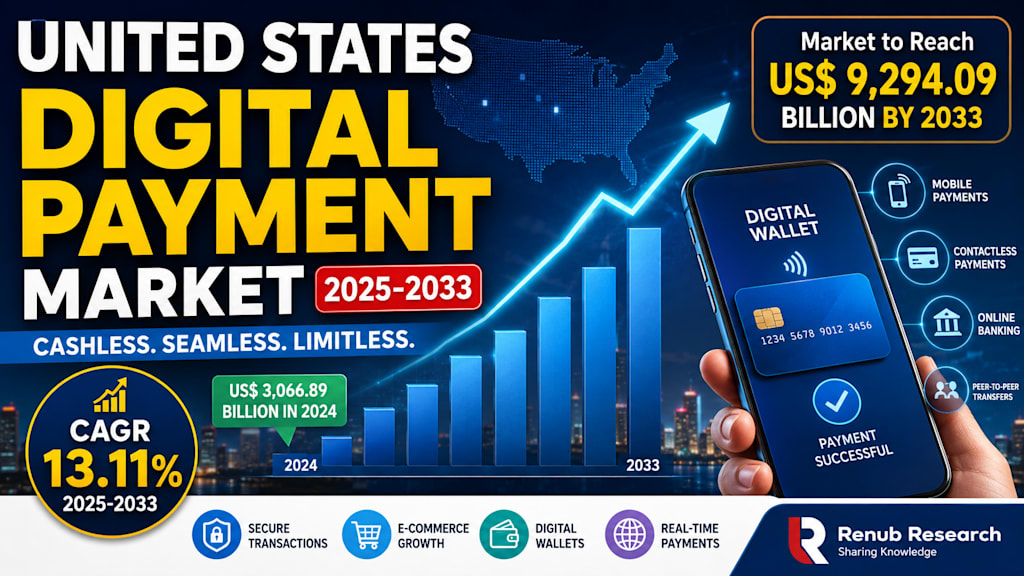
United States Digital Payment Market Size & Forecast 2025–2033
The United States digital payment market is entering a transformative decade, driven by changing consumer habits, technological innovation, and the widespread shift toward cashless transactions. According to Renub Research, the United States Digital Payment Market is projected to grow from US$ 3,066.89 billion in 2024 to US$ 9,294.09 billion by 2033, registering a strong CAGR of 13.11% from 2025 to 2033.
As digital transactions become deeply embedded in everyday life, consumers are increasingly relying on mobile wallets, online banking platforms, contactless cards, peer-to-peer payment applications, and real-time payment systems. From purchasing groceries and paying utility bills to booking travel and subscribing to streaming services, digital payments now power a substantial portion of the American economy.
Digital Payments Become a Core Part of Everyday Life
Digital payment refers to the electronic transfer of money without using physical cash or paper checks. The ecosystem includes debit cards, credit cards, digital wallets, bank transfers, QR-code payments, peer-to-peer applications, and contactless payment technologies.
Over the last decade, digital payments have evolved from a convenience to a necessity. American consumers now expect fast, secure, and frictionless transactions whether shopping online, visiting retail stores, or transferring money to friends and family.
The COVID-19 pandemic significantly accelerated this trend by encouraging contactless payments and reducing dependence on physical cash. Since then, businesses across the country have invested heavily in digital payment infrastructure to meet growing consumer expectations.
Today, digital payments are no longer limited to large corporations. Small businesses, independent retailers, restaurants, healthcare providers, and service companies are actively adopting digital transaction systems to remain competitive.
Smartphone Penetration Continues to Fuel Market Expansion
One of the strongest growth drivers for the digital payment industry is the widespread adoption of smartphones.
Nearly every American owns a mobile phone, while more than nine out of ten citizens use smartphones. These devices have become personal financial hubs, allowing users to shop, transfer money, pay bills, invest, and manage banking activities from virtually anywhere.
The expansion of high-speed internet and 5G connectivity has further enhanced digital payment experiences by enabling faster transaction processing and seamless mobile banking services.
Consumers increasingly prefer mobile-first financial experiences because they offer convenience, accessibility, and speed. Mobile wallets and banking applications have transformed smartphones into powerful payment devices, reducing reliance on cash and traditional payment methods.
As technology advances and connectivity improves nationwide, smartphone-driven payment adoption is expected to remain a key contributor to market growth throughout the forecast period.
E-Commerce Boom Creates Massive Demand for Digital Transactions
The explosive growth of e-commerce continues to strengthen the digital payment ecosystem in the United States.
Online shopping has become an integral part of consumer behavior, with Americans spending billions of dollars annually through digital channels. From retail products and groceries to entertainment subscriptions and digital services, online commerce depends heavily on secure and efficient payment systems.
Payment solutions such as PayPal, Apple Pay, Google Pay, and integrated checkout systems have simplified online purchases while reducing cart abandonment rates.
Consumers increasingly appreciate features such as one-click checkout, saved payment credentials, automatic subscriptions, and installment payment options. These capabilities improve user experience and encourage more frequent digital spending.
As businesses continue expanding their online presence, demand for innovative payment technologies will grow alongside the broader digital economy.
Government Support Strengthens the Cashless Economy
Government initiatives and regulatory developments are creating a favorable environment for digital payment adoption across the United States.
Federal agencies and financial institutions are investing in secure digital infrastructure, cybersecurity frameworks, and financial inclusion initiatives designed to support electronic transactions.
A major milestone has been the development of instant payment capabilities such as FedNow, which enables real-time money transfers across participating financial institutions.
Regulatory focus on fraud prevention, consumer protection, and authentication technologies has further increased trust in digital payment platforms. These measures encourage both businesses and consumers to transition away from cash-based transactions.
With approximately 86.9% of point-of-sale transactions in the United States now occurring through cashless methods, the nation is steadily moving toward a more digitally connected financial ecosystem.
Cybersecurity Remains a Major Industry Challenge
Despite impressive growth prospects, cybersecurity remains one of the most significant challenges facing the digital payment market.
As transaction volumes increase, cybercriminals continue developing sophisticated methods to exploit vulnerabilities within payment systems. Threats such as phishing attacks, account takeovers, ransomware incidents, data breaches, and identity theft remain ongoing concerns.
Consumer trust is essential for sustaining digital payment growth. Any security incident can negatively impact confidence and slow adoption rates.
To combat these risks, payment providers are investing heavily in advanced security technologies including:
Artificial intelligence-powered fraud detection
Tokenization systems
End-to-end encryption
Multi-factor authentication
Biometric verification
Continuous innovation in cybersecurity will be critical to ensuring long-term market stability and consumer confidence.
Bridging the Digital Divide Remains Essential
While digital payment adoption is widespread, unequal access to technology continues to create challenges in certain regions and demographic groups.
Rural communities often face limitations related to broadband connectivity and financial infrastructure. Additionally, lower-income households may lack access to smartphones, banking services, or credit products necessary for participating fully in digital payment ecosystems.
This disparity creates barriers to universal adoption and financial inclusion.
Financial institutions, fintech companies, and government organizations are increasingly introducing affordable digital banking solutions, prepaid cards, and low-cost payment platforms designed to reach underserved populations.
Addressing these accessibility challenges will be essential for ensuring inclusive market growth over the next decade.
Digital Commerce Payments Lead Market Development
Digital commerce represents one of the largest segments within the U.S. digital payment market.
Online retailers, marketplaces, subscription services, food delivery applications, and travel booking platforms all rely heavily on digital transactions. As consumer spending shifts online, businesses are prioritizing payment experiences that are secure, fast, and convenient.
Major shopping events such as Black Friday and Cyber Monday continue to generate record-breaking transaction volumes, highlighting the importance of scalable payment infrastructure.
The growing integration of buy-now-pay-later solutions, mobile checkout technologies, and personalized payment experiences is expected to further strengthen this segment.
Digital Wallets Transform Consumer Payment Preferences
Digital wallets are rapidly reshaping how Americans conduct transactions.
Platforms such as Apple Pay, Google Pay, PayPal, Venmo, and Samsung Pay allow users to make purchases quickly without carrying physical cards or cash.
These wallets offer several advantages, including:
Contactless payment capabilities
Enhanced security features
Loyalty program integration
Rewards management
Biometric authentication
Younger consumers, particularly Millennials and Generation Z, are leading adoption due to their preference for digital-first financial experiences.
As merchant acceptance expands across retail stores, restaurants, transportation systems, and service providers, digital wallets are expected to become increasingly dominant in everyday transactions.
Healthcare Sector Accelerates Digital Payment Adoption
The healthcare industry is emerging as a major contributor to digital payment growth.
Hospitals, clinics, telemedicine providers, and insurance companies are implementing digital billing solutions that simplify payment collection and improve patient experiences.
Patients increasingly prefer paying medical bills through mobile applications, online portals, and automated payment systems.
The rise of telehealth services has further accelerated digital payment adoption within healthcare. Providers benefit from reduced administrative burdens, while patients gain access to more flexible and transparent payment options.
As healthcare digitization continues, payment innovation will remain a central component of patient-centered care strategies.
Telecom and IT Industries Drive Recurring Digital Transactions
The telecom and information technology sectors are significant contributors to the digital payment ecosystem.
Consumers routinely use digital platforms to pay mobile phone bills, internet subscriptions, streaming services, software licenses, and cloud computing fees.
Automatic payment options, subscription billing models, and integrated digital wallets have streamlined recurring transactions while improving customer convenience.
As software-as-a-service (SaaS) and cloud-based business models continue expanding, demand for secure and efficient digital payment systems is expected to rise significantly.
California Leads Innovation in Digital Payments
California remains the largest and most influential digital payment market in the United States.
Home to Silicon Valley and numerous fintech innovators, the state benefits from advanced technological infrastructure, high consumer adoption rates, and a thriving digital economy.
Strong demand for mobile commerce, subscription services, ride-sharing platforms, and digital entertainment contributes to California's leadership position.
Technology giants headquartered in the state continue introducing innovative payment solutions that shape consumer behavior nationwide.
New York Emerges as a Financial Technology Powerhouse
New York's digital payment market continues to flourish due to its position as a global financial center.
The state's dense urban population, advanced banking sector, and thriving fintech ecosystem create ideal conditions for digital payment growth.
Consumers increasingly use contactless payments, mobile wallets, and online banking services across retail stores, restaurants, and public transportation networks.
The city's international business activity also generates substantial demand for secure cross-border payment solutions and financial innovation.
New Jersey Benefits from Regional Digital Transformation
New Jersey is experiencing steady growth in digital payment adoption, supported by its proximity to major financial hubs and increasing consumer demand for cashless transactions.
E-commerce activity, digital banking services, and contactless retail payments are becoming commonplace throughout the state.
Healthcare providers, telecom companies, and utility operators are also embracing digital billing systems to improve operational efficiency and customer satisfaction.
As consumer preferences continue shifting toward convenience and speed, New Jersey's digital payment ecosystem is expected to expand further.
Competitive Landscape
The United States digital payment market remains highly competitive, with established financial institutions, payment processors, and technology companies investing heavily in innovation.
Leading participants continue focusing on security enhancements, merchant expansion, real-time payment capabilities, artificial intelligence integration, and customer experience improvements to strengthen their market positions.
Key companies operating in the market include ACI Worldwide Inc., Aliant Payment Systems Inc., Amazon.com Inc., American Express Company, Apple Inc., Fiserv Inc., Mastercard Incorporated, Novetti Group Limited, PayPal Holdings Inc., and Visa Inc.
10 Recent Company Developments Shaping the Market
1. Visa Inc.
Visa continues expanding real-time payment capabilities and cross-border transaction solutions while investing heavily in AI-driven fraud prevention technologies.
2. Mastercard Incorporated
Mastercard has strengthened its open banking and cybersecurity offerings, helping financial institutions deliver safer digital payment experiences.
3. PayPal Holdings Inc.
PayPal continues enhancing Venmo and merchant services while expanding buy-now-pay-later features and digital commerce integrations.
4. Apple Inc.
Apple has expanded Apple Pay acceptance across retailers and service providers while introducing additional financial service capabilities within its ecosystem.
5. Fiserv Inc.
Fiserv continues investing in embedded finance solutions and cloud-based payment infrastructure for businesses of all sizes.
6. American Express Company
American Express has expanded digital card management features and enhanced rewards integration across mobile platforms.
7. Amazon.com Inc.
Amazon continues improving checkout technologies and payment experiences across its e-commerce ecosystem.
8. ACI Worldwide Inc.
ACI Worldwide is advancing real-time payment technologies that support instant transactions for financial institutions and merchants.
9. Aliant Payment Systems Inc.
Aliant continues enhancing merchant payment processing capabilities through advanced payment acceptance technologies.
10. Novetti Group Limited
Novetti is focusing on digital transaction innovation and cross-border payment solutions to support international commerce.
Future Outlook
The future of the United States digital payment market appears exceptionally strong. Rising smartphone penetration, continuous fintech innovation, expanding e-commerce activity, growing acceptance of digital wallets, and supportive regulatory frameworks will continue driving adoption.
As consumers increasingly prioritize convenience, security, and speed, digital payment solutions will become even more integrated into daily life. Emerging technologies such as artificial intelligence, biometric authentication, embedded finance, and real-time payment systems will further reshape how transactions occur across the economy.
With the market expected to surpass US$ 9.2 trillion by 2033, digital payments are poised to remain one of the most dynamic and influential segments of the U.S. financial services industry.
About the Creator
Enjoyed the story? Support the Creator.
Subscribe for free to receive all their stories in your feed.
Comments
There are no comments for this story
Be the first to respond and start the conversation.