
United States Diabetes Market Size, Share & Growth Forecast to 2034
The United States diabetes market reached USD 31.09 billion in 2025 and is projected to grow to USD 39.80 billion by 2034

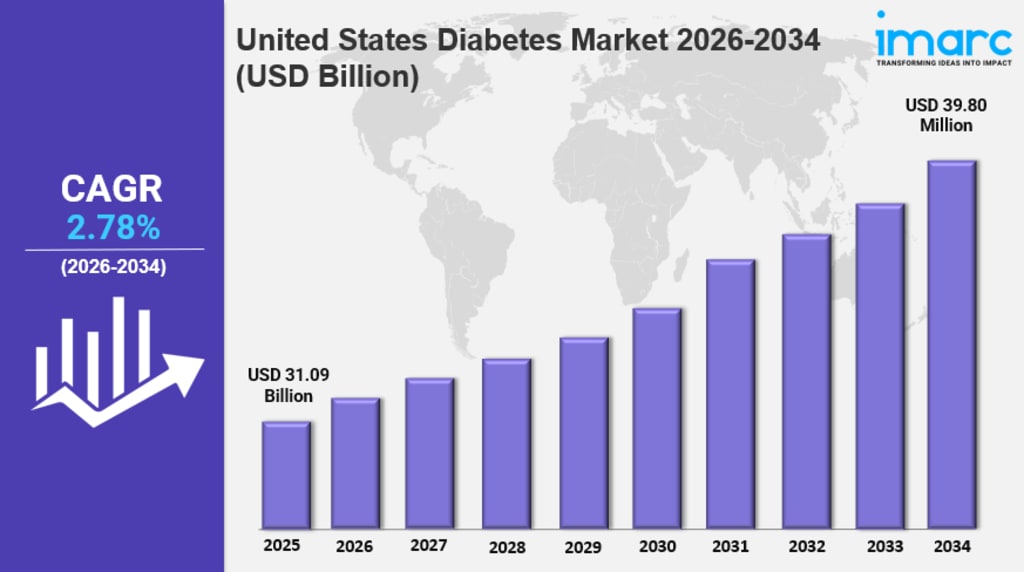
United States Diabetes Market Size, Share, and Growth Forecast (2026–2034)
The United States diabetes market continues to represent a critical segment within the broader healthcare ecosystem, driven by consistent demand for treatment, monitoring, and long-term disease management solutions. The market reached USD 31.09 billion in 2025 and is projected to grow to USD 39.80 billion by 2034, reflecting a CAGR of 2.78% during 2026–2034.
Although growth is moderate, the market remains highly resilient due to the chronic nature of diabetes and the need for continuous care. For pharmaceutical companies, device manufacturers, and healthcare providers, this creates a stable demand environment with recurring revenue potential. Market expansion is increasingly tied to innovation, improved patient outcomes, and cost-effective treatment models rather than volume growth alone.
Request a Sample Report with Latest 2026 Data & Forecasts:
Key Growth Drivers in the United States Diabetes Market: Rising Prevalence and Healthcare Demand
One of the primary drivers of the diabetes market is the rising prevalence of the disease across different age groups. Lifestyle factors, including sedentary habits and dietary patterns, are contributing to increasing diagnosis rates. This is placing sustained pressure on healthcare systems and driving demand for effective treatment solutions.
In addition, an aging population is contributing to higher incidence rates, as older adults are more susceptible to chronic conditions such as diabetes. This demographic trend is creating long-term demand for both medication and monitoring devices.
Healthcare spending and awareness are also playing a role. Patients are seeking earlier diagnosis and continuous management, which is encouraging the adoption of advanced therapies and monitoring tools. For B2B stakeholders, this translates into opportunities to develop solutions that improve patient adherence and clinical outcomes.
Treatment Trends in the U.S. Diabetes Market: Insulin, Oral Drugs, and Advanced Therapies
The treatment landscape in the United States diabetes market is evolving to address diverse patient needs. Insulin remains a core component of diabetes management, particularly for patients with advanced conditions. However, the market is also seeing strong demand for oral medications that offer convenience and ease of use.
Combination therapies are gaining traction as they provide improved glycemic control by targeting multiple pathways. These treatments are helping healthcare providers tailor solutions based on patient profiles.
In addition, there is increasing focus on advanced therapies that offer better efficacy and reduced side effects. Pharmaceutical companies are investing in research and development to bring differentiated products to market, which can address unmet clinical needs and support long-term patient management.
Technology Innovations in Diabetes Care: CGM, Insulin Pumps, and Digital Health Solutions
Technology is playing a transformative role in diabetes care. Continuous glucose monitoring (CGM) systems are enabling real-time tracking of blood glucose levels, helping patients and healthcare providers make informed decisions.
Insulin pumps are also gaining adoption as they provide automated and precise insulin delivery, improving patient convenience and control. These devices are particularly valuable for patients requiring intensive insulin therapy.
Digital health solutions, including mobile applications and connected devices, are further enhancing disease management. These platforms enable remote monitoring, data sharing, and personalized insights, supporting better patient engagement and adherence.
For device manufacturers and technology providers, this segment offers strong growth potential driven by increasing demand for integrated and user-friendly solutions.
Regulatory Landscape and Pricing Challenges in the U.S. Diabetes Market
The regulatory environment in the United States plays a significant role in shaping the diabetes market. Strict approval processes ensure product safety and efficacy, but they also require substantial investment and time for market entry.
Pricing remains a major challenge, particularly in the insulin segment. Rising costs have led to increased scrutiny from policymakers and stakeholders, pushing companies to adopt more transparent and sustainable pricing strategies.
Reimbursement policies and insurance coverage also influence market dynamics. Companies must align their offerings with payer requirements to ensure accessibility and adoption.
For businesses, navigating regulatory and pricing complexities is essential for maintaining competitiveness and achieving long-term growth.
Distribution Channels in the U.S. Diabetes Market: Hospitals, Pharmacies, and Online Platforms
Distribution channels are evolving to support better access to diabetes care products. Hospitals and clinics remain key channels for diagnosis and initial treatment, particularly for complex cases.
Retail pharmacies continue to play a central role in medication distribution, providing convenient access for patients managing chronic conditions. Pharmacists are also increasingly involved in patient education and adherence support.
Online platforms are gaining importance as digital adoption increases. E-commerce and direct-to-consumer models are enabling patients to access medications and devices more easily, especially for routine purchases.
For companies, adopting an omnichannel distribution strategy is critical to ensure product availability and improve customer reach.
Investment Opportunities in the United States Diabetes Market for Pharma and MedTech Companies
The United States diabetes market offers several investment opportunities, particularly in innovation-driven segments. Companies focusing on advanced therapies, digital health solutions, and connected devices are well positioned to capture future growth.
There is also significant potential in preventive care and early diagnosis solutions. Technologies that enable early detection and lifestyle management can reduce long-term healthcare costs and improve patient outcomes.
Strategic partnerships are becoming increasingly important. Collaboration between pharmaceutical companies, device manufacturers, and technology providers is enabling the development of integrated care solutions.
For investors and industry participants, the focus is on scalable models that combine clinical effectiveness, affordability, and user-friendly design. As the market continues to evolve, organizations that align innovation with real-world patient needs will be best positioned to succeed.
About the Creator
Kim Soo hyun
My name is Kim Soo hyun, and I am a research analyst at IMARC Group, specializing in market trends and data analysis to provide insights and support strategic decision-making.
Enjoyed the story? Support the Creator.
Subscribe for free to receive all their stories in your feed.
Comments
There are no comments for this story
Be the first to respond and start the conversation.