
United States Dental Equipment Market Expands with Rapid Digital Dentistry Adoption and AI-Powered Diagnostics
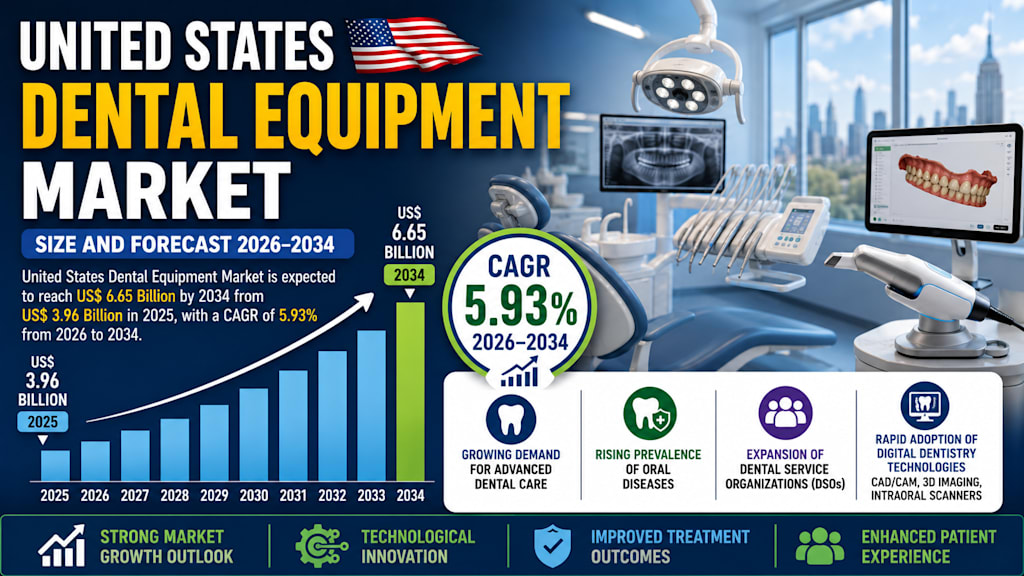
The United States Dental Equipment Market is projected to grow from US$ 3.96 billion in 2025 to US$ 6.65 billion by 2034, supported by increasing oral-health awareness, rising cosmetic dentistry demand, expansion of dental service organizations (DSOs), and rapid adoption of digital dentistry technologies including CAD/CAM systems, intraoral scanners, AI-based imaging, and 3D printing.

United States Dental Equipment Market Overview
The United States dental equipment market is undergoing major technological transformation as dental practices increasingly adopt digital workflows, AI-powered diagnostics, and minimally invasive treatment systems. According to the market outlook, the industry is expected to expand from US$ 3.96 billion in 2025 to US$ 6.65 billion by 2034, growing at a CAGR of 5.93% during the forecast period.
Dental equipment includes a broad range of devices and technologies used for diagnostics, restorative procedures, sterilization, imaging, orthodontics, and patient care. These systems include chair-side units, imaging technologies, CAD/CAM milling machines, dental lasers, 3D printers, intraoral scanners, and sterilization systems that help dental professionals improve precision, workflow efficiency, and patient outcomes.
Growing awareness about oral health, rising prevalence of gum disease and cavities, increasing cosmetic dentistry demand, and expanding investments by Dental Support Organizations (DSOs) are all accelerating adoption of advanced dental equipment across the United States. The market is also benefiting from technological innovation that enables same-day restorations, digital treatment planning, and AI-assisted diagnostics.
Digital Dentistry and AI-Powered Technologies
One of the strongest drivers in the U.S. dental equipment market is the shift toward digital dentistry. Dental practices are rapidly replacing traditional analog systems with digital imaging technologies, AI-based diagnostics, intraoral scanners, and integrated CAD/CAM workflows. These technologies improve diagnostic precision, reduce chair time, enhance patient communication, and streamline restorative procedures.
Digital dentistry is reshaping treatment delivery by enabling dentists to perform same-day restorations, highly accurate implant planning, and minimally invasive procedures. AI-enhanced tools are helping clinicians identify cavities, gum disease, and structural abnormalities earlier while improving workflow integration between dental practices and laboratories.
A major innovation highlighted in the market occurred in May 2025 with the launch of the 3Shape TRIOS 6 intraoral scanner. The device incorporates hyperspectral imaging and AI-assisted diagnostic software known as TRIOS Dx Plus, improving oral-health detection and patient engagement. Such technologies are redefining clinical decision-making and modernizing care delivery throughout the dental industry.
Rising Demand for Cosmetic and Restorative Dentistry
Cosmetic and restorative dentistry continue to be among the fastest-growing areas within the dental industry. Patients increasingly seek aesthetically pleasing outcomes, faster treatments, and minimally invasive procedures, encouraging clinics to invest in advanced diagnostic and restorative equipment.
CAD/CAM systems, intraoral scanners, digital impression technologies, and advanced imaging devices are becoming essential tools for procedures such as crowns, bridges, implants, veneers, and orthodontic aligners. Same-day dentistry capabilities are particularly attractive because they reduce treatment timelines and improve patient convenience.
Align Technology’s iTero Lumina™ Pro imaging system became commercially available in March 2025 after capability expansions introduced in 2024. The system delivers enhanced restorative imaging, broader field capture, and AI-supported diagnostics, helping clinicians deliver highly accurate prosthetic and cosmetic procedures.
The increasing popularity of aesthetic dentistry among both younger and older adults is expected to remain a major contributor to long-term equipment demand in the United States.
Technology Adoption Across Dental Practices
Technology adoption is accelerating across all practice types, including independent clinics, multi-specialty centers, DSOs, and hospital-based dental departments. In an increasingly competitive environment, dental providers are investing in digital systems that improve workflow efficiency, patient satisfaction, and treatment precision.
Large DSOs are especially influential because they often purchase equipment in bulk and standardize digital systems across multiple clinic locations. At the same time, smaller practices are adopting portable and flexible technologies that help modernize services without requiring large-scale infrastructure changes.
A notable example is the Medit i900 Mobility intraoral scanner launched in August 2025. Designed for enhanced mobility and connectivity, the scanner allows flexible deployment across treatment rooms while maintaining advanced imaging capabilities. Its launch reflects the growing market demand for user-friendly and practice-oriented digital solutions.
Market Challenges
Despite strong technological momentum, the U.S. dental equipment market faces several challenges. One of the most significant barriers is the high cost of advanced dental systems such as CAD/CAM units, 3D imaging systems, and dental lasers. These technologies often require major capital investment that can be difficult for smaller clinics to justify.
Digital integration also creates ongoing operational expenses. Dental practices must invest in software upgrades, staff training, system maintenance, and subscription-based digital platforms. These financial pressures contribute to uneven technology adoption between large DSOs and independent clinics.
Another important challenge is the shortage of dental professionals, including hygienists, assistants, and specialized dentists. Staffing shortages reduce clinic productivity and limit the ability of practices to fully utilize advanced technologies. Skill gaps in digital dentistry training also slow adoption of CAD/CAM systems, AI imaging, and 3D printing technologies.
California Dental Equipment Market
California remains one of the largest dental equipment markets in the United States due to its large concentration of dental professionals and strong investments in digital dentistry technologies. According to the California Dental Association, the state had approximately 32,292 licensed dentists in 2024, making it one of the most significant dental markets nationwide.
Major cities including Los Angeles, San Francisco, and San Diego are leading adoption of advanced technologies such as CAD/CAM systems, 3D imaging, laser dentistry, and digital scanners. High patient demand for cosmetic dentistry and same-day restorations continues to accelerate equipment investments throughout the state.
Texas Dental Equipment Market
Texas is emerging as one of the fastest-growing dental equipment markets in the country due to population growth and rising clinical capacity. According to Becker’s Dental Review, Texas had approximately 7,690 general dentists in 2024.
Cities such as Houston, Dallas–Fort Worth, and Austin are experiencing strong adoption of AI-based imaging systems, digital scanners, ergonomic chairs, and chairside CAD/CAM technologies. The rapid expansion of DSOs in Texas is also encouraging larger procurement of advanced equipment systems.
New York Dental Equipment Market
New York represents a mature dental equipment market supported by dense urban populations and advanced specialty-care demand. The New York State Education Department Office of the Professions reported approximately 14,764 licensed dentists with New York addresses as of July 2025.
Dental practices and academic institutions across New York City and Long Island are heavily investing in CBCT systems, 3D printers, intraoral scanners, and digital radiology equipment. Continued emphasis on preventive care and digital workflow integration is sustaining market growth across the state.
Florida Dental Equipment Market
Florida’s dental equipment market is expanding steadily because of demographic growth, strong clinician presence, and increasing oral-health awareness. According to Florida Health CHARTS Oral Health Profile data, Florida had 101.2 licensed dentists per 100,000 population in 2024.
Dental clinics across Miami, Orlando, and Tampa are increasingly investing in digital imaging systems, intraoral scanners, and chairside CAD/CAM technologies to improve patient care and workflow efficiency. High rates of dental emergency visits also contribute to continued demand for advanced treatment and diagnostic equipment.
General Diagnostics Equipment Market
The general diagnostics segment continues to expand as dental practices prioritize preventive care and early disease detection. High-resolution digital X-rays, intraoral cameras, handheld diagnostic tools, and AI-assisted diagnostic systems are becoming standard across modern clinics.
AI-driven screening technologies are improving detection of cavities, periodontal disease, and structural abnormalities while reducing the need for repeated visits. Growing emphasis on value-based care models is also accelerating investment in connected and efficient diagnostic systems.
Radiology Equipment Market
Radiology equipment remains a critical component of modern dental workflows, especially with increasing adoption of digital and 3D imaging systems. Technologies such as CBCT, panoramic imaging, digital radiography sensors, and portable imaging devices allow clinicians to visualize anatomical structures with greater accuracy.
Demand for AI-enhanced radiology platforms is also growing because these systems improve image quality, assist with abnormality detection, and support treatment planning. Hospitals, DSOs, and specialty clinics continue to lead investments in advanced radiology systems.
Orthodontic Equipment Market
The orthodontic equipment market is evolving rapidly with the increasing popularity of clear aligners and digital orthodontic planning systems. Intraoral scanners, 3D printers, digital cephalometric systems, and AI-driven aligner production technologies are helping orthodontic clinics improve treatment precision and efficiency.
Rising adult demand for cosmetic orthodontics and minimally invasive corrective treatments is also supporting investment in advanced orthodontic technologies. Large orthodontic chains and multi-specialty clinics are expanding equipment portfolios to support growing patient volumes.
Hospitals Segment Market
Hospitals are becoming an increasingly important segment within the U.S. dental equipment market as more healthcare systems integrate dental services into broader patient care. Hospital-based dental departments require advanced imaging technologies, surgical units, sterilization systems, and real-time diagnostic platforms.
Demand for dental equipment in hospitals is also increasing because of rising trauma cases, oncology-related dental procedures, and medically complex treatments requiring interdisciplinary care. Strict infection-control standards further encourage investments in advanced sterilization and digital operatory systems.
Competitive Landscape
The U.S. dental equipment market includes major global manufacturers focused on innovation, digital workflow expansion, and advanced imaging technologies. Key companies operating in the market include 3M, Straumann Holding AG, Dentsply Sirona, ZimVie, Envista, Biolase Inc., Young Innovations Inc., Midmark Corporation, Takara Belmont Corporation, and Ultradent Products Inc.
Competition is intensifying as companies introduce AI-based imaging systems, advanced intraoral scanners, ergonomic treatment units, and integrated digital dentistry platforms. Partnerships, acquisitions, and product launches continue to reshape the competitive landscape across the industry.
Final Thoughts
The United States dental equipment market is rapidly transitioning toward a highly digital and AI-driven future. Demand for aesthetic dentistry, preventive care, same-day restorations, and minimally invasive procedures is encouraging clinics and hospitals to invest heavily in advanced dental technologies.
Although high equipment costs and workforce shortages remain challenges, continued innovation in imaging systems, digital workflows, and AI-assisted diagnostics is expected to sustain long-term market growth. As dental providers focus more on efficiency, precision, and patient experience, the industry is likely to remain one of the fastest-evolving segments within healthcare technology.
Recent Developments by Companies
Dentsply Sirona expanded its long-standing collaboration with Burkhart Dental Supply in April 2026 to improve access to professional dental technologies across the United States.
The Medical University of South Carolina received the 2024 Education Innovation Award in May 2025 for its AI-based Second Opinion platform focused on improving dental caries detection through advanced X-ray interpretation.
Midmark Corporation launched an upgraded Mobile Dental Delivery System in January 2025 with enhanced ergonomics, integrated handpieces, scaler support, and lightweight portability.
3Shape introduced the TRIOS 6 intraoral scanner in May 2025 with hyperspectral imaging and AI-assisted diagnostic capabilities through TRIOS Dx Plus software.
Align Technology expanded availability of the iTero Lumina™ Pro imaging system in March 2025, improving restorative imaging and AI-supported diagnostics.
Medit launched the i900 Mobility intraoral scanner in August 2025, focusing on enhanced portability, connectivity, and flexible deployment across dental operatories.
Dental practices across the United States accelerated adoption of AI-driven imaging systems and integrated digital workflows to improve clinical efficiency and patient outcomes during 2025.
DSOs expanded investments in chairside CAD/CAM systems, CBCT imaging, and centralized digital dentistry platforms to standardize treatment quality across multi-site networks.
Hospitals and specialty dental centers increased procurement of advanced sterilization systems and interdisciplinary diagnostic technologies to meet infection-control and surgical care requirements.
Manufacturers continued expanding development of AI-enhanced radiology platforms capable of improving abnormality detection, image quality, and treatment planning accuracy in modern dental practices.
About the Creator
Enjoyed the story? Support the Creator.
Subscribe for free to receive all their stories in your feed.
Comments
There are no comments for this story
Be the first to respond and start the conversation.