
United States Cotton Market Set to Reach US$ 15.78 Billion by 2033 as Global Demand and Sustainable Farming Drive Growth
America's Cotton Industry Balances Export Strength, Innovation, and Climate Challenges in a Rapidly Evolving Textile Economy

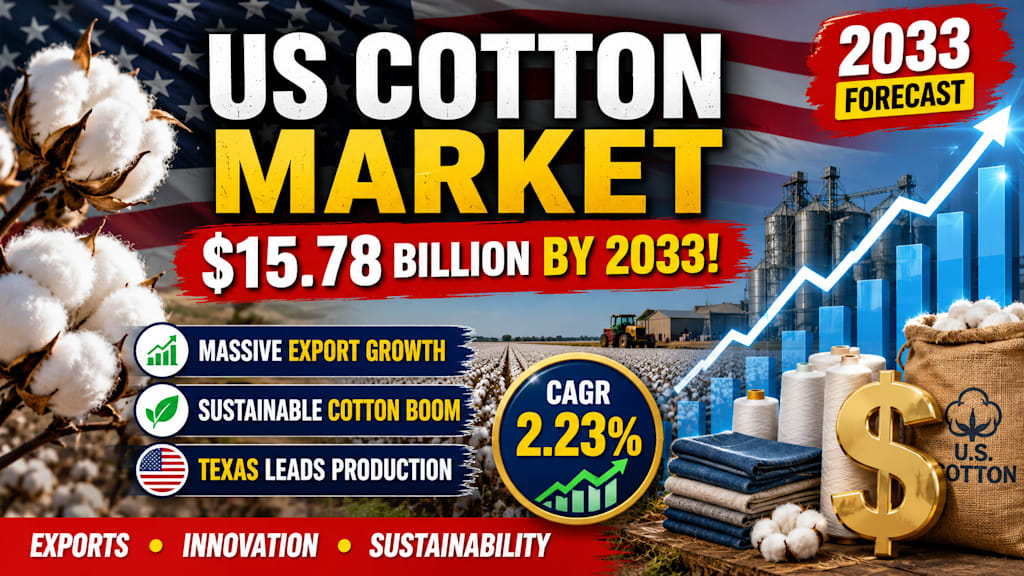
United States Cotton Market Forecast 2025–2033
The United States cotton industry remains one of the most influential pillars of the country's agricultural sector, supplying both domestic manufacturers and international textile markets. As global demand for natural fibers continues to expand, cotton has retained its position as one of the world's most sought-after agricultural commodities.
According to Renub Research, the United States Cotton Market is projected to grow from US$ 12.94 billion in 2024 to US$ 15.78 billion by 2033, expanding at a CAGR of 2.23% during 2025–2033. The market's growth is being supported by increasing textile demand, rising exports, sustainable farming initiatives, and technological advancements in cotton cultivation.
Despite challenges such as climate uncertainty, fluctuating global prices, and international competition, the U.S. cotton industry continues to demonstrate resilience through innovation and strong global trade relationships.
Cotton Remains a Strategic Crop for the United States
Cotton has been deeply embedded in the American agricultural economy for generations. Today, the United States ranks among the world's largest cotton producers and exporters, supplying premium-quality cotton to textile manufacturers across Asia, Europe, and other international markets.
The majority of U.S. cotton production comes from Southern states, where favorable climatic conditions support large-scale cultivation. Texas remains the dominant producer, while states such as Georgia, Mississippi, Arkansas, and California also contribute significantly to national output.
The U.S. primarily produces two commercial cotton varieties:
Upland Cotton
Extra-Long Staple (ELS) Cotton, commonly known as Pima Cotton
Upland cotton accounts for nearly all domestic production and serves as the backbone of the global textile industry.
As consumer preferences increasingly shift toward natural, biodegradable, and sustainable materials, cotton continues to gain importance in apparel, home furnishings, medical textiles, and industrial applications.
Strong Export Performance Fuels Market Expansion
One of the biggest strengths of the U.S. cotton market is its export-oriented structure.
Approximately 80% of cotton produced in the United States is exported to international markets, making foreign demand a major growth engine for the industry.
Countries such as China, Vietnam, Pakistan, Bangladesh, and Turkey remain among the largest buyers of American cotton. These nations depend heavily on imported cotton to support their massive textile manufacturing industries.
American cotton enjoys a strong reputation globally because of:
High fiber quality
Consistent grading standards
Reliable supply chains
Advanced classification systems
Traceable production practices
The growth of textile manufacturing across Asia continues to generate strong demand for U.S. cotton exports. As apparel consumption rises worldwide, particularly in developing economies, American cotton producers are expected to benefit from long-term export opportunities.
Technology is Transforming Cotton Farming
Modern agriculture is revolutionizing cotton production across the United States.
Farmers are increasingly adopting precision agriculture technologies that improve productivity while reducing operational costs and environmental impact.
Several innovations are reshaping the industry:
Precision Farming
GPS-guided equipment, drones, satellite imaging, and real-time data analytics help growers monitor crop health and optimize field management decisions.
Advanced Seed Genetics
Genetically modified cotton varieties offer resistance to pests, diseases, and drought conditions, helping farmers improve yields while reducing chemical usage.
Automated Harvesting
Modern harvesting equipment significantly reduces labor requirements and improves harvesting efficiency, enabling producers to operate larger farms more profitably.
Smart Irrigation Systems
Advanced irrigation technologies allow farmers to manage water resources more effectively, which is particularly important in drought-prone regions such as Texas.
These innovations continue to strengthen the competitiveness of U.S. cotton producers in both domestic and international markets.
Sustainability is Reshaping the Cotton Industry
Environmental sustainability has become a major factor influencing cotton production and purchasing decisions worldwide.
Consumers today are increasingly aware of the environmental consequences associated with synthetic fibers, particularly microplastic pollution. As a result, demand for natural and biodegradable fibers such as cotton is steadily increasing.
The U.S. cotton industry has responded through initiatives focused on:
Water conservation
Soil health improvement
Reduced greenhouse gas emissions
Traceability systems
Responsible pesticide management
Programs such as the U.S. Cotton Trust Protocol have helped establish sustainability benchmarks that align with the environmental goals of global apparel brands.
Major fashion companies are now prioritizing sustainably sourced cotton within their supply chains. This trend is creating additional value for U.S.-grown cotton and encouraging further investment in environmentally responsible farming practices.
As sustainability becomes a key purchasing criterion worldwide, the demand for certified American cotton is expected to increase substantially.
Climate Risks Remain a Significant Concern
While growth prospects remain positive, climate variability presents one of the biggest threats facing the U.S. cotton market.
Cotton production is highly sensitive to weather conditions, making the industry vulnerable to:
Droughts
Heatwaves
Flooding
Storm damage
Unexpected frosts
Texas, the nation's largest cotton-producing state, has experienced severe drought conditions in recent years that have significantly impacted crop yields and farm profitability.
Climate-related disruptions can result in:
Reduced production volumes
Lower fiber quality
Increased irrigation costs
Higher operational risks
Although federal crop insurance programs provide financial protection, farmers continue to face uncertainty as extreme weather events become more frequent.
The industry's future success will depend heavily on investments in drought-resistant seed varieties, climate-smart agriculture, and water-efficient farming technologies.
Global Competition and Trade Uncertainty Create Challenges
The U.S. cotton sector operates within a highly competitive global marketplace.
Countries including India, Brazil, and Uzbekistan continue expanding their cotton production capabilities while benefiting from lower labor costs and government support programs.
This creates pricing pressure for American exporters.
In addition, trade disputes and changing international policies can quickly affect market conditions.
Trade tensions involving major cotton-importing nations often create uncertainty regarding:
Export volumes
Commodity prices
Shipping schedules
Long-term contracts
Because a large percentage of U.S. cotton production is exported, maintaining strong international trade relationships remains critical for industry stability.
Diversifying export destinations and emphasizing premium-quality cotton production will be important strategies for preserving global market share over the coming decade.
Texas Continues to Dominate U.S. Cotton Production
Texas remains the undisputed leader of the American cotton industry.
The state accounts for more than 40% of total U.S. cotton production, making it the most important contributor to national supply.
Several factors support Texas' leadership position:
Vast agricultural land availability
Favorable growing conditions
Extensive farming infrastructure
Strong export connections
Most cotton production occurs in the High Plains and South Texas regions, where upland cotton is cultivated on a large scale.
Although drought conditions continue to challenge producers, technological advancements and federal support programs have helped maintain the state's production strength.
Texas will likely remain the cornerstone of U.S. cotton production throughout the forecast period.
California Focuses on Premium Cotton Production
California occupies a unique position within the American cotton market.
Unlike most states that primarily grow upland cotton, California specializes in extra-long staple (ELS) cotton, commonly marketed as Pima cotton.
Produced mainly in the San Joaquin Valley, California cotton is renowned for:
Exceptional softness
Longer fibers
Superior durability
Premium textile applications
Luxury apparel brands and high-end textile manufacturers frequently prefer Pima cotton due to its superior characteristics.
However, water shortages and increasing environmental regulations have reduced cotton acreage across the state.
Despite these challenges, California continues to maintain its importance as a leading supplier of premium cotton products for global markets.
Florida's Cotton Industry Supports Regional Agriculture
Florida contributes a relatively small share of national cotton production but remains an important participant within the Southeastern cotton belt.
Most cotton farming occurs in the Florida Panhandle region, where upland cotton is cultivated alongside other agricultural crops.
Cotton helps local farmers diversify revenue streams while supporting regional agricultural economies.
Challenges facing Florida growers include:
Hurricane risks
Unpredictable weather patterns
Competition from higher-value crops
Nevertheless, improved seed technologies and sustainable farming practices continue helping producers maintain productivity levels.
New York Influences Cotton Through Fashion and Trade
Although New York is not a cotton-producing state, it plays an important indirect role in the cotton market.
New York City serves as a major center for:
Fashion design
Apparel retailing
Commodity trading
Textile sourcing
Many leading fashion brands, retailers, and importers headquartered in New York influence global cotton demand through purchasing decisions and sourcing strategies.
Additionally, commodity trading activities conducted within the state's financial sector contribute to cotton price discovery and international market dynamics.
As a result, New York remains a significant commercial force within the broader U.S. cotton ecosystem.
Future Outlook for the United States Cotton Market
The outlook for the U.S. cotton industry remains positive despite ongoing challenges.
Several long-term trends are expected to support continued market growth:
Rising global textile production
Increasing demand for natural fibers
Expansion of sustainable fashion initiatives
Technological advancements in agriculture
Continued export growth opportunities
At the same time, industry participants must address issues related to climate resilience, international competition, and market volatility.
By investing in innovation, sustainability, and global partnerships, the U.S. cotton sector is well-positioned to strengthen its role within the international textile supply chain.
With strong export demand and growing emphasis on environmentally responsible production, the industry is expected to achieve steady expansion through 2033.
10 Recent Developments by Key Companies in the Cotton and Textile Sector
1. Coats Group plc
Expanded sustainability initiatives by increasing recycled and environmentally responsible textile solutions across its global manufacturing operations.
2. KPR Mill Limited
Continued capacity expansion across spinning and garment manufacturing facilities to support rising international textile demand.
3. Nitin Spinners Ltd.
Enhanced export capabilities through modernization of spinning infrastructure and improved production efficiency.
4. Weiqiao Textile Company Limited
Strengthened integrated textile manufacturing operations while investing in automation technologies.
5. Nahar Spinning Mills
Focused on value-added yarn production and energy-efficient manufacturing practices.
6. Maharaja Shree Umaid Mills Limited
Expanded premium yarn offerings targeting export-oriented textile manufacturers.
7. Damodar Group
Invested in advanced spinning technologies to improve product quality and operational efficiency.
8. Huafang Group
Increased focus on sustainable textile manufacturing and environmentally responsible production methods.
9. Fortex
Strengthened textile processing capabilities while expanding international customer relationships.
10. Aarti International Limited
Enhanced supply chain operations and broadened participation in cotton-based textile markets.
Final Thoughts
The United States cotton market stands at an important crossroads where sustainability, technology, and global trade are shaping the future of one of America's most valuable agricultural industries.
Projected to reach US$ 15.78 billion by 2033, the market continues to benefit from strong export demand, premium fiber quality, and ongoing innovations in cotton cultivation. While climate risks and international competition remain concerns, the industry's commitment to sustainable production and technological advancement provides a solid foundation for future growth.
As consumers and brands increasingly prioritize natural and responsibly sourced fibers, U.S. cotton is expected to maintain its competitive advantage and remain a vital contributor to the global textile economy throughout the forecast period.
About the Creator
Enjoyed the story? Support the Creator.
Subscribe for free to receive all their stories in your feed.
Comments
There are no comments for this story
Be the first to respond and start the conversation.