
United States Contract Lifecycle Management Software Market Size, Share & Growth Forecast to 2034
The United States contract lifecycle management software market size reached USD 2.4 Billion in 2025 to reach USD 7.7 Billion by 2034

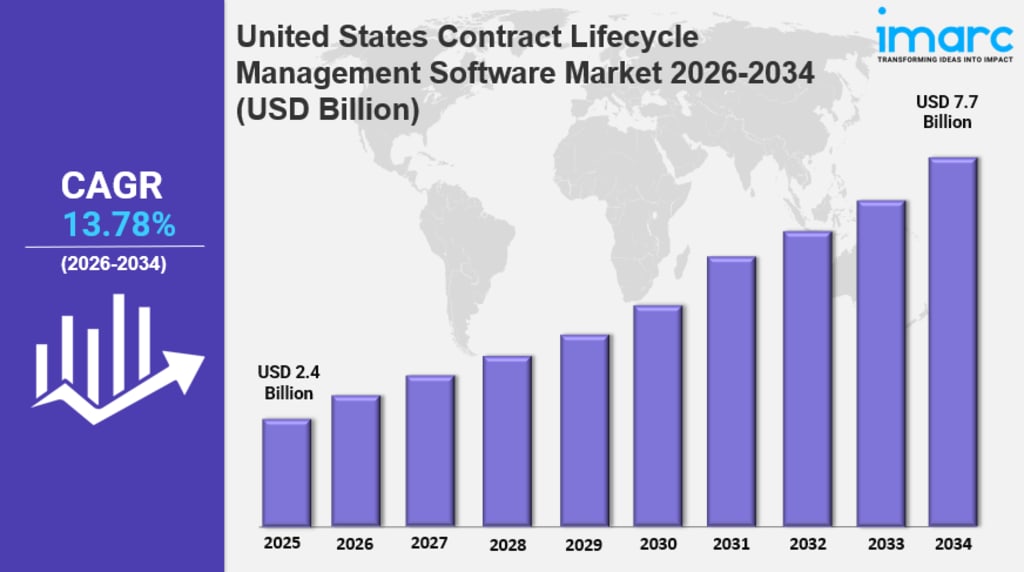
United States Contract Lifecycle Management Software Market Size, Share, and Growth Forecast
Contract lifecycle management (CLM) software is moving from a niche legal tool to a core enterprise system. In the United States, the market reached USD 2.4 billion in 2025 and is expected to grow to USD 7.7 billion by 2034, at a CAGR of 13.78%. This pace reflects a broader shift—contracts are no longer static documents but active business assets that require visibility, control, and speed.
For enterprises, the need is practical. Manual contract handling slows down deal cycles, increases risk, and limits transparency across departments. CLM platforms address these gaps by centralizing contract data, automating workflows, and improving collaboration between legal, procurement, and sales teams. As cloud adoption and AI integration continue to expand, CLM systems are becoming easier to deploy and scale across organizations.
Request a Sample Report with Latest 2026 Data & Forecasts:
Enterprise Adoption Trends Driving the U.S. CLM Software Market
Adoption of CLM software is being led by enterprises that manage large volumes of contracts across multiple departments. Legal teams are no longer the sole users—procurement, finance, and sales operations are now directly involved in contract workflows.
One noticeable trend is the shift toward cloud-based CLM solutions. Businesses prefer platforms that can be deployed quickly, updated regularly, and accessed across locations. This reduces reliance on legacy systems and improves collaboration.
Another trend is the integration of CLM with existing enterprise tools such as CRM and ERP systems. Instead of working in isolation, contracts are now connected to broader business processes, allowing better tracking of obligations, renewals, and performance metrics.
Key Use Cases of CLM Software: Legal, Procurement, and Sales Operations
CLM software is being applied across different functions, each with its own priorities.
Legal teams use CLM to standardize contract templates, manage approvals, and ensure compliance with internal policies. This reduces time spent on repetitive tasks and allows legal professionals to focus on higher-value work.
Procurement teams rely on CLM to manage vendor contracts, track pricing agreements, and monitor supplier performance. With better visibility, they can negotiate more effectively and avoid missed deadlines or renewals.
Sales operations benefit from faster contract generation and approval cycles. This directly impacts revenue by reducing delays in closing deals. Automated workflows ensure that contracts move quickly through review stages without unnecessary bottlenecks.
Cost Savings, Risk Reduction, and ROI from CLM Implementation
The business case for CLM software is often built around efficiency and risk control. Automating contract creation and approval reduces manual work, which lowers administrative costs and shortens turnaround times.
Risk reduction is another key benefit. Centralized contract storage and tracking help organizations avoid missed obligations, compliance issues, and financial penalties. Alerts and reminders ensure that critical dates, such as renewals or expirations, are not overlooked.
Return on investment becomes visible over time. Faster deal cycles improve revenue flow, while better contract management reduces losses caused by inefficiencies or errors. Companies that approach CLM with clear objectives tend to see more consistent results.
Compliance, Data Security, and Integration Challenges in CLM Deployment
Despite the advantages, implementing CLM software comes with challenges. Compliance requirements vary across industries, and organizations need to ensure that their systems align with regulatory standards.
Data security is another concern. Contracts often contain sensitive information, making secure storage and controlled access essential. Businesses must evaluate vendors carefully to ensure that security measures meet their requirements.
Integration can also be complex. Connecting CLM platforms with existing systems such as CRM, ERP, and document management tools requires planning and technical expertise. Without proper integration, the benefits of automation and visibility may be limited.
Investment Opportunities in the U.S. CLM Software Market for Enterprises and SaaS Providers
The growth of the CLM market is creating opportunities for both buyers and solution providers. Enterprises are investing in CLM platforms to improve internal processes and gain better control over contract-related risks.
For SaaS providers, there is demand for specialized solutions that address specific industry needs. Customization, scalability, and ease of integration are becoming key differentiators in the market.
There is also growing interest in AI-driven features such as contract analytics, clause recognition, and predictive insights. These capabilities help organizations extract more value from their contracts and make informed decisions.
Partnerships between software providers and consulting firms are expanding, as businesses often require support in implementation, customization, and ongoing management.
Competitive Landscape and Leading CLM Software Providers in the United States
The U.S. CLM software market includes a mix of established technology companies and specialized vendors. Providers such as DocuSign, Ironclad, Icertis, Coupa, and SAP offer a range of solutions tailored to different business needs.
Competition is centered on usability, integration capability, and feature depth. Larger providers benefit from established ecosystems and broad product portfolios, while smaller vendors focus on flexibility and niche use cases.
For enterprises evaluating CLM solutions, the choice often depends on scalability, ease of deployment, and alignment with existing systems. Selecting the right partner is as important as the technology itself, as it directly impacts long-term adoption and value realization.
About the Creator
Kim Soo hyun
My name is Kim Soo hyun, and I am a research analyst at IMARC Group, specializing in market trends and data analysis to provide insights and support strategic decision-making.
Enjoyed the story? Support the Creator.
Subscribe for free to receive all their stories in your feed.
Comments
There are no comments for this story
Be the first to respond and start the conversation.