
United States Commercial Insurance Market Size & Forecast 2034
The United States commercial insurance market size reached USD 310.0 Billion in 2025. Looking forward, IMARC Group expects the market to reach USD 493.5 Billion by 2034, exhibiting a growth rate (CAGR) of 5.14% during 2026-2034.

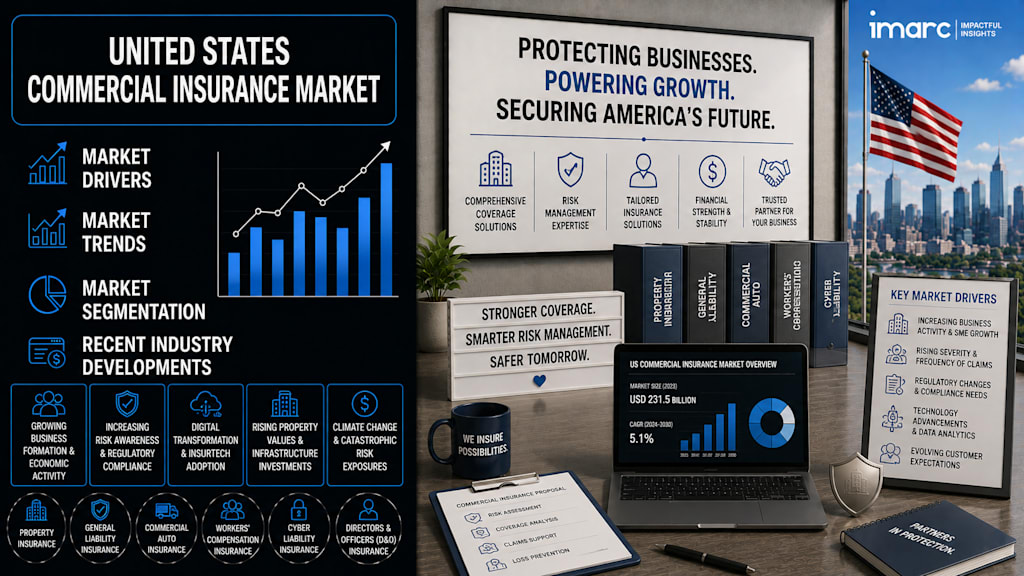
United States Commercial Insurance Market Size, Growth, and Forecast (2026–2034)
In an increasingly complex business environment, risk management has become a critical priority for organizations of all sizes. From natural disasters and cyberattacks to supply chain disruptions and regulatory changes, businesses face a growing range of challenges that can affect operations and financial stability. As a result, commercial insurance continues to play a vital role in helping companies manage uncertainty and protect valuable assets.
In 2026, the commercial insurance landscape in the United States is evolving rapidly as businesses seek more comprehensive and customized protection strategies. Companies are no longer looking for basic coverage alone; they increasingly require solutions tailored to industry-specific risks and emerging threats.
The United States commercial insurance market reached USD 310.0 Billion in 2025 and is projected to grow to USD 493.5 Billion by 2034, exhibiting a compound annual growth rate (CAGR) of 5.14% during 2026–2034. This growth reflects the increasing importance of risk management across industries and the expanding range of risks businesses must address.
Request a Sample Report with Latest 2026 Data & Forecasts:
Key Trends Shaping the United States Commercial Insurance Market
Several major trends are influencing market development:
• Growing demand for cybersecurity insurance coverage
• Increasing focus on climate-related and disaster protection
• Rising need for customized insurance solutions
• Expansion of digital insurance platforms and analytics
• Greater emphasis on risk prevention and mitigation strategies
These trends are reshaping how insurers design products and how businesses approach risk management.
Cybersecurity Risks Are Driving New Demand
One of the most significant developments in the insurance industry is the growing importance of cybersecurity coverage.
Businesses across nearly every sector rely heavily on digital systems, cloud infrastructure, and online operations. While these technologies improve efficiency, they also create new vulnerabilities.
Cyberattacks, ransomware incidents, and data breaches can lead to substantial financial and reputational damage. As a result, organizations are increasingly seeking specialized insurance products that address cyber-related risks.
The growing digital economy is expected to remain a major driver of insurance demand throughout 2026–2034.
Climate and Natural Disaster Risks Are Increasing
Weather-related events continue to present significant challenges for businesses.
Hurricanes, floods, wildfires, severe storms, and other natural disasters can cause extensive property damage and operational disruptions. Rising property values further increase the financial impact of these events.
Businesses are increasingly recognizing the importance of comprehensive coverage that protects physical assets while supporting business continuity.
Insurers are also investing in advanced risk assessment tools to better understand and manage climate-related exposures.
Customization Is Becoming a Competitive Advantage
Every business faces a unique set of risks based on its industry, location, size, and operational model.
As a result, demand for customized insurance solutions is growing. Companies increasingly seek policies tailored to their specific needs rather than relying on standardized coverage packages.
Customized policies allow organizations to address emerging risks while optimizing insurance costs.
This trend is encouraging insurers to develop more flexible and industry-focused products.
Technology Is Transforming the Insurance Industry
Technology is playing an increasingly important role in commercial insurance.
Artificial intelligence and data analytics are helping insurers improve underwriting processes, assess risks more accurately, and streamline claims management.
Digital platforms are making it easier for businesses to compare coverage options, purchase policies, and manage claims online.
Predictive analytics is also helping organizations identify potential risks before they become costly problems.
As technology continues advancing, insurers are expected to offer more data-driven and personalized services.
Investment Opportunities in the Market
The continued expansion of the commercial insurance sector creates opportunities for investors and industry participants.
Companies are investing in:
• Cyber insurance solutions
• Digital insurance technologies
• Risk analytics platforms
• Climate risk assessment tools
• Industry-specific insurance products
Insurtech innovation is also attracting significant attention, with startups introducing new approaches to underwriting, customer engagement, and claims processing.
These developments are helping modernize the industry and improve operational efficiency.
Challenges Facing the Industry
Despite strong growth prospects, several challenges remain.
The increasing frequency and severity of natural disasters can create pricing pressures and claims volatility. Regulatory changes may also require insurers to continuously adapt their products and processes.
Cybersecurity threats are becoming more sophisticated, making risk assessment increasingly complex.
Additionally, maintaining affordability while providing comprehensive coverage remains a challenge for many providers.
Successfully balancing these factors will be critical for sustainable market growth.
Future Outlook (2026–2034)
Looking ahead, the United States commercial insurance market is expected to continue expanding as businesses place greater emphasis on resilience and risk management.
Between 2026 and 2034, demand for cybersecurity coverage, climate-related protection, customized insurance products, and technology-enabled services is likely to increase. Businesses will continue seeking solutions that help them navigate uncertainty while supporting long-term growth.
Future developments may include AI-driven underwriting, advanced predictive risk modeling, personalized policy structures, and greater integration of digital platforms.
These innovations are expected to reshape how commercial insurance is delivered and managed.
Conclusion
The United States commercial insurance market is evolving in response to changing business risks, technological advancements, and increasing demand for specialized protection. Supported by growing awareness of cybersecurity threats, climate-related challenges, and operational complexities, the industry is expected to experience steady growth through 2026–2034.
While challenges such as regulatory changes and risk volatility remain, continued innovation and investment are helping insurers develop more effective solutions. As businesses navigate an increasingly complex environment, commercial insurance will remain an essential component of long-term stability and success.
About the Creator
Jackson Watson
I'm a market research analyst at Imarc group company delivering data-driven insights, industry analysis, and customized research solutions. We support businesses with market sizing, competitive analysis, and strategic decision-making.
Enjoyed the story? Support the Creator.
Subscribe for free to receive all their stories in your feed.
Comments
There are no comments for this story
Be the first to respond and start the conversation.