
United States Biofertilizer Market Size Hits USD 2,103.37 Million by 2034
The United States biofertilizer market reached USD 827.94 Million in 2025 and is projected to reach USD 2,103.37 Million by 2034, growing at a CAGR of 10.92% during 2026-2034.

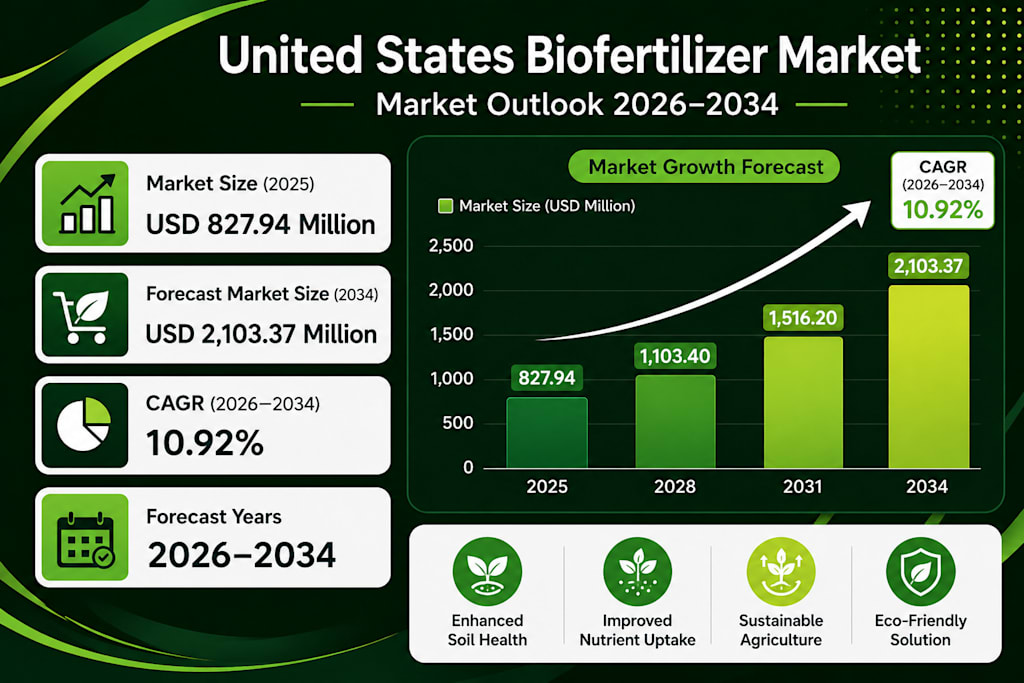
United States Biofertilizer Market Size, Growth, and Forecast (2026–2034)
Agriculture is entering a new era where sustainability and productivity are becoming equally important. Farmers are increasingly looking for solutions that improve crop yields while minimizing environmental impact. As concerns about soil degradation, chemical fertilizer overuse, and climate change continue to grow, biofertilizers are emerging as a promising alternative. In 2026, the United States agricultural sector is witnessing increased adoption of biological products that support long-term soil health and sustainable farming practices.
The United States biofertilizer market reached USD 827.94 Million in 2025 and is projected to grow to USD 2,103.37 Million by 2034, expanding at a compound annual growth rate (CAGR) of 10.92% during 2026–2034. This strong growth reflects increasing awareness of environmentally responsible farming methods and growing demand for sustainable agricultural inputs.
Biofertilizers are products containing beneficial microorganisms that enhance nutrient availability, improve soil fertility, and support plant growth naturally. These products help reduce dependence on synthetic fertilizers while promoting healthier agricultural ecosystems.
Request a Sample Report with Latest 2026 Data & Forecasts:
Key Trends Shaping the United States Biofertilizer Market
Several important trends are influencing market development:
• Growing adoption of sustainable and regenerative farming practices
• Rising demand for organic and environmentally friendly agricultural inputs
• Increasing use of nitrogen-fixing biofertilizers
• Expansion of seed treatment applications for crop enhancement
• Growing focus on soil health management and conservation agriculture
These trends highlight the agricultural sector's shift toward more sustainable production systems.
Major Growth Drivers in the United States Biofertilizer Industry
Several factors continue supporting market expansion.
One of the primary growth drivers is the increasing demand for sustainable agriculture. Farmers are seeking solutions that help maintain productivity while reducing environmental impact.
Another important factor is the growing emphasis on soil health improvement. Healthy soil plays a critical role in supporting crop productivity, water retention, and long-term agricultural sustainability.
Government support is also contributing significantly to market growth. Programs encouraging climate-smart farming practices and conservation efforts are helping producers adopt sustainable agricultural technologies.
In recent years, substantial funding has been directed toward initiatives that support conservation practices and environmental stewardship across agricultural operations. These efforts continue encouraging the adoption of biofertilizers and other biological inputs.
Additionally, consumers are increasingly interested in sustainably produced food products, creating additional incentives for environmentally responsible farming practices.
How Biofertilizers Support Sustainable Farming
Biofertilizers offer several benefits that align with modern agricultural goals.
Unlike conventional chemical fertilizers, biofertilizers work by enhancing natural biological processes in the soil. Beneficial microorganisms help plants access nutrients more efficiently and improve overall soil fertility.
These products can contribute to improved nutrient utilization, stronger root systems, and better crop resilience.
Biofertilizers also support efforts to reduce chemical input usage while promoting environmentally responsible farming methods.
As sustainability becomes increasingly important during 2026–2034, biofertilizers are expected to play a larger role in agricultural production systems.
Market Insights and Adoption Patterns
Different segments of the biofertilizer market continue showing strong growth potential.
Nitrogen-fixing biofertilizers currently represent a significant portion of market demand, accounting for approximately 49.6% of the market by type. Their ability to naturally improve nitrogen availability makes them valuable across multiple crop categories.
Seed treatment applications remain particularly important, representing approximately 46.2% of application demand. Farmers increasingly utilize biological seed treatments to support early-stage crop development and improve performance.
Regionally, the Midwest continues to lead market activity, accounting for approximately 34.8% of market revenues, supported by its extensive agricultural production and focus on sustainable farming practices.
Investment Opportunities in the United States Biofertilizer Market
The rapid growth of the market presents numerous opportunities for investors and agricultural businesses.
Companies are investing in biological crop inputs, microbial technologies, and sustainable agriculture solutions to strengthen market competitiveness.
There is also increasing interest in research and development aimed at improving product effectiveness and expanding applications.
Investments in precision agriculture technologies and digital farming platforms continue supporting market development.
Collaborations between biotechnology companies, agricultural organizations, and research institutions are also accelerating innovation.
With strong growth expected through 2034, the market offers attractive long-term opportunities.
Challenges Impacting the United States Biofertilizer Industry
Despite positive growth prospects, several challenges remain.
One challenge is limited awareness among some farming communities regarding biological alternatives.
Another issue is variability in field performance, as environmental conditions can influence product effectiveness.
Storage and handling requirements may also create logistical considerations for certain products.
Additionally, educating producers about long-term benefits remains important for broader market adoption.
Future Outlook (2026–2034)
Looking ahead, the United States biofertilizer market is expected to maintain strong momentum.
Between 2026 and 2034, demand for sustainable agricultural solutions, soil health products, and biological crop inputs is likely to increase significantly. Farmers are expected to continue adopting practices that improve productivity while supporting environmental goals.
Future developments may focus on advanced microbial formulations, precision application technologies, and integrated soil management strategies.
The continued expansion of climate-smart agriculture initiatives and conservation programs is also expected to support market growth.
Overall, the market appears positioned for sustained development driven by agricultural innovation, environmental awareness, and growing demand for sustainable farming practices.
Conclusion
The United States biofertilizer market is evolving rapidly as farmers increasingly embrace sustainable agricultural practices and soil health management strategies. Supported by growing environmental awareness, government conservation initiatives, and advancements in biological technologies, the market is expected to experience substantial growth during 2026–2034.
Although challenges such as education and product adoption remain, continued investment and innovation are likely to support long-term development. As agriculture moves toward more sustainable production systems, biofertilizers are expected to become an increasingly important component of modern farming.
About the Creator
Jackson Watson
I'm a market research analyst at Imarc group company delivering data-driven insights, industry analysis, and customized research solutions. We support businesses with market sizing, competitive analysis, and strategic decision-making.
Enjoyed the story? Support the Creator.
Subscribe for free to receive all their stories in your feed.
Comments
There are no comments for this story
Be the first to respond and start the conversation.