
United States Autonomous Vehicles Market Accelerates as AI Innovation and Investments Drive Future Mobility
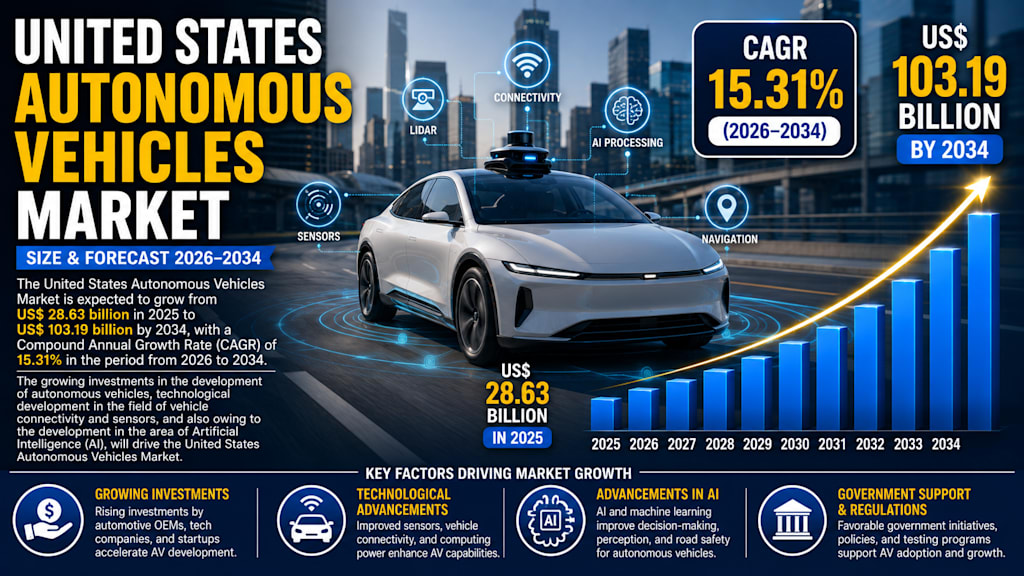
Advancements in artificial intelligence, sensor technologies, and strong industry collaboration are propelling the U.S. autonomous vehicles market from US$ 28.63 billion in 2025 to US$ 103.19 billion by 2034 at a CAGR of 15.31%.

United States Autonomous Vehicles Market Overview
The United States autonomous vehicles market is entering a high-growth phase, driven by rapid advancements in artificial intelligence, machine learning, and sensor technologies. Autonomous vehicles (AVs), also known as self-driving cars, are equipped with advanced systems that enable them to perceive their environment, make decisions, and operate with minimal or no human intervention.
According to Renub Research, the U.S. autonomous vehicles market is expected to expand from US$ 28.63 billion in 2025 to US$ 103.19 billion by 2034, growing at a robust CAGR of 15.31% between 2026 and 2034.
These vehicles rely on a combination of technologies, including cameras, radar, lidar, GPS, ultrasonic sensors, and AI-driven algorithms, to navigate roads safely. From advanced driver-assistance systems (ADAS) to fully autonomous vehicles, the market is evolving rapidly, reshaping the future of transportation.
Key Growth Drivers in the U.S. Autonomous Vehicles Market
Strong Investment and Industry Collaboration
One of the most significant drivers of the market is the substantial investment from automotive manufacturers, technology companies, and venture capital firms. These investments are accelerating research and development, enabling faster commercialization of autonomous technologies.
Collaborations between automakers and technology firms are particularly important. Partnerships such as those between General Motors and NVIDIA, and Hyundai Motor Group with Waymo, highlight how industry players are combining expertise in hardware, software, and AI to advance autonomous mobility solutions.
Additionally, advancements in sensor technologies—such as lidar, radar, and high-resolution cameras—are improving object detection and environmental awareness, making autonomous systems more reliable and scalable.
Growing Demand for Safety and Mobility Efficiency
The demand for safer and more efficient transportation is another key factor driving adoption. Autonomous vehicles have the potential to significantly reduce accidents caused by human error, which remains a leading cause of road fatalities.
By improving reaction times and situational awareness, AVs can enhance road safety while optimizing traffic flow and reducing congestion. These benefits are particularly valuable in urban environments, where traffic density and mobility challenges are increasing.
Autonomous vehicles are also being explored for ride-sharing, logistics, and delivery services, offering cost savings and operational efficiency for businesses and consumers alike.
Technological Advancements in AI and Connectivity
Artificial intelligence is at the core of autonomous vehicle development. Machine learning algorithms enable vehicles to process large volumes of data in real time, improving decision-making and adaptability.
Advancements in cloud computing and edge computing are further enhancing the capabilities of AV systems by enabling faster data processing and seamless updates. The reduction in sensor costs, particularly lidar, is also making autonomous technology more accessible for mid-range vehicles.
Challenges in the U.S. Autonomous Vehicles Market
Regulatory and Legal Complexity
Regulatory uncertainty remains a major challenge for the autonomous vehicles market. Different states have varying regulations, creating a fragmented legal environment that complicates large-scale deployment.
Issues related to liability, insurance, safety standards, and data ownership are still evolving. Clear and consistent regulatory frameworks will be essential to ensure widespread adoption and public trust.
High Development Costs and Public Acceptance
The development of autonomous vehicles requires significant investment in hardware, software, testing, and validation. High costs and long development timelines pose financial risks for companies.
Public acceptance is another critical factor. Concerns about safety, reliability, and cybersecurity can influence consumer adoption. Building trust through rigorous testing, transparency, and education will be crucial for market growth.
Segment Insights in the U.S. Autonomous Vehicles Market
Level 2 Autonomous Vehicles
Level 2 (L2) autonomous vehicles represent the most widely adopted segment, offering partial automation features such as adaptive cruise control, lane-keeping assistance, and automatic braking. These systems require human supervision but provide significant safety and convenience benefits.
Actuators and Hardware Components
Actuators play a critical role in enabling precise vehicle control by converting electronic signals into physical actions. The demand for advanced actuators is increasing as vehicles become more automated.
Ultrasonic Sensors
Ultrasonic sensors are widely used for short-range detection in parking assistance and obstacle avoidance systems. Their cost-effectiveness and ease of integration make them a key component in autonomous vehicle systems.
Human-Machine Interface (HMI)
HMI hardware and software enable interaction between the vehicle and its occupants. Features such as touchscreens, voice commands, and gesture controls enhance user experience and ensure safe transitions between manual and autonomous modes.
Autonomous Passenger Vehicles
The passenger vehicle segment is driven by applications in personal mobility, ride-sharing, and car-sharing services. Autonomous passenger vehicles aim to improve convenience, reduce stress, and enhance accessibility for users.
Regional Insights Within the United States
California
California leads the U.S. autonomous vehicles market, supported by a strong innovation ecosystem and favorable regulatory environment. Silicon Valley serves as a hub for technology companies and startups developing AI, sensors, and software for autonomous vehicles.
New York
New York’s market is driven by the need for efficient urban mobility solutions. The state focuses on public transportation, smart mobility, and safety, with pilot programs supporting autonomous vehicle adoption.
New Jersey
New Jersey is emerging as a key market due to its strategic location and strong logistics infrastructure. Autonomous vehicles are being tested for freight movement, port operations, and highway applications.
Washington
Washington’s market benefits from strong expertise in software development and AI. The state supports innovation through pilot programs and partnerships, particularly in smart mobility and autonomous delivery solutions.
Market Segmentation
The U.S. autonomous vehicles market is segmented by level of automation, hardware, software, vehicle type, application, propulsion, and region. Levels range from L1 to fully autonomous L5 systems, while hardware includes sensors, actuators, and communication systems.
Applications span civil, defense, transportation, logistics, and construction, with propulsion types including electric, hybrid, and internal combustion engines.
Key Companies in the U.S. Autonomous Vehicles Market
Leading companies in the market include Alphabet Inc., Amazon.com Inc., Apple Inc., Aptiv, Baidu Inc., BMW, Mercedes-Benz Group AG, Didi Chuxing, Ford Motor Company, and General Motors. These companies are driving innovation through AI integration, strategic partnerships, and large-scale investments.
Final Thoughts
The United States autonomous vehicles market is poised for transformative growth as technological innovation, investment, and demand for safer mobility solutions continue to rise. Autonomous vehicles have the potential to redefine transportation by improving safety, efficiency, and accessibility.
While challenges such as regulatory complexity and public acceptance remain, ongoing advancements in AI, connectivity, and sensor technologies are expected to drive long-term adoption. As the market evolves, autonomous vehicles will play a central role in shaping the future of mobility and smart transportation systems.
About the Creator
Enjoyed the story? Support the Creator.
Subscribe for free to receive all their stories in your feed.
Comments
There are no comments for this story
Be the first to respond and start the conversation.