
United States Airspace and Procedure Design Market Set for Strong Growth Through 2034 as Aviation Modernization Accelerates
Rising Air Traffic, Smart Navigation Systems, and Drone Integration Drive Future of U.S. Skies

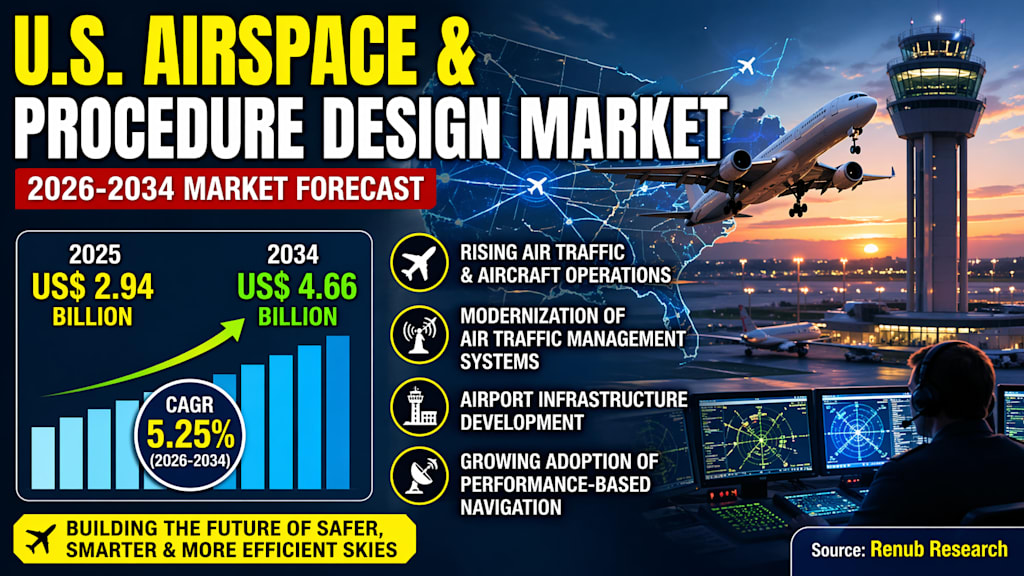
The United States aviation sector is entering a new era of modernization, efficiency, and digital transformation. As airports become busier, airlines seek lower fuel costs, and regulators prepare for the next generation of aircraft, the need for smarter airspace planning has never been greater. This demand is fueling rapid expansion in the United States Airspace and Procedure Design Market.
According to , the United States Airspace and Procedure Design Market is projected to increase from US$ 2.94 Billion in 2025 to US$ 4.66 Billion by 2034, growing at a CAGR of 5.25% during 2026–2034.
This growth reflects the urgent need to redesign air routes, improve airport arrival and departure procedures, integrate drones, and support next-generation air traffic management systems across the country.
What Is Airspace and Procedure Design?
Airspace and procedure design refers to the planning, structuring, and optimization of controlled airspace and aircraft movement procedures. It includes:
- Air route design
- Terminal airspace planning
- Instrument approach procedures
- Departure and arrival paths
- Performance-Based Navigation (PBN) systems
- Noise and environmental route planning
- Safety separation structures
These systems help ensure aircraft move safely, efficiently, and with minimal delays through one of the busiest aviation networks in the world.
The United States has one of the most complex aviation ecosystems globally, supporting commercial airlines, cargo carriers, military operations, business jets, private aviation, and emerging drone systems. Managing all of this traffic requires constant redesign and technological upgrades.

Why the Market Is Growing Fast
1. Increasing Air Traffic Across the Country
Passenger travel demand continues to rise, while air cargo shipments remain essential for e-commerce and logistics. This creates congestion at major hubs and regional airports alike.
As flight volumes increase, airports and aviation authorities must redesign routes and procedures to reduce bottlenecks, shorten taxi times, and improve runway efficiency.
According to the data provided by Renub Research, the FAA Air Traffic Organization supports more than 44,000 flights daily and over 3 million airline passengers across an airspace spanning more than 29 million square miles
That scale creates enormous opportunities for procedure redesign specialists, navigation consultants, and airspace software providers.
2. FAA Modernization and Digital Transformation
The U.S. government is heavily investing in aviation modernization. Legacy radar-based systems are gradually being replaced with satellite-enabled navigation, real-time data systems, and automation technologies.
The Federal Aviation Administration (FAA) has reportedly committed billions of dollars to modernize the national air traffic control system, with broader implementation targeted by 2028
Modernization projects are creating demand for:
- RNAV/RNP procedure design
- Data-driven route optimization
- Simulation systems
- Air traffic automation platforms
- Flight validation technologies
3. Sustainability and Fuel Efficiency Goals
Airlines are under pressure to lower emissions and fuel burn. Smarter procedures such as Continuous Descent Operations and optimized departure paths help aircraft save fuel while reducing noise and delays.
Every minute saved in the air or on the ground can generate millions of dollars in annual savings across large airline fleets.
This makes airspace design not only a safety function—but a profitability tool.
4. Integration of Drones and Advanced Air Mobility
The future of aviation includes drones, delivery aircraft, and electric air taxis. Integrating these new users into existing airspace safely is one of the industry's biggest challenges.
The U.S. Department of Transportation has already launched strategies and planning initiatives for Advanced Air Mobility (AAM), showing how serious the nation is about next-generation flight systems
As drone corridors, low-altitude traffic systems, and urban air mobility networks expand, airspace planners will play a central role.
Key Challenges Facing the Industry
Despite strong growth potential, several challenges remain.
Regulatory Complexity
Changes to airspace procedures often require coordination among:
- Airlines
- Airports
- Military authorities
- Air traffic controllers
- Environmental agencies
- Local communities
Noise concerns, environmental reviews, and operational conflicts can slow implementation timelines.
Legacy Infrastructure
Many aircraft and facilities still rely on older technologies. Since not all fleets are equally equipped for advanced navigation systems, nationwide implementation can be uneven.
This mixed-technology environment adds complexity to designing procedures that work for everyone.
Market Segments Driving Revenue
Air Route Traffic Control Centers (ARTCC)
These centers manage aircraft during en-route flight at high altitudes across long distances. As domestic and international traffic rises, ARTCC modernization remains essential.
Automation, satellite surveillance, and traffic flow management tools are improving controller performance and safety.
Air Traffic Control Towers
Airport towers remain the nerve center for takeoff, landing, taxiing, and runway movement. With airports expanding capacity, tower upgrades and digital tools are in high demand.
Aeronautical Information Management (AIM)
The aviation industry is moving from paper-based systems toward real-time digital data management. Accurate aeronautical data is critical for navigation databases, pilot briefing systems, and safety compliance.
Hardware and Software Opportunities
The market includes both physical systems and digital platforms.
Hardware Includes:
- Radar interfaces
- Validation systems
- Design workstations
- Simulation platforms
- Navigation devices
Software Includes:
- Procedure design software
- Traffic modeling tools
- Route optimization platforms
- Safety analytics systems
- Environmental impact modeling
As airports digitize operations, software spending is expected to accelerate.
Commercial Aviation Demand Leading Growth
Commercial airlines are expected to remain the largest customer segment. Airlines want:
- Better on-time performance
- Reduced delays
- Lower fuel consumption
- Fewer emissions
- Better passenger satisfaction
This creates continuous demand for optimized routes and smarter terminal procedures.
Military Aviation Also Important
The U.S. military requires specialized training zones, secure corridors, tactical procedures, and coordination with civilian traffic systems.
As defense aviation modernizes and unmanned systems expand, military airspace design will remain a valuable segment.
Top States Driving Demand
California
California has some of America’s busiest and most complex airspace, supported by major airports, dense urban traffic, coastal geography, and military activity.
Texas
Texas benefits from fast population growth, airport expansion, and heavy commercial plus military traffic.
New York
New York’s crowded metro airspace requires highly precise routing and synchronized airport procedures.
Washington
Washington is known for technology leadership, sustainability priorities, difficult terrain, and advanced aviation testing environments.
Other high-potential states include Florida, Illinois, New Jersey, Pennsylvania, Georgia, Arizona, and Colorado
Leading Companies in the Market
Several major global aviation technology firms are active in this sector, including:
- Honeywell International Inc.
- RTX Corporation
- Leonardo S.p.A.
- THALES
- Saab AB
- L3Harris Technologies, Inc.
These companies provide navigation systems, automation platforms, surveillance tools, and air traffic management technologies.
Future Outlook to 2034
The next decade will transform how aircraft move through U.S. skies. With increasing passenger traffic, more drones, sustainability targets, and digital ATC systems, demand for professional airspace and procedure design services will rise steadily.
What was once a back-end technical function is now becoming a strategic growth industry linked to transportation efficiency, national infrastructure, defense readiness, and future mobility.
As the U.S. builds the aviation network of tomorrow, airspace design will be one of the invisible systems making it all possible.
Final Thoughts
The United States Airspace and Procedure Design Market may not be visible to most travelers, but it affects every flight. Faster departures, safer landings, lower delays, quieter communities, and cleaner aviation all depend on intelligent route planning.
With the market forecast to reach US$ 4.66 Billion by 2034, this specialized sector is quietly becoming one of the most important foundations of America’s aviation future.
About the Creator
Enjoyed the story? Support the Creator.
Subscribe for free to receive all their stories in your feed.
Comments
There are no comments for this story
Be the first to respond and start the conversation.