
United States Agricultural Machinery Market to Reach US$61.66 Billion by 2034 as Smart Farming and Automation Transform Modern Agriculture
Growing adoption of precision agriculture, increasing labor shortages, expanding farm automation, and supportive government initiatives are driving the steady growth of the U.S. agricultural machinery market.

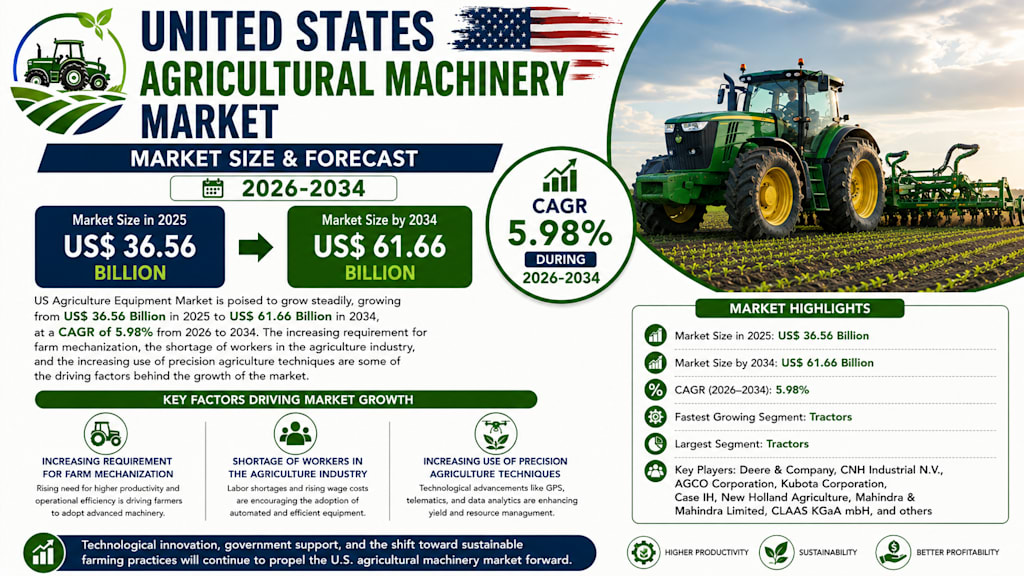
Smart Agricultural Machinery Is Reshaping American Farming
Agriculture has always been one of the foundations of the U.S. economy, and modern technology is transforming how farmers cultivate crops, manage resources, and improve productivity. As commercial farms expand and labor shortages become increasingly challenging, agricultural machinery has become essential for maintaining efficiency and meeting growing food demand.
Today's farming equipment extends far beyond traditional tractors and harvesters. Modern agricultural machinery incorporates GPS guidance, artificial intelligence, sensors, automation, drones, and precision farming technologies that enable farmers to maximize productivity while reducing costs and minimizing environmental impact.
According to the latest market outlook, the United States Agricultural Machinery Market is projected to grow from US$36.56 billion in 2025 to US$61.66 billion by 2034, registering a compound annual growth rate (CAGR) of 5.98% during 2026–2034. Rising farm mechanization, increasing labor shortages, and widespread adoption of precision agriculture technologies continue to drive long-term market expansion.
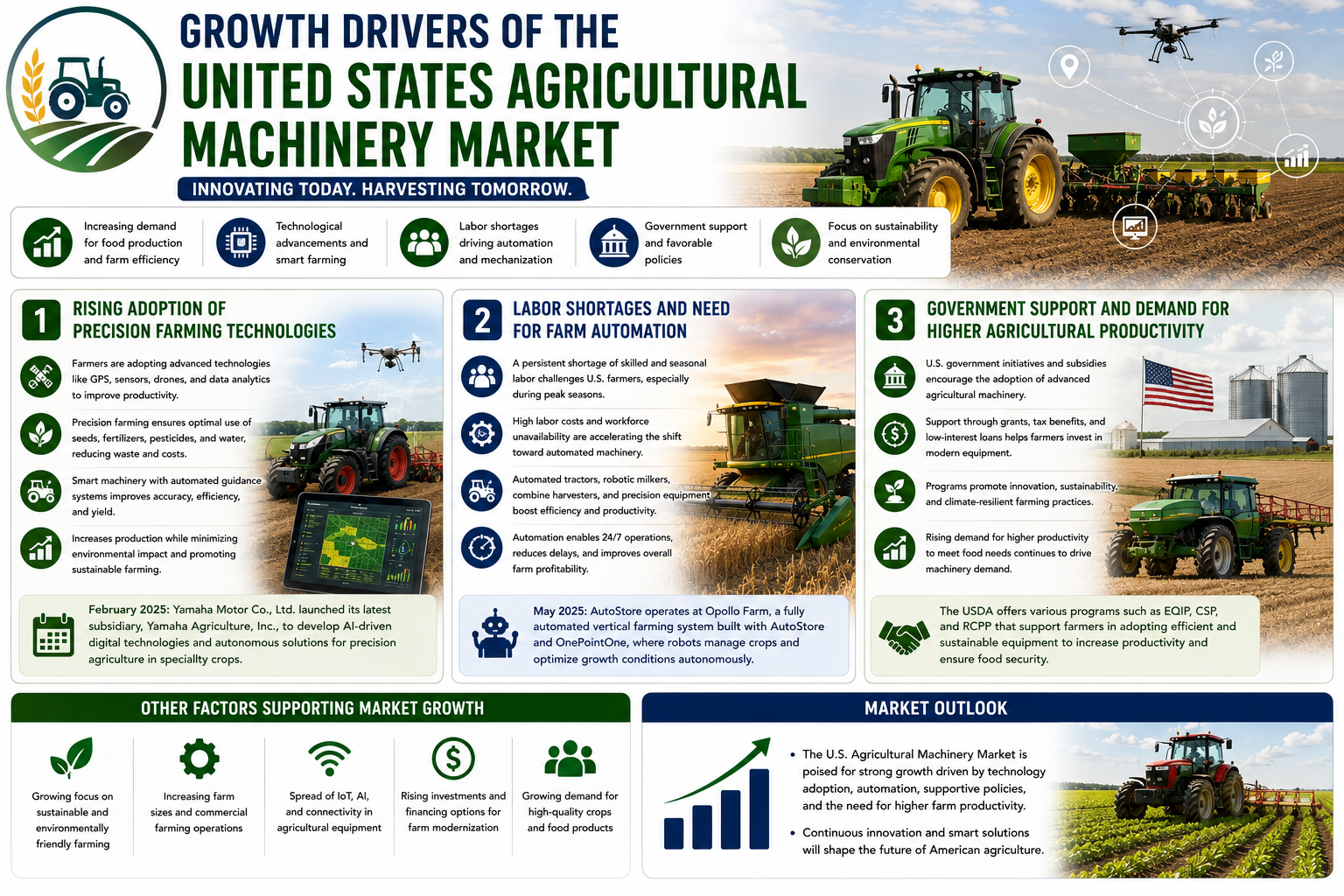
Agricultural Machinery Powers Modern Farming
Agricultural machinery includes a wide range of mechanical equipment used throughout the farming cycle.
These machines include tractors, harvesters, plows, cultivators, seed drills, irrigation systems, sprayers, balers, forage equipment, and specialized machinery designed for planting, fertilizing, harvesting, and field maintenance.
Modern machinery allows farmers to cultivate larger areas while improving operational efficiency and reducing dependence on manual labor.
Advanced technologies integrated into today's equipment also help farmers monitor crop conditions, optimize resource utilization, and increase yields through precision agriculture.
Precision Farming Continues Driving Market Growth
One of the strongest drivers of the U.S. agricultural machinery market is the rapid adoption of precision farming technologies.
Modern equipment increasingly integrates GPS navigation, satellite positioning, sensors, drones, artificial intelligence, and real-time data analytics to improve farming efficiency.
Precision agriculture enables farmers to apply seeds, fertilizers, pesticides, and irrigation only where needed, reducing waste while maximizing crop productivity.
Automated steering systems, intelligent sprayers, and data-driven farm management platforms help operators make better decisions based on field-specific conditions.
As sustainable agriculture gains importance, precision farming technologies are expected to remain a major source of market growth.
Labor Shortages Accelerate Farm Automation
The agriculture industry continues facing significant labor shortages across many regions of the United States.
Finding sufficient workers during planting and harvesting seasons has become increasingly difficult while labor costs continue rising.
Farmers are therefore investing in automation technologies capable of performing repetitive agricultural tasks more efficiently than manual labor.
Automated tractors, robotic harvesters, precision sprayers, autonomous machinery, and robotic dairy systems enable farms to maintain productivity despite workforce limitations.
Automation also allows equipment to operate longer hours while improving consistency and reducing operational delays.
Government Support Strengthens Agricultural Investment
Government initiatives continue encouraging modernization throughout the agricultural sector.
Federal and state programs provide financial assistance through grants, low-interest loans, disaster relief funding, and agricultural development initiatives that encourage farmers to purchase advanced equipment.
Agricultural universities and extension services also promote the adoption of modern farming technologies through education, training, and research programs.
These supportive policies enable producers to improve productivity while strengthening national food security and agricultural competitiveness.
Tractors Remain the Backbone of U.S. Agriculture
Agricultural tractors continue representing the largest segment within the market.
Modern tractors perform a wide variety of farming operations including plowing, planting, spraying, hauling, cultivation, irrigation, and operating numerous farm implements.
Today's tractors increasingly feature GPS guidance, autonomous driving capabilities, fuel-efficient engines, telematics, and precision farming technologies.
Manufacturers also continue investing in electric and autonomous tractor development as the industry moves toward greater sustainability and automation.
The demand for powerful and intelligent tractors is expected to remain strong throughout the forecast period.
Micro-Irrigation Machinery Supports Sustainable Farming
Water conservation has become an increasingly important priority for American agriculture.
Micro-irrigation systems—including drip irrigation, sprinkler irrigation, and precision irrigation equipment—enable farmers to deliver water directly to crops while minimizing waste.
These systems are particularly valuable in drought-prone regions and for cultivating high-value crops such as fruits, vegetables, vineyards, and orchards.
Technological advances continue improving irrigation efficiency while reducing water consumption and operational costs.
Government initiatives promoting sustainable water management further strengthen this market segment.
Harvesting Machinery Improves Productivity
Harvesting equipment remains essential for large-scale commercial farming operations.
Combine harvesters, forage harvesters, harvesting robots, and self-propelled harvesting systems significantly reduce harvesting time while minimizing crop losses.
Modern combines increasingly incorporate automation, GPS navigation, yield monitoring, and intelligent sensors that optimize harvesting efficiency.
As labor shortages continue affecting agricultural operations, demand for advanced harvesting equipment is expected to increase steadily.
Cultivators and Tillers Maintain Soil Health
Cultivators and tillers play an important role in soil preparation before planting.
These machines loosen compacted soil, improve aeration, remove weeds, and create favorable seedbeds that promote healthy crop growth.
Small and medium-sized farms particularly benefit from versatile tillage equipment capable of supporting multiple farming operations.
Manufacturers continue improving machine durability, fuel efficiency, and operating performance to meet changing agricultural requirements.
Agricultural Mowers Support Livestock Farming
Agricultural mowers remain indispensable for hay production, pasture maintenance, and livestock feed preparation.
Disc mowers, rotary mowers, and mower conditioners allow farmers to harvest forage crops quickly while preserving nutritional quality.
Livestock and dairy farms rely heavily on these machines to maintain consistent feed supplies throughout the year.
Technological innovation has improved cutting efficiency while reducing fuel consumption and maintenance requirements.
High Equipment Costs Remain a Challenge
Despite their operational benefits, modern agricultural machines require significant financial investment.
Advanced tractors, combine harvesters, autonomous equipment, and precision farming systems often involve substantial purchase costs in addition to maintenance, software updates, repairs, and fuel expenses.
Smaller farms may find these investments difficult without financial assistance or favorable financing options.
Manufacturers continue developing flexible financing programs while introducing equipment suitable for farms of different sizes.
Supply Chain Disruptions Affect Equipment Availability
Agricultural machinery manufacturing depends heavily on components including steel, semiconductors, engines, electronics, and tires.
Global supply chain disruptions, inflation, transportation delays, and raw material shortages have affected production schedules and equipment availability.
Delivery delays may create operational challenges for farmers who require machinery during critical planting and harvesting periods.
Strengthening domestic manufacturing capabilities and supply chain resilience remains an important priority for the industry.
Regional Markets Continue Driving Demand
California remains one of the nation's largest agricultural machinery markets due to its production of fruits, vegetables, nuts, and specialty crops, together with widespread adoption of precision farming and irrigation technologies.
Texas continues experiencing strong machinery demand supported by extensive farmland, livestock production, cotton cultivation, and increasing investment in GPS-enabled farming equipment.
New York benefits from diverse agricultural production including dairy farming, fruit cultivation, and vegetable production, encouraging adoption of specialized farm machinery.
Florida continues expanding demand for tractors, irrigation systems, harvesters, and specialty crop equipment used throughout its citrus, sugarcane, vegetable, and horticultural industries.
These states continue leading technological innovation within American agriculture.
Innovation Will Shape the Future of Agricultural Machinery
The future of agricultural machinery will be driven by automation, artificial intelligence, robotics, electrification, and digital connectivity.
Autonomous tractors, AI-powered harvesting systems, precision irrigation, drone-based monitoring, and predictive maintenance technologies are expected to become increasingly common.
Manufacturers are also investing in electric machinery, battery technologies, and environmentally sustainable equipment capable of reducing emissions while maintaining high productivity.
Data-driven farming platforms will continue helping farmers make more informed operational decisions while maximizing profitability.
Final Thoughts
The United States agricultural machinery market continues evolving as technology transforms nearly every aspect of modern farming.
The projected growth from US$36.56 billion in 2025 to US$61.66 billion by 2034, supported by a 5.98% CAGR, reflects increasing demand for automation, precision agriculture, and sustainable farming practices.
Although equipment costs, labor shortages, and supply chain disruptions remain important challenges, continued government support, technological innovation, and expanding adoption of smart farming solutions position the U.S. agricultural machinery industry for strong long-term growth. As agriculture becomes increasingly data-driven and automated, advanced machinery will remain essential for ensuring productivity, sustainability, and food security across the United States.
About the Creator
Enjoyed the story? Support the Creator.
Subscribe for free to receive all their stories in your feed.
Comments
There are no comments for this story
Be the first to respond and start the conversation.