
United States Agricultural Machinery Market: How Automation and Precision Farming Are Transforming American Agriculture
Rising demand for farm mechanization, labor shortages, and smart farming technologies are fueling the next wave of agricultural innovation

The American agricultural sector is undergoing a technological revolution. As farmers face increasing pressure to improve productivity, manage labor shortages, and meet growing food demand, advanced agricultural machinery is becoming more essential than ever before.
From GPS-guided tractors and autonomous harvesters to precision irrigation systems and AI-powered farming platforms, modern agricultural equipment is helping farmers cultivate larger areas more efficiently while reducing operational costs and resource waste.
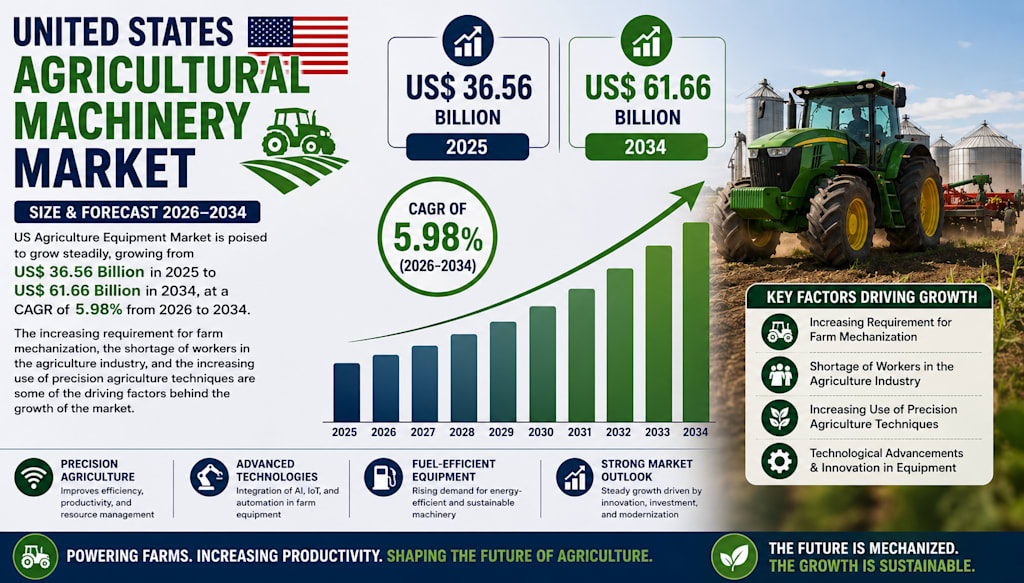
According to Renub Research, the United States Agricultural Machinery Market is projected to grow from US$ 36.56 billion in 2025 to US$ 61.66 billion by 2034, expanding at a CAGR of 5.98% between 2026 and 2034. Rising adoption of precision agriculture technologies, increasing labor shortages, and government support for agricultural modernization are among the major factors driving market growth.
As agriculture enters the digital age, machinery is evolving from simple mechanical equipment into intelligent systems capable of transforming how food is produced across the United States.
The Growing Importance of Agricultural Machinery
Agricultural machinery refers to the equipment and mechanical tools used throughout the farming process to improve efficiency, reduce manual labor, and enhance productivity.
Modern farm operations rely on a wide range of machinery, including:
- Tractors
- Harvesters
- Irrigation systems
- Seed drills
- Sprayers
- Cultivators
- Balers
- Ploughs
- Mowers
These machines assist farmers during various stages of crop production, including:
- Soil preparation
- Planting
- Irrigation
- Fertilization
- Crop protection
- Harvesting
- Post-harvest management
In the United States, where commercial farming operations often span thousands of acres, agricultural machinery has become indispensable for maintaining efficiency and profitability.
The growing complexity of modern farming is creating strong demand for technologically advanced equipment capable of handling large-scale operations with greater precision.
Precision Farming Is Driving a New Era of Growth
One of the strongest growth drivers in the agricultural machinery market is the rapid adoption of precision farming technologies.
Precision agriculture uses advanced digital tools to optimize farming operations through data-driven decision-making.
Key technologies include:
- GPS guidance systems
- Field sensors
- Drones
- Satellite imagery
- Data analytics platforms
- Artificial intelligence
When integrated into agricultural machinery, these technologies allow farmers to:
- Apply fertilizers more accurately
- Optimize irrigation schedules
- Reduce pesticide usage
- Improve crop yields
- Minimize resource waste
GPS-enabled tractors, automated sprayers, and intelligent harvesters are increasingly becoming standard equipment on modern farms.
These systems help farmers maximize productivity while supporting environmentally sustainable practices.
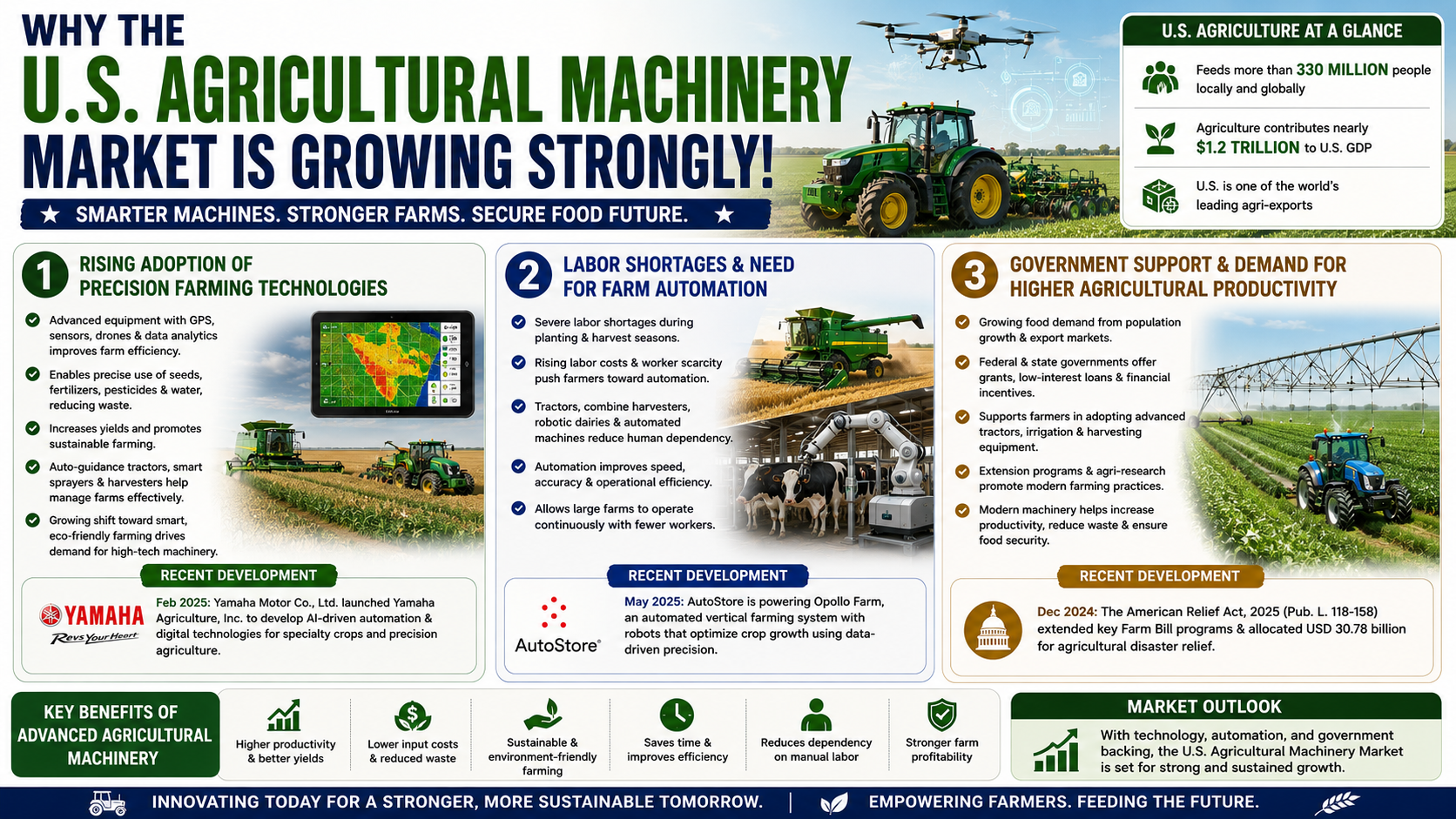
A notable industry development occurred in February 2025 when Yamaha Motor Co., Ltd. launched Yamaha Agriculture, Inc., a subsidiary focused on developing automation and AI-driven technologies for specialty crop farming. The company aims to combine autonomous robotic systems with advanced data analytics to further accelerate precision agriculture adoption.
As farmers increasingly embrace smart agriculture, demand for advanced machinery is expected to continue rising.
Labor Shortages Are Accelerating Automation
The U.S. agricultural sector faces a growing labor shortage that is reshaping farming operations nationwide.
Finding sufficient workers for planting, harvesting, and field maintenance has become increasingly difficult, particularly during peak agricultural seasons.
Several factors contribute to labor challenges:
- Aging workforce
- Declining availability of farm labor
- Rising labor costs
- Immigration-related workforce constraints
- Seasonal employment difficulties
As a result, farmers are increasingly turning to automation as a practical solution.
Modern machinery can perform repetitive tasks faster, more consistently, and with fewer workers.
Examples include:
- Autonomous tractors
- Robotic harvesters
- Automated dairy systems
- Self-guided sprayers
- Smart irrigation systems
Automation allows large farms to operate continuously while reducing dependence on manual labor.
In May 2025, AutoStore partnered with OnePointOne to develop Opollo Farm, a fully automated vertical farming system that uses robotics to move crops while automatically adjusting water and nutrient delivery. Such projects demonstrate how automation is beginning to transform agricultural production beyond traditional field farming.
Labor shortages are expected to remain one of the strongest incentives for machinery investment in the coming years.
Government Support Is Encouraging Modernization
Federal and state governments continue playing an important role in promoting agricultural modernization.
Growing concerns regarding:
- Food security
- Global competitiveness
- Resource conservation
- Climate resilience
have encouraged policymakers to support machinery adoption through various initiatives.
Farmers increasingly benefit from:
- Low-interest financing programs
- Equipment grants
- Disaster relief funding
- Agricultural modernization incentives
- Extension education programs
These initiatives help reduce the financial burden associated with purchasing advanced machinery.
In December 2024, the American Relief Act, 2025 allocated approximately US$ 30.78 billion in agricultural disaster relief funding while extending several programs authorized under the 2018 Farm Bill. Such measures provide additional support for farmers investing in productivity-enhancing technologies.
Government-backed programs continue encouraging broader adoption of modern farming equipment across the country.
Agricultural Tractors Remain the Backbone of Modern Farming
Among all machinery categories, tractors remain the most important segment within the agricultural equipment market.
Modern tractors perform numerous critical tasks, including:
- Plowing
- Tillage
- Seeding
- Hauling
- Spraying
- Operating auxiliary equipment
Large-scale commercial farms rely heavily on high-powered tractors to manage extensive agricultural operations efficiently.
Recent innovations have transformed tractors into sophisticated technology platforms equipped with:
- GPS navigation
- Automated steering
- Telematics systems
- Precision application tools
- Remote monitoring capabilities
Manufacturers are also investing heavily in electrification and autonomous technologies.
For example, Deere & Company plans to introduce its first electric and autonomous-ready tractor by 2026, while AGCO has expanded investments in electric tractor development through its Fendt e100 Vario platform.
These innovations are expected to redefine tractor performance and sustainability over the next decade.
Micro-Irrigation Machinery Is Supporting Water Efficiency
Water management is becoming increasingly important in American agriculture, particularly in drought-prone regions.
As a result, demand for micro-irrigation systems is growing rapidly.
Popular solutions include:
- Drip irrigation
- Precision irrigation
- Sprinkler systems
- Smart irrigation controls
These technologies enable farmers to deliver water directly to crops while minimizing waste.
Benefits include:
- Improved water efficiency
- Higher crop yields
- Reduced operating costs
- Enhanced sustainability
Micro-irrigation systems are especially valuable for growers producing fruits, vegetables, and other high-value crops. Government support for water conservation initiatives is further accelerating adoption.
As climate variability increases, efficient irrigation technologies are expected to play an increasingly important role in farm operations.
Combine Harvesters Are Becoming Smarter and More Efficient
The combine harvester market continues experiencing strong demand due to its ability to perform multiple harvesting functions simultaneously.
Modern combines can:
- Harvest crops
- Thresh grain
- Separate kernels
- Remove unwanted plant material
This significantly reduces labor requirements and improves harvesting efficiency.
Advanced combine harvesters now incorporate:
- GPS guidance systems
- Yield monitoring sensors
- Automated controls
- Real-time performance analytics
These technologies help farmers maximize crop recovery while minimizing waste.
The growing labor shortage and demand for productivity improvements are expected to drive continued investment in next-generation harvesting equipment.
Agricultural Mowers Continue Supporting Livestock Operations
Agricultural mowers remain essential equipment for livestock and dairy farming operations.
They are commonly used for:
- Cutting hay
- Harvesting forage crops
- Pasture maintenance
- Feed preparation
Technological advancements have improved mower performance through:
- Faster cutting speeds
- Reduced fuel consumption
- Better crop preservation
- Increased operational efficiency
Both tractor-mounted and self-propelled mower systems are helping farmers maintain productivity while reducing labor requirements.
The continued growth of livestock farming is expected to support steady demand for agricultural mowing equipment.
Challenges Facing the Industry
Despite strong growth prospects, the agricultural machinery market faces several important challenges.
High Equipment Costs
Advanced agricultural machinery requires significant investment.
Modern systems equipped with:
- GPS technology
- Automation features
- Robotics
- Artificial intelligence
often carry substantial purchase prices.
Beyond acquisition costs, farmers must also manage:
- Maintenance expenses
- Software updates
- Fuel costs
- Operator training
These financial barriers can limit adoption among smaller farming operations.
Supply Chain Disruptions
Agricultural equipment manufacturers depend heavily on components such as:
- Steel
- Semiconductors
- Tires
- Engines
Global supply chain disruptions can delay equipment production and delivery, creating challenges during critical planting and harvesting periods. Rising transportation and material costs have further complicated procurement efforts.
Addressing these challenges will be essential for sustaining long-term industry growth.
Regional Markets Driving Expansion
California
California remains one of the most important agricultural machinery markets due to its large-scale production of fruits, vegetables, nuts, and specialty crops. Farmers are increasingly adopting precision agriculture technologies and automated harvesting systems to address labor shortages and environmental regulations.
Texas
Texas benefits from extensive farmland and strong production of cotton, corn, wheat, sorghum, and livestock products. Growing adoption of GPS-enabled tractors and modern irrigation systems is supporting machinery demand across the state.
New York
New York's diverse agricultural sector, including dairy farming and specialty crops, is driving demand for tractors, mowers, harvesters, and smart irrigation equipment. Smaller farms increasingly favor versatile machinery designed to improve efficiency.
Florida
Florida's agricultural industry relies heavily on specialized equipment for citrus, sugarcane, vegetables, and ornamental crops. Strong demand for irrigation systems and precision agriculture technologies continues supporting market growth.
Final Thoughts
The United States Agricultural Machinery Market is entering a transformative period fueled by automation, precision agriculture, and the growing need for efficient food production.
With the market expected to expand from US$ 36.56 billion in 2025 to US$ 61.66 billion by 2034, machinery manufacturers, technology providers, and farmers all stand to benefit from continued modernization.
Advancements in artificial intelligence, robotics, autonomous vehicles, and smart farming technologies are reshaping how crops are planted, irrigated, managed, and harvested.
While challenges such as equipment affordability and supply chain constraints remain, the long-term outlook for agricultural mechanization remains highly positive.
As the agriculture sector seeks to feed a growing population while improving sustainability and productivity, advanced machinery will remain at the heart of America's farming future.
About the Creator
Enjoyed the story? Support the Creator.
Subscribe for free to receive all their stories in your feed.
Comments
There are no comments for this story
Be the first to respond and start the conversation.