
United Kingdom High Bandwidth Memory Market to Reach US$ 587.86 Million by 2034 as AI and Cloud Computing Fuel Unprecedented Demand
The UK High Bandwidth Memory (HBM) Market is projected to grow at a CAGR of 18.24% between 2026 and 2034, driven by artificial intelligence, high-performance computing, cloud infrastructure expansion, and next-generation semiconductor innovation.

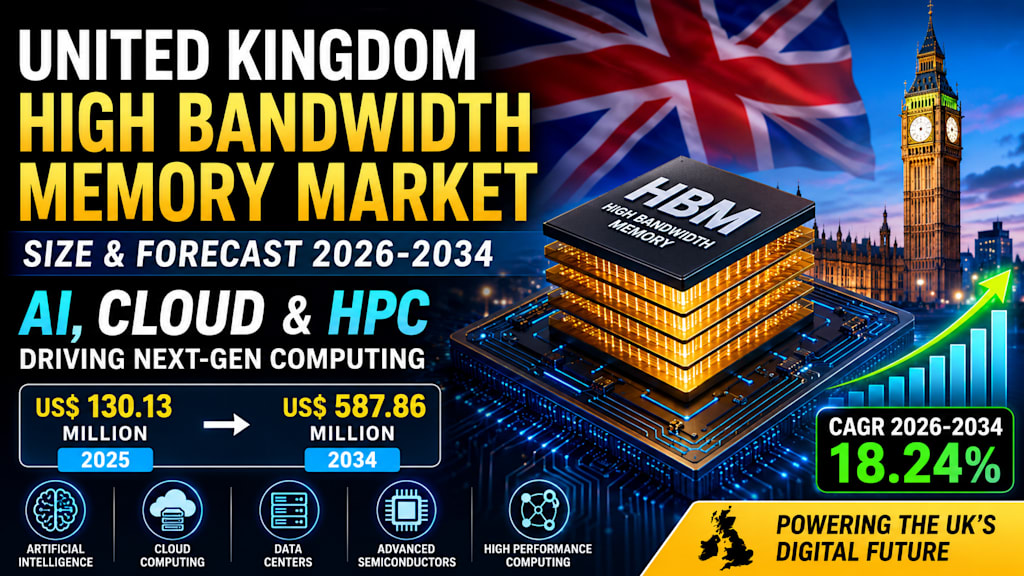
United Kingdom High Bandwidth Memory Market Size & Forecast 2026–2034
The United Kingdom is rapidly positioning itself as one of Europe's leading technology hubs, fueled by investments in artificial intelligence, cloud computing, digital infrastructure, and advanced semiconductor technologies. At the center of this transformation is High Bandwidth Memory (HBM), a next-generation memory architecture designed to support the intensive computing requirements of AI models, scientific simulations, and data-driven applications.
According to Renub Research, the United Kingdom High Bandwidth Memory Market is expected to grow from US$ 130.13 Million in 2025 to US$ 587.86 Million by 2034, expanding at a remarkable CAGR of 18.24% during 2026–2034.
As organizations increasingly depend on AI-powered systems, cloud-native applications, and high-performance computing platforms, the demand for ultra-fast and energy-efficient memory solutions continues to surge. HBM is emerging as a foundational technology supporting the UK's ambitions in digital innovation, AI leadership, and advanced computing infrastructure.
Understanding High Bandwidth Memory
High Bandwidth Memory is an advanced memory technology that significantly improves data transfer speeds by vertically stacking memory dies and placing them closer to processors such as GPUs, AI accelerators, and high-performance CPUs.
Unlike traditional DRAM, HBM delivers:
Higher memory bandwidth
Lower latency
Improved power efficiency
Reduced physical footprint
Enhanced processing performance
These advantages make HBM indispensable for applications involving:
Artificial Intelligence
Machine Learning
High-Performance Computing (HPC)
Scientific Research
Gaming Graphics
Data Analytics
Cloud Computing
Autonomous Systems
As computational workloads become increasingly complex, HBM serves as a critical enabler for future computing architectures.
AI Revolution Accelerating HBM Adoption
Artificial intelligence is arguably the most significant catalyst behind the UK's HBM market growth.
Large Language Models (LLMs), generative AI platforms, deep learning networks, and advanced analytics systems require enormous amounts of memory bandwidth. Conventional memory solutions often struggle to meet these requirements, leading enterprises to adopt HBM-enabled GPUs and accelerators.
Industries across the UK are rapidly integrating AI technologies:
Financial institutions use AI for fraud detection and risk assessment.
Healthcare providers leverage machine learning for diagnostics and medical imaging.
Cybersecurity firms deploy AI-driven threat detection systems.
Research organizations utilize AI for climate modeling and scientific discovery.
The UK government's commitment to AI development further strengthens market growth. The launch of the AI Opportunities Action Plan in 2025 highlighted the nation's strategy to become a global AI powerhouse, creating favorable conditions for HBM deployment across public and private sectors.
As AI workloads continue to expand, memory performance becomes increasingly critical, making HBM a strategic technology investment.
Growing Data Center Investments Creating New Opportunities
The UK's booming data center industry is another major factor driving HBM demand.
Cloud service providers and hyperscale operators are investing heavily in infrastructure capable of supporting AI training, advanced analytics, and enterprise cloud services. Modern data centers increasingly rely on HBM-powered processors and GPUs to deliver superior performance while maintaining energy efficiency.
Organizations migrating workloads to the cloud require:
Faster data processing
Real-time analytics
Scalable AI infrastructure
Efficient resource utilization
HBM helps achieve these objectives by providing substantially greater memory throughput than traditional alternatives.
The opening of major cloud facilities and multi-billion-pound investments in UK data center infrastructure reflect growing demand for AI-ready computing environments. As cloud adoption continues across industries, HBM-equipped servers are becoming essential components of next-generation digital infrastructure.
Semiconductor Innovation Supporting Long-Term Market Expansion
The United Kingdom's semiconductor ecosystem is also playing a significant role in HBM market development.
Universities, research institutions, and technology companies are actively working on advanced packaging technologies, memory optimization, and next-generation chip design. Innovations in 2.5D and 3D semiconductor integration are particularly important because HBM relies on sophisticated stacking and interconnect technologies.
Government-backed semiconductor initiatives are encouraging:
Research collaboration
Innovation funding
Talent development
International partnerships
Advanced manufacturing capabilities
The UK's semiconductor strategy aims to strengthen domestic capabilities while fostering partnerships with global chip manufacturers. These efforts are expected to accelerate HBM adoption across AI accelerators, networking processors, and advanced computing systems.
As semiconductor technologies evolve, HBM will remain at the core of future computing architectures.
Challenges Facing the UK High Bandwidth Memory Market
Despite strong growth prospects, several challenges could impact market expansion.
High Manufacturing Costs
HBM remains significantly more expensive than conventional DRAM due to its complex manufacturing process.
Producing HBM requires:
Through-Silicon Via (TSV) technology
Advanced packaging techniques
Precision die stacking
Specialized testing procedures
These factors increase production costs and create pricing challenges for organizations seeking widespread deployment.
Small and medium-sized enterprises often find HBM-based solutions financially challenging despite their performance advantages.
Supply Chain Constraints
Global HBM production remains concentrated among a small number of manufacturers.
This concentration creates:
Supply shortages
Procurement delays
Price fluctuations
Longer lead times
As demand for AI hardware continues to surge worldwide, securing HBM-enabled components becomes increasingly competitive.
UK enterprises, research facilities, and cloud providers may face difficulties obtaining sufficient hardware to meet growing computational requirements.
Technical Complexity and Talent Shortages
Integrating HBM into advanced computing systems requires specialized engineering expertise.
Organizations must address challenges involving:
Thermal management
Signal integrity
System architecture optimization
Advanced packaging integration
The UK currently faces shortages of professionals with expertise in semiconductor packaging, AI hardware design, and memory architecture development.
Expanding education programs and industry collaboration will be essential to addressing these talent gaps.
United Kingdom HBM Servers Market
HBM-powered servers are gaining significant traction across the UK.
These servers provide exceptional performance for:
AI model training
Large language model deployment
Scientific simulations
Genomics research
Financial analytics
Compared with traditional server architectures, HBM-enabled systems dramatically improve computational efficiency and reduce processing times.
Research institutions, cloud providers, and enterprise organizations increasingly view HBM servers as critical infrastructure investments capable of supporting future digital transformation initiatives.
United Kingdom HBM Networking Market
Networking applications represent another important growth segment.
Telecommunications providers and hyperscale data centers are adopting HBM-powered networking components to handle rising traffic volumes generated by:
5G deployment
Edge computing
Cloud services
Video streaming
Internet of Things (IoT) applications
HBM enhances the performance of:
Smart NICs
Data Processing Units (DPUs)
Network processors
Advanced switching platforms
Its ability to process large amounts of data efficiently while minimizing power consumption aligns with the UK's sustainability and digital infrastructure goals.
HBM2 Continues to Maintain Market Relevance
Although newer generations are emerging, HBM2 remains widely deployed throughout the UK.
Research institutions, universities, and enterprise organizations continue using HBM2-based systems because they offer:
Proven reliability
Cost-effectiveness
Mature ecosystem support
Broad hardware compatibility
Many AI inference workloads, graphics rendering applications, and scientific computing environments continue to perform effectively using HBM2 technologies.
This established foundation ensures ongoing market demand throughout the forecast period.
HBM3 Leading the Next Generation of Computing
HBM3 represents the future of high-performance memory in the UK market.
Offering significantly higher bandwidth and improved efficiency compared to previous generations, HBM3 is becoming the preferred choice for:
Generative AI systems
Exascale computing
Advanced simulations
Climate modeling
Quantum research
Research centers and cloud providers are increasingly deploying HBM3-enabled platforms to support next-generation workloads.
Although costs remain relatively high, the performance advantages justify investment for organizations pursuing cutting-edge computational capabilities.
GPU-Based HBM Demand Surges Across Industries
GPUs equipped with HBM are rapidly becoming essential tools for organizations operating in data-intensive environments.
Key sectors adopting HBM GPUs include:
Banking and financial services
Scientific research
Healthcare
Manufacturing
Government agencies
Artificial intelligence startups
These systems provide the memory bandwidth necessary to process massive datasets and execute complex AI models efficiently.
The UK's ambition to strengthen sovereign AI capabilities further supports long-term demand for HBM-powered GPU platforms.
London Leads the UK's HBM Market
London remains the largest regional market for HBM adoption.
Several factors contribute to its leadership position:
Strong concentration of financial institutions
Growing AI startup ecosystem
Leading universities
Advanced digital infrastructure
Major cloud and data center investments
Financial organizations in London increasingly utilize HBM-powered systems for quantitative analysis, algorithmic trading, and fraud detection.
Meanwhile, AI startups rely on advanced computing resources to develop innovative machine learning solutions.
These dynamics make London a major center for HBM consumption and innovation.
Manchester Emerging as a High-Growth Technology Hub
Manchester is rapidly establishing itself as a significant contributor to the UK's HBM ecosystem.
The city benefits from:
Leading research universities
Expanding innovation districts
Growing technology workforce
Strong scientific research programs
Applications involving bioinformatics, materials science, environmental modeling, and industrial automation increasingly depend on HBM-enabled computing infrastructure.
As Manchester continues attracting investment in advanced technology sectors, demand for high-performance memory solutions is expected to grow substantially.
10 Recent Developments from Key Companies
1. Samsung Electronics
Expanded development of next-generation HBM3E solutions targeting AI accelerators and data center applications.
2. SK hynix
Strengthened global leadership in HBM3 production and increased supply capacity for AI-focused GPUs.
3. Micron Technology
Introduced advanced HBM3E products optimized for generative AI and large-scale data center deployments.
4. Nvidia Corporation
Launched new AI accelerator platforms utilizing high-capacity HBM memory to support large language models.
5. Advanced Micro Devices (AMD)
Expanded AI GPU offerings incorporating advanced HBM technologies for enterprise and cloud environments.
6. Intel Corporation
Accelerated development of AI-focused processors integrated with advanced memory architectures and packaging technologies.
7. Amkor Technology
Enhanced advanced semiconductor packaging capabilities supporting HBM integration and chiplet architectures.
8. Powertech Technology Inc.
Invested in memory packaging and testing technologies to support growing global HBM demand.
9. United Microelectronics Corporation (UMC)
Expanded semiconductor manufacturing collaborations supporting AI and memory-intensive applications.
10. Industry-Wide HBM4 Development
Major memory manufacturers accelerated research into HBM4 technology, promising significantly higher bandwidth and efficiency for future AI systems.
Final Thoughts
The United Kingdom High Bandwidth Memory market is entering a period of exceptional growth as artificial intelligence, cloud computing, and advanced data processing reshape the country's digital economy.
With the market projected to rise from US$ 130.13 Million in 2025 to US$ 587.86 Million by 2034, HBM is becoming a foundational technology for next-generation computing infrastructure. Strong government support, expanding semiconductor innovation, increasing AI adoption, and rapid cloud infrastructure investments create a favorable environment for sustained market expansion.
While challenges such as high costs, supply constraints, and technical complexity remain, the long-term outlook for the UK HBM market remains highly positive. As organizations seek faster, more efficient, and more scalable computing solutions, High Bandwidth Memory will continue to play a pivotal role in powering the UK's digital future.
About the Creator
Enjoyed the story? Support the Creator.
Subscribe for free to receive all their stories in your feed.
Comments
There are no comments for this story
Be the first to respond and start the conversation.