
United Arab Emirates Red Meat Market to Reach US$ 1,003.50 Million by 2034 as Premium Meat Demand and Foodservice Expansion Accelerate Growth
Rising tourism, growing expatriate population, expanding retail infrastructure, and increasing preference for premium protein sources are strengthening the UAE red meat industry

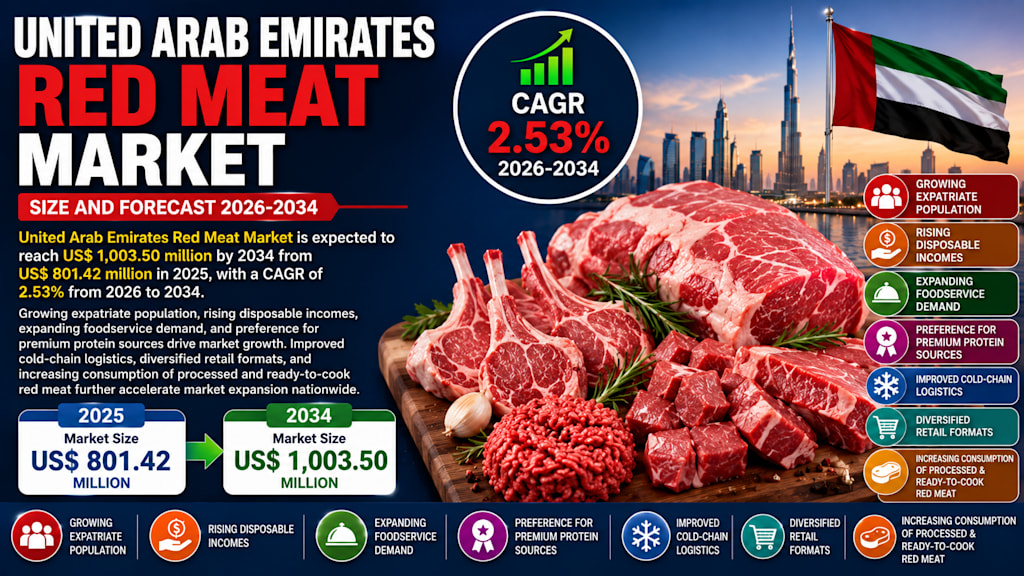
The United Arab Emirates red meat market is witnessing stable growth as rising incomes, strong tourism activity, and expanding foodservice demand continue increasing consumption across the country. According to Renub Research, the UAE red meat market is projected to grow from US$ 801.42 million in 2025 to US$ 1,003.50 million by 2034, registering a CAGR of 2.53% from 2026 to 2034. Growing expatriate populations, increasing disposable incomes, diversified retail formats, and stronger demand for processed and ready-to-cook meat products are major factors supporting market expansion nationwide.
Red meat remains an important part of the UAE’s culinary culture and foodservice industry. Beef, lamb, goat, veal, and processed meat products are widely consumed across households, restaurants, luxury hotels, catering operations, and modern retail channels. The country’s multicultural population has also created strong demand for a wide range of international meat styles, cuts, and preparation methods.
As urbanization continues and consumer lifestyles become increasingly convenience-oriented, the market is evolving rapidly. Retailers and suppliers are investing heavily in cold-chain logistics, premium imports, traceable supply systems, and value-added product formats to meet changing consumer expectations.
Foodservice and Hospitality Industries Are Driving Strong Demand
One of the most important growth drivers for the UAE red meat market is the rapid expansion of the hospitality and foodservice sectors.
The UAE welcomes millions of tourists annually while maintaining a large expatriate population, creating substantial demand for premium meat products across hotels, steakhouses, restaurants, and catering services. International cuisines such as Arabic, Turkish, Mediterranean, Brazilian, and Western dining heavily feature beef, lamb, and specialty meat dishes, further boosting overall consumption.
Business tourism, luxury hospitality developments, and rising dining-out culture are also supporting stronger meat demand throughout the Emirates. Gourmet burger chains, barbecue concepts, and upscale fine-dining restaurants continue introducing premium imported cuts from Australia, South America, Europe, and Asia.
This growth is encouraging suppliers to strengthen cold-chain systems, quality-control measures, portioning technologies, and distribution capabilities to ensure consistent supply across foodservice channels.
The increasing popularity of premium culinary experiences is also raising consumer expectations regarding meat quality, freshness, and sourcing transparency.
Modern Retail and E-Commerce Expansion Is Increasing Accessibility
The development of modern retail infrastructure has significantly improved consumer access to red meat products across the UAE.
Hypermarkets, supermarkets, gourmet stores, and specialty butcher shops now offer consumers a wide variety of fresh, frozen, processed, and ready-to-cook meat products. This growing retail diversity is helping strengthen nationwide consumption trends.
E-commerce platforms and mobile grocery delivery applications are also transforming purchasing behavior. Consumers increasingly prefer the convenience of ordering premium meat cuts, marinated products, and frozen ready-to-cook meals online.
Digital platforms emphasize hygiene, temperature-controlled delivery, traceability, and quality assurance, helping build stronger consumer trust in online meat purchases.
Retailers are simultaneously investing in:
- Advanced cold-storage systems
- Improved packaging technologies
- In-store butchery services
- Temperature-controlled logistics
- Freshness monitoring systems
- Product traceability programs
These improvements are helping maintain product quality while expanding the availability of imported and premium meat products across different consumer segments.
High Disposable Income Supports Premium Meat Consumption
The UAE’s affluent consumer base plays a major role in shaping red meat consumption patterns.
High disposable incomes enable strong demand for premium imported meats such as wagyu beef, angus beef, organic lamb, and halal-certified specialty cuts. These premium products are particularly popular among expatriates, luxury dining establishments, and high-income households.
The country’s multicultural demographics also contribute to diverse consumption preferences. Consumers from the Middle East, South Asia, Europe, and Latin America each bring distinct culinary traditions that support demand for various cuts, cooking styles, and processing formats.
Festive occasions, social gatherings, and family celebrations further strengthen demand for lamb, goat, and beef products throughout the year.
At the same time, health-conscious consumers are increasingly seeking leaner meats, hormone-free products, and traceable supply chains. In response, suppliers are expanding offerings of grass-fed, organic, and responsibly sourced meat products.
This broad range of preferences is helping drive both volume growth and premiumization within the UAE red meat market.
Processed and Ready-to-Cook Products Are Gaining Popularity
Changing lifestyles and urban work patterns are increasing demand for convenient meat products across the UAE.
Consumers increasingly prefer processed and ready-to-cook formats that save preparation time while maintaining quality and taste. Marinated cuts, pre-seasoned cubes, sausages, patties, frozen meals, and portion-controlled packaging are becoming more common across supermarkets and online grocery channels.
This trend is particularly strong among younger professionals, dual-income households, and busy urban families seeking quick meal solutions.
Food manufacturers and retailers are responding by expanding product variety and investing in packaging technologies that improve shelf life and freshness.
The convenience-driven segment is expected to continue growing as consumers increasingly prioritize speed, hygiene, and ease of preparation in everyday meal planning.
Heavy Dependence on Imports Remains a Major Challenge
Despite strong market growth, the UAE remains heavily dependent on imported red meat because of limited domestic livestock production.
The report notes that this dependence exposes the market to global supply-chain disruptions, shipping delays, geopolitical risks, and international price fluctuations.
Imported meat products must also comply with strict halal, quality, and hygiene standards, adding complexity to sourcing operations.
Cold-chain disruptions during long-distance transportation can affect freshness, shelf life, and consumer confidence, especially for premium chilled products.
Global challenges such as droughts, livestock disease outbreaks, and regulatory changes in exporting countries may also impact supply stability and pricing.
As a result, suppliers increasingly focus on diversified sourcing strategies, stronger logistics management, and supply-chain resilience to reduce operational risk.
Rising Operational Costs Are Creating Industry Pressure
The UAE red meat market also faces significant operational cost pressures.
Temperature-controlled storage, refrigerated transportation, cold-chain monitoring, and last-mile delivery systems all contribute to high logistics expenses. Rising feed costs, inflation, labor expenses, packaging requirements, and currency fluctuations further increase import prices.
Retailers and foodservice operators must carefully balance affordability with premium product quality, which becomes increasingly difficult in a cost-intensive environment.
Advanced packaging solutions and compliance requirements also add financial pressure across the supply chain.
These rising operational costs may affect both consumer affordability and supplier profitability in the coming years, making efficiency improvements increasingly important.
Dubai and Abu Dhabi Continue Leading Market Expansion
Dubai and Abu Dhabi remain the UAE’s most influential red meat markets because of their strong tourism industries, affluent populations, and advanced retail ecosystems.
Luxury hotels, premium restaurants, and international dining chains generate substantial demand for imported beef, lamb, and specialty meat products. Gourmet retail stores and high-end supermarkets also cater to consumers seeking premium halal-certified and organic meats.
E-commerce growth is especially strong in these cities, where online grocery platforms provide rapid delivery of chilled and frozen meat products.
Corporate activity, expatriate communities, and urban lifestyle trends continue supporting strong consumption across both household and foodservice sectors.
As tourism and urbanization continue expanding, Dubai and Abu Dhabi are expected to remain central drivers of market growth.
Regional Markets Across the UAE Are Expanding Steadily
Other regions across the UAE are also contributing significantly to market expansion.
The Northeast region benefits from strong retail infrastructure, residential development, and rising foodservice activity. High-income households and expatriate communities support demand for premium beef and lamb products.
The Midwest region is experiencing growth through expanding residential zones, commercial development, and rising middle-class consumption. Consumers increasingly seek both affordable and premium meat options across supermarkets and specialty butcher shops.
In South UAE, cultural preferences for lamb and goat meat remain strong, especially during social gatherings and traditional celebrations. Retail penetration and cold-chain development are improving product accessibility throughout the region.
Meanwhile, West UAE benefits from tourism growth, coastal developments, and luxury hospitality activity. Demand for premium imported meats remains especially strong among fine-dining restaurants and upscale consumers.
Together, these regional trends are helping strengthen nationwide red meat consumption patterns.
Recent Developments Are Strengthening the Market Outlook
Several major developments are reshaping the UAE red meat market and improving supply-chain efficiency.
In September 2025, Al Ain Farms Group and Food Tech Valley announced plans for a 260,000-square-foot logistics hub in Dubai during the Future Food Forum 2025 organized by the Ministry of Economy and Tourism. The project aims to improve food delivery efficiency while supporting the UAE’s Net Zero 2050 sustainability goals.
In October 2024, Union Coop formed a strategic partnership with Al Islami Foods focused on improving customer experience and strengthening value-driven retail offerings through a three-month initiative backed by AED 1 million in investment.
In July 2024, Ghitha Holding, a subsidiary of IHC Food Holding LLC, completed the acquisition of Arabian Farms Investments LLC for AED 240 million. The acquisition strengthens the company’s position within the regional livestock and food production landscape across both the UAE and Saudi Arabia.
These developments highlight how logistics investment, retail partnerships, and corporate acquisitions are supporting long-term market modernization.
Key Companies Operating in the UAE Red Meat Market
Major companies operating in the UAE red meat market include BRF, Siniora Food Industries, Tanmiah Food Company, The Savola Group, Albatha Group, and JBS.
These companies compete through import capabilities, halal certification standards, product diversification, cold-chain infrastructure, and premium meat sourcing strategies.
Final Thoughts
The UAE red meat market is steadily expanding as rising tourism, premium dining culture, growing retail accessibility, and strong consumer purchasing power continue driving demand.
Consumers increasingly seek high-quality, convenient, and premium meat products that align with modern lifestyles and diverse culinary preferences. At the same time, foodservice growth, e-commerce expansion, and stronger cold-chain systems are improving market accessibility and operational efficiency.
According to Renub Research, the UAE red meat market is expected to reach US$ 1,003.50 million by 2034, reflecting stable long-term growth despite ongoing operational and import-related challenges.
About the Creator
Enjoyed the story? Support the Creator.
Subscribe for free to receive all their stories in your feed.
Comments
There are no comments for this story
Be the first to respond and start the conversation.