
U.S. Two Wheeler Market Size Growth Share Trends Demand & Forecast 2034
The U.S. Two Wheeler Market Size reached USD 34.9 Billion in 2025 and is projected to grow to USD 41.0 Billion by 2034

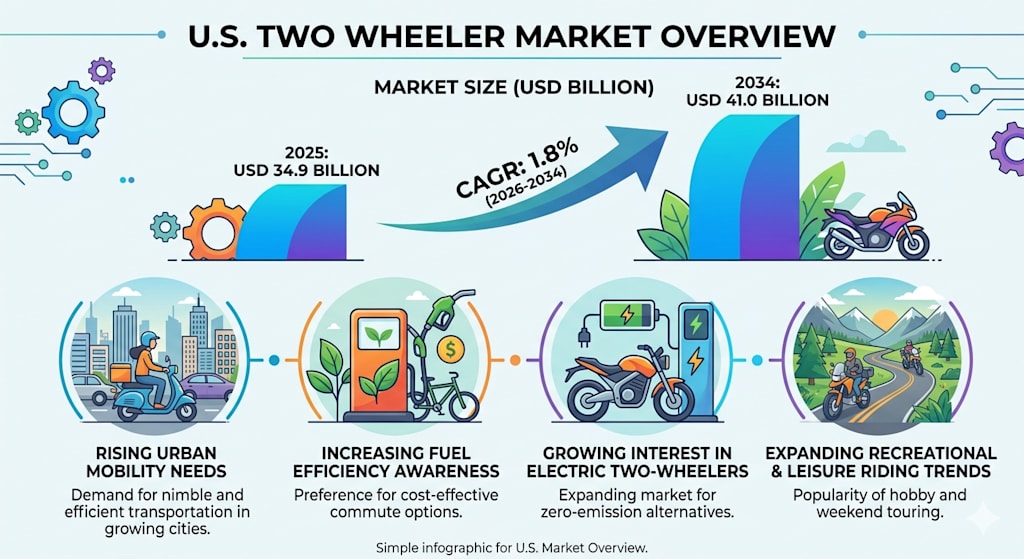
U.S. Two Wheeler Market Size, Share, and Growth Forecast (2026–2034)
The U.S. Two Wheeler Market Size reached USD 34.9 Billion in 2025 and is projected to grow to USD 41.0 Billion by 2034, expanding at a CAGR of 1.8% during 2026–2034. While the growth rate remains moderate compared to emerging markets, the industry continues to demonstrate resilience, supported by evolving mobility patterns and a shift toward cost-efficient transportation solutions.
From a B2B perspective, the U.S. Two Wheeler Market is increasingly influenced by fleet operators, delivery service providers, and shared mobility platforms. Businesses are actively integrating two-wheelers into last-mile logistics networks, especially in urban areas where congestion and operational costs remain key concerns. Additionally, OEMs and suppliers are focusing on product diversification, offering both internal combustion engine (ICE) and electric models to cater to a wider range of commercial and recreational applications.
Request a Sample Report with Latest 2026 Data & Forecasts:
Key Trends Shaping the U.S. Two Wheeler Market
One of the most prominent trends in the U.S. Two Wheeler Market is the gradual transition toward electric mobility. Although adoption is still in its early stages compared to other regions, increasing investments in EV infrastructure and supportive policy frameworks are encouraging both manufacturers and fleet operators to explore electric two-wheelers. Businesses are particularly interested in electric models due to their lower operating and maintenance costs over time.
Another notable trend is the integration of advanced technologies, including connected vehicle systems, GPS tracking, and telematics. These features are becoming essential for B2B users such as delivery companies and rental operators, enabling real-time fleet monitoring, route optimization, and predictive maintenance. As a result, technology providers and software companies are emerging as key stakeholders within the broader ecosystem.
Major Growth Drivers in the U.S. Two Wheeler Market
Urban mobility challenges remain a primary driver for the U.S. Two Wheeler Market Growth. Traffic congestion, limited parking availability, and rising fuel costs are pushing consumers and businesses to consider two-wheelers as a practical alternative to traditional vehicles. For commercial users, especially in food delivery and courier services, two-wheelers offer faster turnaround times and improved operational efficiency.
The expanding gig economy is another significant growth catalyst. With more individuals participating in delivery and ride-sharing platforms, the demand for affordable and fuel-efficient two-wheelers is increasing. This creates opportunities for leasing companies, financing institutions, and OEMs to develop flexible ownership models tailored to gig workers.
Environmental awareness is also playing a crucial role. As sustainability becomes a priority for both consumers and corporations, there is a growing shift toward low-emission transportation options. Electric two-wheelers, in particular, are gaining attention as businesses seek to reduce their carbon footprint and align with ESG goals.
Challenges Impacting the U.S. Two Wheeler Market Growth
Despite steady demand, the U.S. Two Wheeler Market faces several structural challenges. One of the key issues is the relatively low adoption of two-wheelers for daily commuting compared to other regions. Cultural preferences and safety concerns continue to limit widespread acceptance, particularly among older demographics.
Regulatory complexities also pose challenges for market participants. Variations in state-level laws related to licensing, safety standards, and emissions can create operational hurdles for manufacturers and fleet operators. Compliance with these regulations often increases costs and slows down product launches.
Another critical challenge is the limited charging infrastructure for electric two-wheelers. While progress is being made, the current network is not yet sufficient to support large-scale adoption, particularly for commercial fleets that require reliable and widespread charging access.
Supply chain disruptions and fluctuating raw material costs further impact the industry. Manufacturers are facing pressure to maintain competitive pricing while managing rising input costs, which can affect profit margins and investment decisions.
Forecast and Strategic Opportunities in the U.S. Two Wheeler Industry
Looking ahead, the U.S. Two Wheeler Market Forecast indicates steady, opportunity-driven growth, particularly in niche and high-value segments. Electric two-wheelers are expected to play a more prominent role as infrastructure improves and battery technologies advance. Businesses that invest early in EV ecosystems, including charging solutions and battery management systems, are likely to gain a competitive edge.
The expansion of last-mile delivery services presents a significant opportunity for B2B stakeholders. As e-commerce continues to grow, the need for efficient and scalable delivery solutions will drive demand for two-wheelers, especially in densely populated urban areas. Partnerships between OEMs, logistics companies, and technology providers will be critical in capturing this opportunity.
Another area of potential lies in aftermarket services and maintenance. With an increasing number of two-wheelers in operation, the demand for spare parts, servicing, and performance upgrades is expected to rise. Companies that offer integrated service networks and digital maintenance solutions can strengthen customer retention and generate recurring revenue streams.
Strategically, market players should focus on product innovation, cost optimization, and customer-centric business models. Customization, flexible financing, and digital integration will be key differentiators in a competitive landscape. Additionally, aligning with sustainability goals and regulatory requirements will be essential for long-term success.
About the Creator
Kim Soo hyun
My name is Kim Soo hyun, and I am a research analyst at IMARC Group, specializing in market trends and data analysis to provide insights and support strategic decision-making.
Enjoyed the story? Support the Creator.
Subscribe for free to receive all their stories in your feed.
Comments
There are no comments for this story
Be the first to respond and start the conversation.