
U.S. Steel Tubes Market Size Growth Share Trends Demand & Forecast 2034
The U.S. steel tubes market reached USD 666.39 million in 2025 and is projected to grow to USD 748.54 million by 2034, registering a CAGR of 1.30% during 2026–2034.

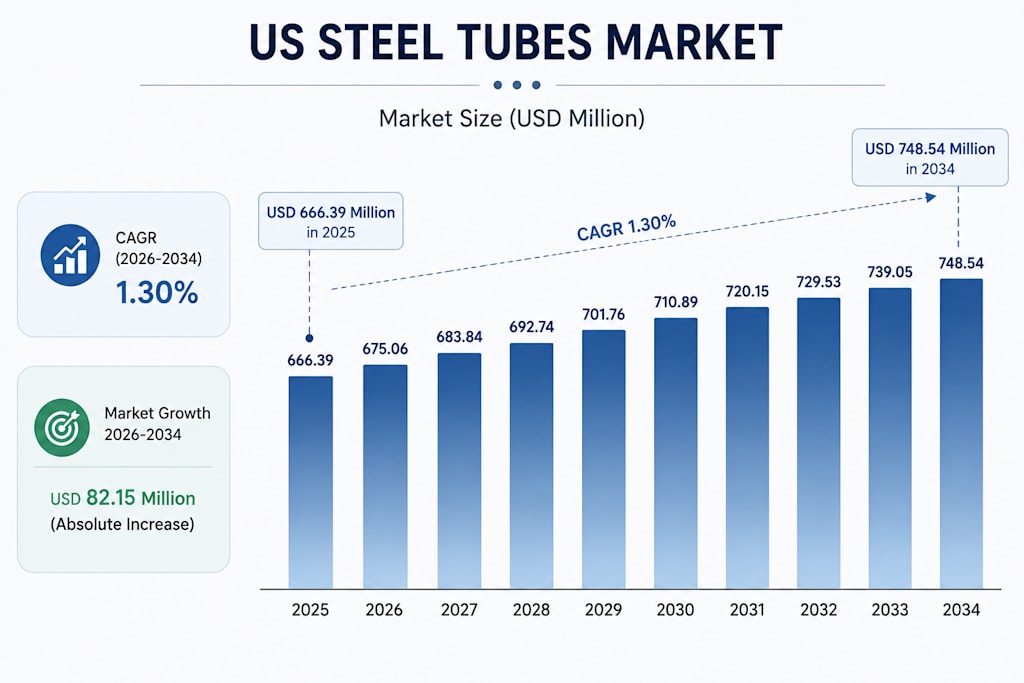
U.S. Steel Tubes Market Size, Share, and Forecast (2026–2034)
The U.S. steel tubes market continues to play an important role across construction, automotive, energy, infrastructure, and industrial manufacturing sectors. The market reached USD 666.39 million in 2025 and is projected to grow to USD 748.54 million by 2034, registering a CAGR of 1.30% during 2026–2034.
Although the market is growing at a moderate pace, demand remains stable due to the wide application range of steel tubes in structural and mechanical operations. Industrial modernization, infrastructure upgrades, and ongoing investment in energy and transportation projects continue to support long-term demand.
Request a Sample Report with Latest 2026 Data & Forecasts:
Key Trends Shaping the U.S. Steel Tubes Market
Several industry trends are influencing the direction of the U.S. steel tubes market. One of the major trends is the growing demand for high-strength and lightweight steel tubing solutions across automotive and industrial applications. Manufacturers are focusing on materials that improve performance while reducing overall structural weight.
Another important trend is the increasing use of advanced manufacturing technologies. Automation, precision welding, and improved finishing processes are helping companies enhance production efficiency and maintain product consistency.
Sustainability is also becoming more relevant within the industry. Steel tube manufacturers are investing in energy-efficient production methods and recycling practices to improve environmental performance and meet evolving regulatory expectations.
Additionally, infrastructure development projects across the United States are supporting demand for steel tubes used in bridges, pipelines, water systems, and commercial construction activities.
Growth Drivers in the U.S. Steel Tubes Industry
The construction sector remains one of the primary growth drivers for the steel tubes market. Demand for residential, commercial, and industrial infrastructure continues to create steady consumption of structural steel tubing products.
The energy industry also contributes significantly to market demand. Steel tubes are widely used in oil and gas transportation, renewable energy systems, and industrial processing facilities. Expanding investments in pipeline modernization and energy infrastructure are supporting product demand.
In the automotive sector, manufacturers are increasingly using steel tubes in chassis systems, exhaust structures, and safety components. The focus on vehicle durability and performance continues to support adoption across multiple vehicle categories.
Industrial manufacturing activities are another key factor supporting market growth. Machinery, heavy equipment, and factory systems require durable tubing solutions capable of handling demanding operational conditions.
Challenges in the U.S. Steel Tubes Industry: Trade Policies, Competition, and Cost Pressures
Despite stable demand, the U.S. steel tubes industry faces several operational and market-related challenges. Trade policies and tariff-related uncertainties can affect raw material availability and pricing structures, creating difficulties for manufacturers and buyers.
Cost pressure remains another important challenge. Fluctuations in steel prices, energy costs, and transportation expenses directly impact production margins. Manufacturers must balance cost management with maintaining product quality and operational efficiency.
The industry also faces intense competition from both domestic and international suppliers. Companies are under pressure to improve delivery timelines, strengthen customer relationships, and maintain competitive pricing.
Supply chain disruptions can further affect market performance, particularly for industries that rely on timely procurement and consistent inventory management. As a result, many businesses are investing in supply chain resilience and localized sourcing strategies.
Investment Opportunities in the U.S. Steel Tubes Market
The U.S. steel tubes market presents several opportunities for investors, manufacturers, and industrial suppliers. Infrastructure modernization projects are expected to create long-term demand for steel tubing products used in transportation, utilities, and public construction projects.
Investments in advanced manufacturing capabilities are also creating opportunities for companies seeking higher operational efficiency and product precision. Automation and digital production systems are helping manufacturers improve productivity and reduce waste.
The renewable energy sector represents another growth area. Steel tubes are increasingly used in solar structures, wind energy installations, and energy transmission systems, creating opportunities for specialized product suppliers.
In addition, companies focusing on high-performance and customized steel tubing solutions are likely to benefit from growing demand across automotive, aerospace, and industrial engineering applications.
Businesses that prioritize product quality, efficient operations, and long-term customer partnerships are expected to maintain a stronger competitive position in the evolving market environment.
Competitive Landscape and Key Players in the U.S. Steel Tubes Industry
The competitive landscape of the U.S. steel tubes industry includes a mix of large integrated steel producers, specialized tube manufacturers, and regional suppliers. Competition is primarily based on product quality, pricing, production capacity, and distribution capabilities.
Leading companies are focusing on expanding manufacturing efficiency and strengthening supply chain networks to improve customer service and delivery performance. Product diversification is also becoming an important strategy, particularly for companies serving multiple end-use industries.
Technological advancement remains a key competitive factor. Manufacturers investing in automated production systems and precision engineering capabilities are improving operational performance and product consistency.
As demand patterns continue to evolve across infrastructure, automotive, and industrial sectors, companies with strong technical expertise and flexible manufacturing capabilities are expected to remain competitive in the U.S. steel tubes market.
About the Creator
Kim Soo hyun
My name is Kim Soo hyun, and I am a research analyst at IMARC Group, specializing in market trends and data analysis to provide insights and support strategic decision-making.
Enjoyed the story? Support the Creator.
Subscribe for free to receive all their stories in your feed.
Comments
There are no comments for this story
Be the first to respond and start the conversation.