
U.S. Network Security Market Size Growth & Industry Demands Report 2034
U.S. Network Security Market Size Trends, Growth Demand & Forecast 2026-2034

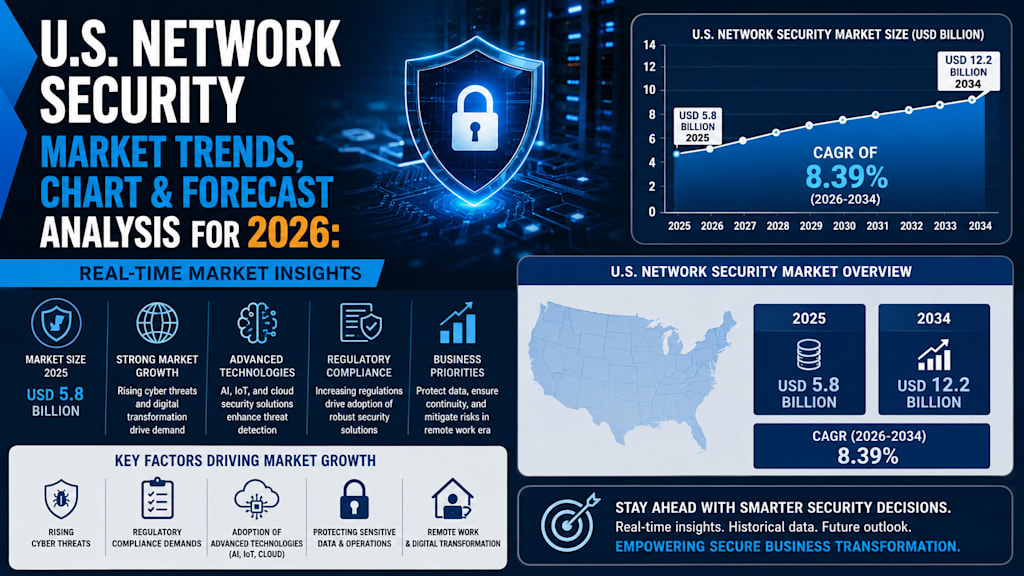
United States Network Security Market Overview and Growth Prospects
Organizations across the United States are investing heavily in network security as cyber threats become more sophisticated and digital infrastructure grows increasingly complex. Businesses are operating in environments that include cloud platforms, remote workforces, connected devices, and data-intensive applications, all of which require stronger security frameworks. According to industry estimates, the U.S. network security market was valued at USD 5.8 billion in 2025 and is projected to reach USD 12.2 billion by 2034, reflecting steady growth over the coming years.
The increasing frequency of ransomware attacks, data breaches, and phishing campaigns has encouraged organizations to strengthen their cybersecurity strategies. At the same time, regulatory requirements and growing concerns about data privacy continue to influence investment decisions across industries.
Why Cybersecurity Has Become a Boardroom Priority for U.S. Enterprises
Cybersecurity is no longer viewed solely as an IT responsibility. Today, executive leadership teams and boards of directors recognize cyber risk as a business risk. A major security incident can result in financial losses, operational disruptions, reputational damage, and regulatory penalties.
As organizations continue their digital transformation initiatives, cybersecurity has become closely linked to business continuity and customer trust. Many enterprises now incorporate security considerations into strategic planning, technology investments, and risk management programs. This shift has elevated network security from a technical necessity to a key business priority.
Enterprise Network Security Spending Trends and Investment Drivers
Security spending across enterprises continues to increase as organizations seek to protect expanding digital environments. Investments are being directed toward next-generation firewalls, endpoint protection platforms, network monitoring tools, threat detection systems, and cloud security solutions.
Several factors are supporting spending growth. These include the increasing use of cloud-based applications, rising cybercrime activity, stricter compliance requirements, and the growing volume of sensitive business data being transmitted across networks. Organizations are also allocating resources to improve incident response capabilities and strengthen employee cybersecurity awareness.
Businesses are increasingly seeking solutions that offer visibility across distributed environments while simplifying security management and reducing operational complexity.
The Role of Zero Trust Security in Modern Business Networks
The traditional approach of trusting users and devices within a corporate network is becoming less effective in today's distributed work environment. As a result, many organizations are adopting Zero Trust security models.
Zero Trust operates on the principle of continuously verifying users, devices, and applications before granting access to resources. Rather than assuming trust based on network location, access decisions are based on identity, device health, authentication status, and other contextual factors.
This approach helps reduce the risk of unauthorized access and limits the movement of threats within networks. As remote work, hybrid work models, and cloud adoption continue to expand, Zero Trust strategies are becoming an important component of enterprise cybersecurity programs.
How AI-Powered Security Solutions Are Enhancing Threat Intelligence
Artificial intelligence is playing an increasingly important role in cybersecurity operations. Security teams face growing volumes of alerts and network activity data, making it difficult to identify potential threats quickly through manual analysis alone.
AI-powered security tools can analyze large datasets, detect unusual behavior patterns, and identify indicators of compromise more efficiently. These capabilities help organizations improve threat detection, accelerate response times, and reduce the workload on security personnel.
Machine learning models are also being used to enhance threat intelligence by identifying emerging attack techniques and supporting proactive risk management efforts. As cyber threats continue to evolve, AI-driven security technologies are expected to become more widely adopted across enterprise environments.
Cloud Security and Secure Access Service Edge (SASE) Adoption Trends
The rapid migration of workloads and applications to the cloud has changed how organizations approach network security. Traditional perimeter-based security models are often insufficient for cloud-first environments where users access resources from multiple locations and devices.
To address these challenges, businesses are adopting cloud security solutions and Secure Access Service Edge (SASE) architectures. SASE combines networking and security functions into a unified cloud-delivered framework, enabling organizations to provide secure access regardless of user location.
The adoption of SASE is helping enterprises improve network visibility, simplify security management, and support remote and hybrid workforces while maintaining strong security controls.
Industry-Specific Network Security Requirements Across Key Sectors
Network security requirements vary significantly across industries due to differences in operational environments, regulatory obligations, and risk profiles.
Healthcare organizations focus on protecting patient information and ensuring compliance with healthcare regulations. Financial institutions prioritize fraud prevention, secure transactions, and customer data protection. Manufacturing companies are increasingly securing operational technology systems and connected industrial devices.
Government agencies, educational institutions, and retail businesses also face unique security challenges that require specialized approaches. As a result, many cybersecurity vendors are developing industry-specific solutions tailored to particular operational and compliance requirements.
Opportunities for Cybersecurity Vendors, MSSPs, and Cloud Security Providers
The evolving threat landscape is creating significant opportunities for technology providers operating in the network security ecosystem. Organizations often face cybersecurity skill shortages and resource constraints, making external expertise increasingly valuable.
Managed Security Service Providers (MSSPs) are helping businesses monitor networks, manage security operations, and respond to incidents without maintaining large in-house teams. Cloud security providers are supporting organizations as they transition to cloud-based environments and adopt hybrid infrastructure models.
Demand is also growing for consulting services, security assessments, compliance support, and threat intelligence solutions. Providers that offer scalable and integrated security capabilities are well positioned to benefit from long-term market expansion.
Key Challenges Facing Organizations in Securing Digital Infrastructure
Despite increasing investment, organizations continue to face several cybersecurity challenges. The threat landscape is evolving rapidly, with attackers using more sophisticated techniques to target networks and sensitive data.
Many enterprises also struggle with security complexity due to fragmented technology environments and multiple security tools. Talent shortages remain a concern, limiting the availability of qualified cybersecurity professionals.
Additionally, balancing security requirements with user experience and operational efficiency can be difficult. Organizations must continuously adapt their security strategies to address emerging risks while supporting business objectives.
Competitive Landscape and Strategic Developments
The network security industry remains highly competitive, with technology providers focusing on innovation, product integration, and strategic partnerships. Vendors are expanding their portfolios to address cloud security, identity management, threat intelligence, and AI-driven security analytics.
Mergers, acquisitions, and collaborations continue to shape the competitive landscape as companies seek to enhance capabilities and broaden market reach. Many providers are also investing in platform-based approaches that consolidate multiple security functions into unified solutions.
Future Outlook for the United States Network Security Market
The future of the U.S. network security market remains closely tied to ongoing digital transformation initiatives and the increasing importance of cyber resilience. As organizations adopt cloud technologies, connected devices, artificial intelligence, and advanced analytics, the need for comprehensive security solutions will continue to grow.
Businesses are expected to focus on proactive threat prevention, stronger identity management, and integrated security architectures that support evolving operational requirements. With cyber risks remaining a major concern across industries, network security will continue to play a critical role in protecting digital assets, maintaining customer trust, and supporting long-term business growth.
About the Creator
Kim Soo hyun
My name is Kim Soo hyun, and I am a research analyst at IMARC Group, specializing in market trends and data analysis to provide insights and support strategic decision-making.
Enjoyed the story? Support the Creator.
Subscribe for free to receive all their stories in your feed.
Comments
There are no comments for this story
Be the first to respond and start the conversation.