
U.S. Laser Marking Market Size Growth Share Industry Demand & Forecast 2034
U.S. Laser Marking Market Size Growth Share Trends & Forecast 2034

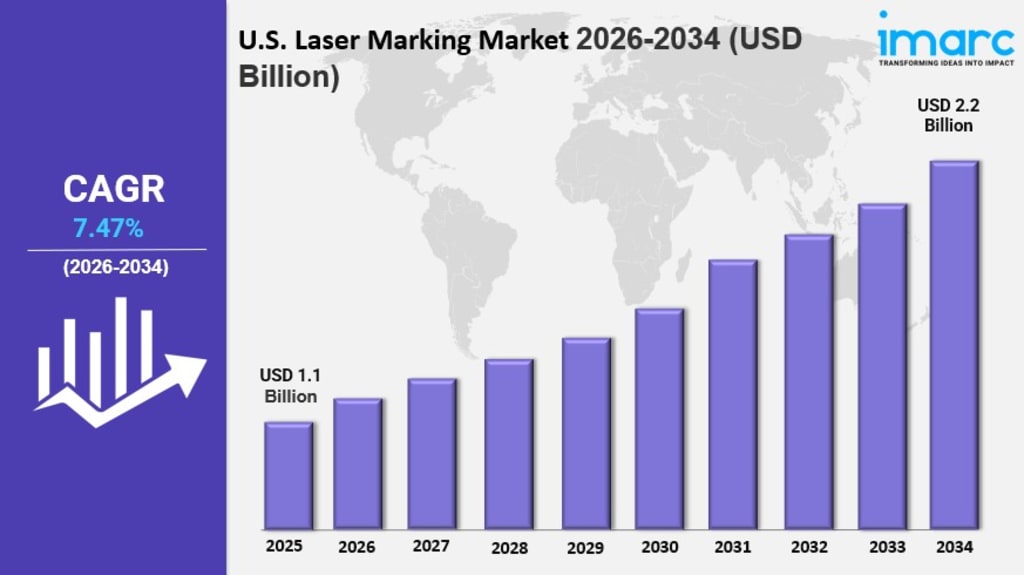
U.S. Laser Marking Market Size, Share, and Forecast (2026–2034)
Laser marking has become an important part of modern manufacturing in the United States. Industries are increasingly using laser-based systems to improve precision, product identification, and production efficiency. From automotive parts to medical devices, manufacturers rely on permanent marking solutions that can withstand heat, friction, and long-term usage.
The U.S. laser marking market reached USD 1.1 billion in 2025 and is expected to reach USD 2.2 billion by 2034, growing at a CAGR of 7.47% during 2026–2034. Adoption is increasing as factories continue shifting toward automated production and digital manufacturing systems.
Request the Latest Market Report with 2026–2034 Forecast Insights
Key Trends Shaping the U.S. Laser Marking Market
One noticeable trend in the industry is the growing use of laser marking within automated production environments. Manufacturing companies are connecting laser systems with robotics and smart factory equipment to reduce manual work and improve production speed.
Demand for traceability is also increasing. Automotive, aerospace, and electronics companies now require detailed tracking for individual parts and components. Permanent markings such as QR codes, serial numbers, and product identifiers help manufacturers improve inventory management and quality control.
The electronics industry is creating additional demand as devices continue becoming smaller and more compact. Tiny components require highly accurate marking methods that do not damage delicate surfaces. Laser technology is helping manufacturers maintain precision even in limited spaces.
Sustainability is another factor influencing adoption. Traditional marking methods often require inks, solvents, and replacement materials. Laser systems reduce waste and support cleaner production processes, which aligns with the environmental goals of many manufacturers.
Growth Drivers in the U.S. Laser Marking Industry
Automation remains one of the strongest drivers behind the expansion of laser marking technologies in the United States. Manufacturers are investing in systems that improve production consistency and reduce operational errors.
The automotive sector continues to be a major user of laser marking equipment. Vehicle manufacturers need permanent markings for engine components, safety systems, wiring parts, and tracking applications throughout the production process.
Healthcare and medical device manufacturing are also supporting industry demand. Surgical instruments, implants, and medical tools require clear and durable markings that meet strict regulatory requirements. Laser systems help companies maintain accuracy and compliance.
Growth in electronics and semiconductor manufacturing is creating additional opportunities for equipment suppliers. Precision marking has become essential for identifying microchips, connectors, and other advanced electronic components.
Government support for advanced manufacturing and industrial modernization is further encouraging adoption across different sectors.
Technology Advancements in the U.S. Laser Marking Market: Fiber Lasers, Automation, and Smart Manufacturing
Technology improvements are changing how laser marking systems operate in industrial environments. Fiber laser technology is becoming more widely used because it offers higher speed, better energy efficiency, and lower maintenance requirements compared to older systems.
Manufacturers are also integrating laser equipment with automated production software and robotic systems. This helps factories improve workflow efficiency and maintain consistent production quality.
Smart manufacturing technologies are influencing the industry as well. Companies are increasingly using connected systems that allow real-time monitoring, production tracking, and process optimization.
Portable and compact laser marking machines are becoming more common in industrial settings. These systems provide flexibility for manufacturers that need mobile or space-efficient equipment.
Software development is another important area of progress. Improved software allows manufacturers to customize marking designs, automate workflows, and increase overall precision during production.
Challenges in the U.S. Laser Marking Industry: High Initial Costs and Integration Complexities
Although the industry continues to grow, businesses still face several challenges when adopting laser marking systems. One of the biggest concerns is the high upfront investment required for advanced equipment. Smaller manufacturers may delay adoption because of budget limitations.
System integration can also be complicated, especially in older manufacturing facilities. Companies often need technical upgrades and additional software support to connect laser systems with existing production lines.
Training employees to operate advanced equipment is another important consideration. Skilled operators and maintenance teams are necessary to ensure efficient system performance and reduce downtime.
Rapid technological changes can create pressure for businesses to regularly upgrade equipment. Manufacturers must balance the benefits of advanced technology with operational and financial costs.
Supply chain issues and rising industrial equipment costs may also affect purchasing decisions in certain sectors.
Investment Opportunities in the U.S. Laser Marking Market
The U.S. laser marking industry continues to attract investment because of its growing role in industrial automation and precision manufacturing. Demand is increasing across automotive, healthcare, aerospace, packaging, and electronics industries.
Fiber laser systems remain one of the most attractive investment segments due to their efficiency and broad industrial applications. Companies developing advanced and energy-efficient solutions are likely to benefit from increasing adoption.
Smart factory development is opening new business opportunities for equipment manufacturers and software providers. Businesses that combine automation, data integration, and precision marking technologies are improving manufacturing efficiency for industrial clients.
Medical device manufacturing also offers long-term growth potential. Regulatory requirements for product identification and traceability are encouraging healthcare manufacturers to invest in reliable marking technologies.
Companies focusing on customization, automation compatibility, and production efficiency are expected to strengthen their position as industrial modernization continues across the United States.
Competitive Landscape and Key Players in the U.S. Laser Marking Industry
Competition in the U.S. laser marking industry is driven by technology innovation, equipment reliability, and automation capabilities. Manufacturers are investing in advanced systems designed to improve precision, speed, and production flexibility.
• TRUMPF – Develops industrial laser systems widely used in manufacturing and metal processing applications.
• Coherent Corp. – Provides laser solutions for industrial, electronics, and medical manufacturing sectors.
• KEYENCE – Supplies laser marking equipment integrated with factory automation technologies.
• Gravotech – Focuses on permanent marking and industrial traceability systems.
• LaserStar Technologies – Offers laser marking and welding solutions for industrial and healthcare applications.
• Telesis Technologies – Specializes in permanent part marking systems for manufacturing industries.
• Han's Laser Technology Industry Group – Provides laser marking and industrial automation solutions for large-scale production environments.
About the Creator
Kim Soo hyun
My name is Kim Soo hyun, and I am a research analyst at IMARC Group, specializing in market trends and data analysis to provide insights and support strategic decision-making.
Enjoyed the story? Support the Creator.
Subscribe for free to receive all their stories in your feed.
Comments
There are no comments for this story
Be the first to respond and start the conversation.