
U.S. Insect Protein Market Size Growth Share Industry Demand & Forecast 2034
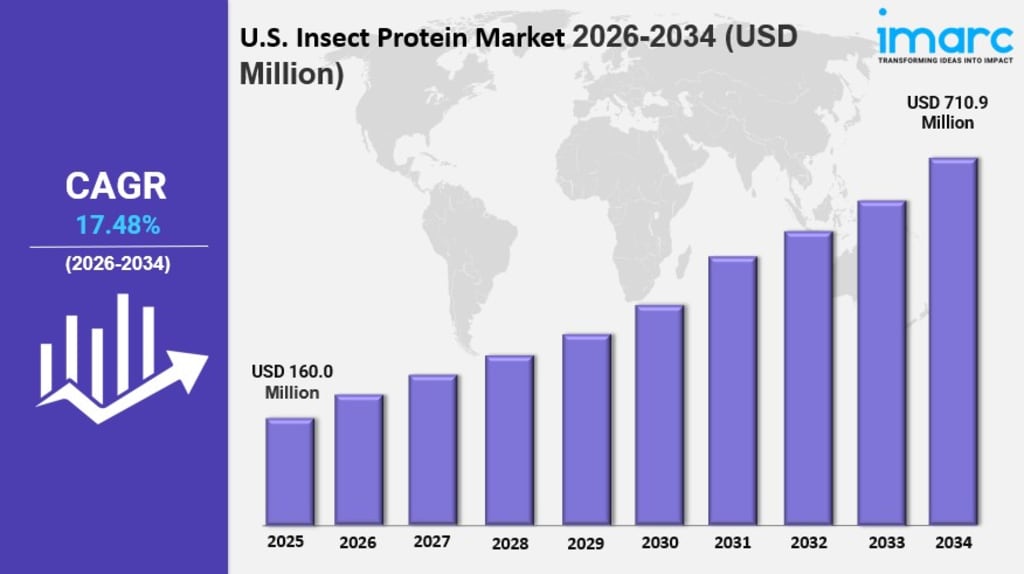
The U.S. insect protein market was valued at USD 160.0 million in 2025 and is projected to reach USD 710.9 million by 2034, growing at a CAGR of 17.48%

U.S. Insect Protein Market Size, Share, and Forecast (2026–2034)
The U.S. insect protein market is gaining attention as industries search for sustainable and efficient protein alternatives. The market was valued at USD 160.0 million in 2025 and is projected to reach USD 710.9 million by 2034, growing at a CAGR of 17.48% during 2026–2034.
Market growth is being supported by increasing demand for sustainable protein sources, rising pressure on traditional livestock production, and expanding applications in animal feed and pet nutrition. Insect protein is being explored as a practical solution due to its lower environmental impact, efficient feed conversion rates, and reduced land and water requirements.
The market is also benefiting from technological improvements in insect farming systems and growing investment activity from private companies and food technology firms. As awareness regarding sustainable food systems continues to increase, the U.S. insect protein industry is expected to witness broader commercial adoption across multiple sectors.
Key Trends Shaping the U.S. Insect Protein Market
• Increasing use in pet food and animal feed: Manufacturers are adopting insect protein as a sustainable and nutritious alternative protein source.
• Growing focus on circular economy practices: Insect farming helps utilize food waste and agricultural byproducts for protein production.
• Rising demand for sustainable feed ingredients: Companies are seeking environmentally responsible solutions for animal nutrition.
• Expansion of product innovation: Businesses are introducing insect protein powders, oils, and processed ingredients for multiple applications.
• Improving commercial use across industries: Insect-based ingredients are gaining adoption in feed, pet food, and food processing sectors.
• Increasing investment in automated farming systems: Producers are investing in advanced insect farming technologies to improve efficiency.
• Adoption of advanced production technologies: Climate control systems, robotics, and digital monitoring tools are supporting scalability and operational performance.
Growth Drivers in the U.S. Insect Protein Industry
One of the primary growth drivers in the U.S. insect protein market is the increasing demand for sustainable protein alternatives. Traditional livestock production requires significant land, water, and feed resources, encouraging industries to explore more efficient protein solutions.
The pet food industry is contributing strongly to market growth. Consumers are increasingly seeking sustainable and high-protein pet nutrition products, which is encouraging manufacturers to include insect-based ingredients in formulations.
Rising investment in food technology and alternative protein startups is another important growth factor. Companies are expanding research and production capabilities to improve product quality and commercial scale.
Government support and regulatory progress are also helping the industry develop. As regulatory frameworks become clearer, businesses are gaining more confidence in expanding operations and entering new application areas.
In addition, growing interest in environmentally responsible production methods is encouraging companies to invest in insect farming technologies that support lower carbon emissions and reduced waste generation.
Rising Demand for Sustainable and Alternative Protein Sources in the United States
Demand for alternative proteins continues to increase across the United States as consumers and businesses focus more on sustainability and resource efficiency. Insect protein is gaining recognition because it provides high nutritional value while requiring fewer natural resources compared to traditional protein sources.
Animal feed manufacturers are increasingly adopting insect protein to improve sustainability in poultry, aquaculture, and livestock production. The ingredient offers amino acids and nutrients that support animal health and feed efficiency.
The pet food sector is also emerging as a major application area. Many premium pet food brands are introducing insect-based products as environmentally responsible alternatives to conventional animal proteins.
In the broader food industry, interest in alternative proteins is supporting research into insect-based ingredients for human consumption. Although adoption remains limited compared to plant-based proteins, the market continues to evolve as awareness increases.
Technology and Production Trends in the U.S. Insect Protein Market
Technology is playing a critical role in improving insect protein production across the United States. Automated farming systems are helping producers manage temperature, humidity, feeding, and harvesting processes more efficiently.
Artificial intelligence and digital monitoring tools are also being integrated into production facilities to improve productivity and quality control. These systems allow companies to optimize breeding conditions and reduce operational inefficiencies.
Processing technology is advancing as well. Manufacturers are investing in drying, grinding, and extraction technologies to improve the consistency and shelf life of insect protein products.
Research and development activities are expanding across the industry. Companies and research institutions are working on improving insect species selection, feed conversion efficiency, and nutritional performance to support commercial scalability.
As production technologies continue to improve, the market is expected to benefit from lower operating costs and higher production capacity.
Challenges in the U.S. Insect Protein Industry: Consumer Awareness, Regulations, and Scalability
Despite strong growth potential, the U.S. insect protein market faces several challenges. Consumer awareness remains one of the biggest barriers, particularly in applications related to human food consumption. Many consumers are still unfamiliar with insect-based products and their nutritional benefits.
Regulatory standards also continue to evolve. Businesses must comply with food safety, labeling, and ingredient approval requirements before entering commercial markets. Regulatory uncertainty in some application areas can slow product development and expansion plans.
Scalability is another challenge for producers. Expanding insect farming operations requires investment in infrastructure, automation, and supply chain management. Smaller companies may face difficulties achieving large-scale production while maintaining profitability.
Supply chain development is also still in progress. The industry requires stronger processing, storage, and distribution networks to support broader commercial adoption.
Additionally, pricing pressures and competition from plant-based protein alternatives may influence market growth in certain segments.
Investment Opportunities in the U.S. Insect Protein Market
The U.S. insect protein market offers investment opportunities across feed, pet food, food technology, and sustainable agriculture sectors. Animal feed remains one of the most promising segments due to increasing demand for sustainable and efficient feed ingredients.
Pet food applications are also creating strong commercial opportunities. Premium pet nutrition brands are investing in insect-based formulations that align with sustainability and protein-focused consumer preferences.
Technology and automation represent another major investment area. Companies developing advanced insect farming systems, climate management solutions, and processing technologies are expected to benefit from industry expansion.
Research partnerships and production facilities are also attracting investor interest. Businesses that can improve scalability, product quality, and operational efficiency are likely to strengthen their market position.
As sustainability continues to influence food and agriculture industries, insect protein companies that focus on innovation and commercial scalability are expected to see long-term growth opportunities.
Competitive Landscape and Key Players in the U.S. Insect Protein Industry
• Ÿnsect – Focuses on insect-based ingredients for animal feed, pet food, and agricultural applications.
• InnovaFeed – Specializes in sustainable insect protein solutions for aquaculture, livestock feed, and plant nutrition.
• EnviroFlight – Develops black soldier fly protein products for animal feed and sustainable agriculture markets.
• Aspire Food Group – Operates automated insect farming facilities focused on food and feed ingredient production.
• Protix – Produces insect-based proteins and lipids for pet food, aquaculture, and livestock sectors.
• Beta Hatch – Focuses on mealworm farming and insect-based feed ingredients using sustainable production methods.
• Entomo Farms – Supplies cricket-based protein ingredients for food and nutrition applications.
About the Creator
Kim Soo hyun
My name is Kim Soo hyun, and I am a research analyst at IMARC Group, specializing in market trends and data analysis to provide insights and support strategic decision-making.
Enjoyed the story? Support the Creator.
Subscribe for free to receive all their stories in your feed.
Comments
There are no comments for this story
Be the first to respond and start the conversation.