
U.S. Eyewear Market Size Trends Share Growth Demand & Forecast 2026-2034
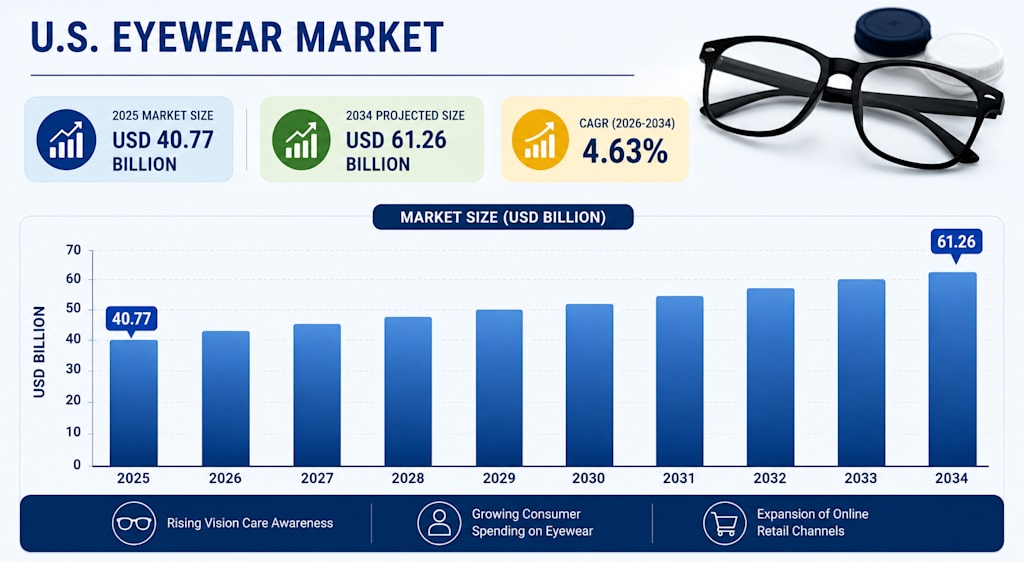
The U.S. eyewear market reached USD 40.77 billion in 2025 and is projected to grow to USD 61.26 billion by 2034, exhibiting a CAGR of 4.63%.

U.S. Eyewear Market Size, Share, and Forecast (2026–2034)
The U.S. eyewear market continues to expand steadily, supported by rising vision care awareness, increasing screen exposure, and growing demand for premium eyewear products. The market reached USD 40.77 billion in 2025 and is projected to grow to USD 61.26 billion by 2034, exhibiting a CAGR of 4.63% during 2026–2034.
Eyewear products are increasingly viewed as both healthcare necessities and fashion accessories. This dual role is creating opportunities for manufacturers, retailers, and technology providers across prescription eyewear, sunglasses, and contact lenses. Growing consumer interest in personalized products, premium materials, and digital purchasing experiences is also reshaping market dynamics.
For businesses operating in the sector, the focus is shifting toward innovation, omnichannel retail strategies, and value-added services that improve customer engagement and retention.
Request the Latest Market Report with 2026–2034 Forecast Insights
Key Trends Shaping the U.S. Eyewear Market 2026
• Growing demand for blue-light lenses: Increasing screen exposure across work, education, and entertainment is driving adoption of blue-light filtering eyewear.
• Fashion-driven consumer preferences: Consumers are choosing eyewear products that combine visual appeal with functionality.
• Trend-focused product launches: Brands are introducing new collections, collaborations, and premium frame designs to attract style-conscious buyers.
• Expansion of online eyewear platforms: Direct-to-consumer and digital retail channels are improving product accessibility and convenience.
• Enhanced digital shopping experience: Virtual try-on technologies are helping consumers compare styles and make informed purchasing decisions online.
• Rising focus on sustainability: Growing consumer interest in eco-friendly frames, recyclable packaging, and ethically sourced materials.
• Shift toward sustainable business practices: Eyewear companies are increasingly adopting environmentally responsible manufacturing and packaging strategies.
Growth Drivers in the United States Eyewear Industry 2026
The increasing prevalence of vision-related conditions remains a major growth driver for the U.S. eyewear market. Extended digital device usage and aging demographics are contributing to rising demand for prescription glasses and contact lenses.
Growing awareness regarding preventive eye care is further supporting market expansion. Consumers are seeking regular eye examinations and investing in products that improve comfort and vision protection.
Rising disposable income is also influencing purchasing behavior, particularly in premium and branded eyewear categories. Consumers are more willing to spend on high-quality lenses, designer frames, and advanced coatings that offer durability and enhanced visual performance.
Additionally, insurance coverage and vision care benefits continue to support product accessibility, encouraging consumers to replace or upgrade eyewear products more frequently.
Technology and Product Innovation in the U.S. Eyewear Industry
Technology is playing an increasingly important role in product development and customer experience across the eyewear market. Smart eyewear products incorporating audio features, augmented reality capabilities, and connectivity functions are gaining attention, particularly among tech-oriented consumers.
Lens technology is also advancing rapidly. Manufacturers are introducing lightweight materials, anti-reflective coatings, transition lenses, and improved blue-light protection solutions to meet evolving consumer preferences.
Digital innovation is transforming retail operations as well. Artificial intelligence-based recommendations, virtual fitting tools, and automated prescription verification systems are improving efficiency and personalization for both consumers and retailers.
Companies are also investing in customization capabilities, allowing consumers to select frame styles, lens options, and fit preferences tailored to individual needs.
Challenges in the U.S. Eyewear Market: Pricing, Supply Chain, and Counterfeit Products
Despite positive growth prospects, the U.S. eyewear market faces several operational and competitive challenges. Pricing pressure remains a concern, particularly in premium segments where consumers often compare products across multiple channels before purchasing.
Supply chain disruptions continue to affect sourcing, manufacturing timelines, and inventory management. Fluctuating raw material costs and international logistics challenges can impact product pricing and availability.
Counterfeit products are another challenge within the industry. The growing presence of imitation eyewear products online affects brand reputation and consumer trust, particularly for premium and luxury brands.
In addition, intense competition among established companies and digital-first entrants is increasing pressure on pricing strategies, customer acquisition costs, and product differentiation.
Investment Opportunities in the United States Eyewear Market
The U.S. eyewear market presents multiple investment opportunities across product innovation, digital retail, and premium segments. Smart eyewear and advanced lens technologies are emerging as important growth areas with long-term commercial potential.
E-commerce platforms and omnichannel retail strategies are also attracting investment as businesses seek to improve customer convenience and operational efficiency. Companies that integrate physical retail with digital experiences are likely to strengthen market positioning.
Premium eyewear categories continue to offer growth opportunities as consumers increasingly prioritize quality, comfort, and brand value. Sustainable eyewear products are also gaining traction, creating opportunities for environmentally focused brands and manufacturers.
For investors and industry participants, businesses that combine technology integration, efficient distribution, and strong brand differentiation are expected to remain competitive in the evolving market landscape.
Competitive Landscape and Leading Companies in the U.S. Eyewear Industry
• EssilorLuxottica – The dominant global eyewear leader with strong vertical integration across lenses, frames, and retail distribution networks.
• Johnson & Johnson Vision – A key player in contact lenses and vision care solutions, focusing on advanced optical health technologies.
• Alcon – Specializes in eye care products including contact lenses and surgical vision solutions with strong clinical focus.
• CooperVision – Major provider of soft contact lenses, known for innovation in comfort and vision correction technologies.
• Bausch + Lomb – Offers a wide portfolio of eye health products including contact lenses, surgical products, and ophthalmic pharmaceuticals.
• Carl Zeiss Vision – Focuses on high-precision lenses and advanced optical solutions for prescription eyewear.
About the Creator
Kim Soo hyun
My name is Kim Soo hyun, and I am a research analyst at IMARC Group, specializing in market trends and data analysis to provide insights and support strategic decision-making.
Enjoyed the story? Support the Creator.
Subscribe for free to receive all their stories in your feed.
Comments
There are no comments for this story
Be the first to respond and start the conversation.