
U.S. Edge Computing Market Size to Hit USD 46.2 Billion by 2033
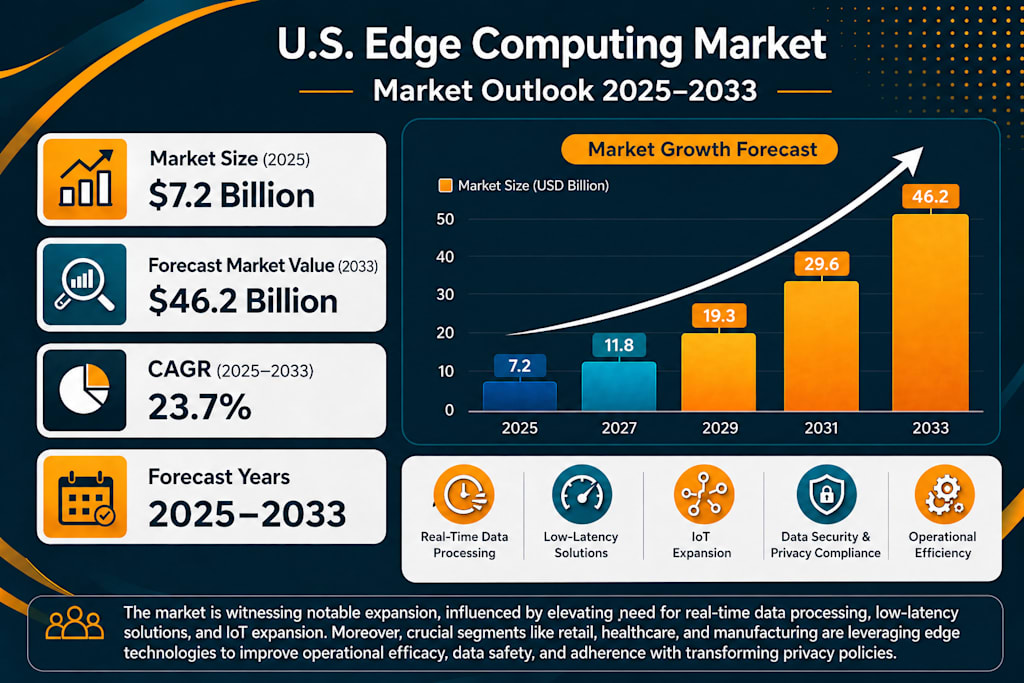
The U.S. edge computing market size is anticipated to reach USD 7.2 Billion in 2025. Looking forward, IMARC Group estimates the market to reach USD 46.2 Billion by 2033, exhibiting a CAGR of 23.7% from 2025-2033.

U.S. Edge Computing Market: Trends, Growth Drivers, and Future Outlook
The way data is processed and managed is undergoing a major shift, and edge computing is at the center of this transformation. Instead of relying solely on centralized cloud systems, businesses are increasingly moving toward decentralized computing closer to the data source. This approach is helping organizations improve speed, efficiency, and security making edge computing a critical part of modern digital infrastructure.
The U.S. edge computing market is growing at an impressive pace. It is anticipated to reach USD 7.2 Billion in 2025, and projections suggest it could expand to USD 46.2 Billion by 2033, registering a compound annual growth rate (CAGR) of 23.7% from 2025 to 2033. This remarkable growth reflects the rising demand for faster data processing and real-time decision-making across industries.
Request a Sample Report with Latest Data & Forecasts:
Why Edge Computing Is Gaining Momentum
One of the biggest reasons behind the rise of edge computing is the increasing need for real-time data processing. Applications like autonomous vehicles, smart cities, and industrial automation require immediate responses. Traditional cloud systems can introduce delays, but edge computing reduces latency by processing data closer to where it is generated.
Another factor fueling adoption is the explosion of connected devices. The rapid growth of the Internet of Things (IoT) means billions of devices are constantly generating data. Sending all this data to centralized servers is not always practical. Edge computing helps manage this data more efficiently while reducing bandwidth usage.
Industry-Wide Adoption Driving Growth
Several sectors in the United States are actively embracing edge computing to improve operations and enhance customer experiences.
• Retail: Businesses are using edge solutions for real-time inventory tracking, personalized shopping experiences, and faster payment systems.
• Healthcare: Hospitals and clinics are leveraging edge technology for remote monitoring, faster diagnostics, and improved patient care.
• Manufacturing: Smart factories rely on edge computing for predictive maintenance, automation, and minimizing downtime.
These industries benefit from faster processing speeds and better data security, which are essential in today’s competitive environment.
Focus on Data Security and Compliance
With increasing concerns around data privacy and cybersecurity, edge computing offers a significant advantage. By processing sensitive information locally rather than sending it to centralized servers, organizations can reduce the risk of data breaches.
Additionally, evolving data protection regulations are pushing companies to adopt solutions that ensure compliance. Edge computing helps businesses align with these requirements by maintaining better control over data handling and storage.
Technological Advancements Supporting Expansion
The growth of technologies like 5G is further accelerating the adoption of edge computing. High-speed connectivity enables faster communication between devices and edge nodes, making real-time applications more efficient and reliable.
Artificial intelligence (AI) and machine learning are also playing a key role. When combined with edge computing, these technologies allow for instant data analysis and smarter decision-making without relying heavily on cloud infrastructure.
Challenges to Consider
Despite its strong growth potential, the edge computing market does face certain challenges. Setting up edge infrastructure can be costly, especially for small and medium-sized businesses. Managing distributed systems also requires advanced technical expertise.
However, as technology continues to evolve and costs decrease, these challenges are expected to become less significant over time.
Future Outlook
The future of edge computing in the United States looks highly promising. As businesses continue to prioritize speed, efficiency, and security, the demand for edge solutions will only increase. The integration of advanced technologies like AI, IoT, and 5G will further strengthen the market’s growth trajectory.
In the coming years, edge computing is likely to become a standard component of digital strategies across industries. Companies that adopt this technology early will have a competitive advantage in delivering faster services and better user experiences.
Conclusion
The U.S. edge computing market is entering a phase of rapid expansion, driven by the need for real-time processing, growing IoT adoption, and increasing focus on data security. With projections indicating substantial growth over the next decade, edge computing is set to play a crucial role in shaping the future of technology and business operations.
As industries continue to evolve, embracing edge computing will no longer be optional it will be essential for staying competitive in a data-driven world.
About the Creator
Jackson Watson
I'm a market research analyst at Imarc group company delivering data-driven insights, industry analysis, and customized research solutions. We support businesses with market sizing, competitive analysis, and strategic decision-making.
Enjoyed the story? Support the Creator.
Subscribe for free to receive all their stories in your feed.
Comments
There are no comments for this story
Be the first to respond and start the conversation.