
Turning Saltwater Into Opportunity: How Desalination Is Reshaping the World's Water Future
As water scarcity intensifies across continents, desalination is emerging as one of the most important technologies for securing sustainable freshwater supplies in the decades ahead.

Water is often described as the world's most valuable resource, yet access to clean and reliable freshwater is becoming increasingly difficult for millions of people. Population growth, climate change, urbanization, industrial expansion, and prolonged droughts are placing unprecedented pressure on existing water resources. In many regions, traditional freshwater supplies can no longer keep pace with demand.
As governments, industries, and communities search for solutions to this growing challenge, desalination has emerged as one of the most promising technologies available. By converting seawater and other saline water sources into usable freshwater, desalination offers an opportunity to create reliable water supplies independent of rainfall patterns and shrinking groundwater reserves.
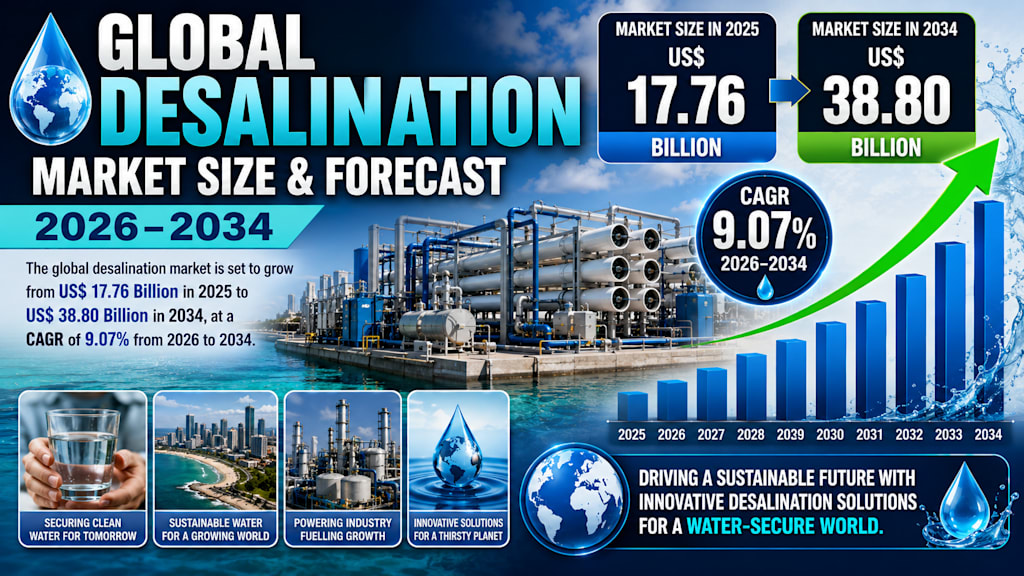
The market's growth reflects this increasing importance. According to Renub Research, the global desalination market is expected to expand from US$ 17.76 Billion in 2025 to US$ 38.80 Billion by 2034, growing at a compound annual growth rate (CAGR) of 9.07% between 2026 and 2034. Rising water scarcity, increasing industrial demand, technological innovation, and government investments are among the primary forces driving this remarkable growth.
As freshwater resources become increasingly strained, desalination is transitioning from an alternative solution to a critical component of global water security.
Understanding Desalination and Its Growing Importance
Desalination is the process of removing salts, minerals, and other impurities from seawater or brackish water to produce freshwater suitable for drinking, agriculture, industry, and municipal use.
The two most common desalination methods are reverse osmosis and thermal distillation. Both technologies have evolved significantly over the past few decades, becoming more efficient, reliable, and capable of producing large volumes of potable water.
Historically, desalination was viewed as an expensive solution reserved primarily for wealthy nations with severe water shortages. Today, technological improvements and falling operational costs have expanded its viability across a much broader range of countries and industries.
Nations throughout the Middle East, including Saudi Arabia and the United Arab Emirates, have long relied on desalination as a critical water source. However, adoption is now accelerating across regions such as North America, Europe, Asia-Pacific, and Australia as water stress becomes a more widespread challenge.
The growing recognition that freshwater resources are finite has positioned desalination as an essential tool for long-term water management.
Water Scarcity Is Becoming a Global Crisis
Perhaps the most significant factor driving the desalination market is the worsening global water shortage.
According to data highlighted in the market report, approximately four billion people—nearly two-thirds of the global population—experience severe water scarcity for at least one month each year. More than two billion people already live in countries facing inadequate water supplies.
The situation is expected to worsen in the coming decades. Experts estimate that half of the world's population could live in water-stressed areas, while hundreds of millions of people may face displacement due to extreme water shortages. By 2040, roughly one in four children worldwide could be living in regions experiencing extremely high levels of water stress.
Several factors are contributing to this crisis. Population growth continues to increase demand for freshwater, while climate change disrupts rainfall patterns and accelerates drought conditions. Groundwater depletion, urban expansion, and agricultural consumption further strain available resources.
For coastal regions, desalination offers an attractive solution because it provides access to an essentially limitless source of water: the ocean.
Unlike reservoirs, rivers, and groundwater aquifers, seawater supplies are not dependent on seasonal weather conditions. This reliability makes desalination an increasingly valuable component of long-term water planning.
Technology Is Transforming Desalination Economics
For many years, desalination faced criticism due to its high costs and substantial energy requirements. Today, however, technological advancements are dramatically improving the economics of water production.
Reverse osmosis systems have become more efficient, reducing energy consumption while increasing output quality. Improvements in membrane technology have enhanced filtration performance and extended equipment lifespans.
Energy recovery systems are helping operators capture and reuse energy throughout the desalination process, significantly reducing operational costs.
Automation and digital monitoring technologies are also improving plant efficiency. Advanced control systems optimize water treatment processes, minimize waste, and improve maintenance planning.
The integration of renewable energy sources such as solar and wind power is further transforming the industry. By pairing desalination facilities with clean energy infrastructure, operators can reduce both operating expenses and environmental impacts.
A notable example occurred in May 2025 when SUEZ, alongside CTCI Group and Hung Hua, began construction of Taiwan's first large-scale municipal reverse osmosis desalination facility in Hsinchu. The project highlights how modern technology is making desalination more practical for urban water supply systems.
As innovation continues, desalination is becoming increasingly competitive with traditional water supply alternatives.
Governments Are Making Water Security a Priority
Government support remains one of the strongest drivers behind desalination market expansion.
Many countries now view water security as a strategic national priority. Long-term development plans increasingly include investments in desalination infrastructure to ensure reliable water supplies for growing populations and industrial sectors.
Public-private partnerships are becoming common financing mechanisms for large desalination projects. These collaborations help governments access private sector expertise while reducing financial risks associated with major infrastructure investments.
International organizations are also supporting desalination development in regions facing severe water stress.
Recent developments demonstrate the growing commitment to desalination. In March 2026, South Korea established a public-private coalition aimed at expanding desalination technologies domestically and internationally as part of broader efforts to address global water scarcity challenges.
As water availability becomes increasingly unpredictable, governments are expected to continue investing heavily in desalination capacity.
Reverse Osmosis Leads the Market
Among available technologies, reverse osmosis (RO) has emerged as the dominant force within the desalination industry.
RO systems use semi-permeable membranes to remove salts and contaminants from water, producing high-quality freshwater with relatively low energy consumption compared to traditional thermal processes.
The technology's efficiency, scalability, and declining costs have made it the preferred choice for municipal, industrial, and commercial applications worldwide.
Advances in membrane materials continue improving performance while reducing operational expenses. The compatibility of RO systems with renewable energy sources further strengthens their appeal.
As countries seek cost-effective and environmentally responsible solutions to water scarcity, reverse osmosis is expected to remain the leading desalination technology throughout the forecast period.
Municipal Water Supply Is Driving Demand
Municipal desalination represents one of the fastest-growing application segments within the market.
Rapid urbanization and population growth are placing enormous pressure on municipal water systems. Many cities are struggling to meet rising demand using conventional water sources alone.
Desalination offers municipalities a reliable and drought-resistant source of freshwater that can supplement existing supplies and enhance long-term resilience.
Large-scale desalination facilities are increasingly being integrated into municipal water networks, helping cities reduce vulnerability to climate variability and groundwater depletion.
Public awareness regarding water conservation and sustainability is also encouraging support for alternative water sources.
As urban populations continue expanding, municipal desalination projects are expected to play an increasingly important role in maintaining water security.
Seawater Remains the Dominant Water Source
Seawater desalination accounts for the largest share of global desalination activity.
Given that oceans cover more than 70 percent of the Earth's surface, seawater represents an abundant and virtually unlimited resource.
Countries across the Middle East, Asia-Pacific, Europe, and North America continue investing heavily in seawater desalination infrastructure to secure dependable freshwater supplies.
Technological improvements have significantly reduced the costs associated with seawater treatment, making large-scale projects more economically viable than ever before.
While challenges remain, including energy consumption and environmental concerns, seawater desalination continues gaining momentum as a practical solution to growing water shortages.
Brackish Water Desalination Is Expanding Rapidly
Brackish water desalination is becoming increasingly important in regions located far from coastlines.
Because brackish water contains lower salinity levels than seawater, it requires less energy to treat. This makes desalination more affordable and accessible for many communities and industries.
Agriculture, manufacturing, and municipal water providers are increasingly adopting brackish water desalination systems to supplement existing freshwater supplies.
Local governments are also investing in smaller-scale facilities designed to address regional water shortages efficiently.
As freshwater availability declines, brackish water desalination is expected to become a critical component of broader water management strategies.
Environmental Challenges Still Require Attention
Despite its many advantages, desalination is not without challenges.
Energy consumption remains one of the industry's primary concerns. Reverse osmosis and thermal desalination processes require substantial power inputs, particularly in large-scale facilities. This can increase operational costs and carbon emissions when fossil fuels are used as energy sources.
Another significant issue involves brine disposal. Desalination generates highly concentrated saltwater byproducts that must be managed carefully to avoid damaging marine ecosystems. Improper disposal can alter ocean salinity levels and negatively affect aquatic life.
Environmental groups and industry leaders continue working to develop sustainable disposal methods and cleaner production practices.
Ongoing innovation will be essential for balancing water security goals with environmental protection objectives.
Regional Markets Leading Global Growth
The United States continues to experience steady growth in desalination adoption, particularly in drought-prone regions such as California, Texas, and the Southwest. Growing concerns regarding water availability are encouraging investments in alternative supply sources.
The United Kingdom is gradually expanding desalination as a supplementary water source, especially during drought periods and seasonal shortages.
India is witnessing rapid market growth due to population expansion, industrialization, declining groundwater levels, and increasing urban water demand. States such as Tamil Nadu and Gujarat are actively investing in desalination infrastructure.
Saudi Arabia remains one of the world's largest desalination markets, relying extensively on desalinated water to meet national water requirements. Continued investments in renewable-powered desalination facilities are strengthening the country's leadership position.
Final Thoughts
Water scarcity is no longer a future concern—it is a present reality affecting billions of people worldwide. As populations grow and climate conditions become increasingly unpredictable, securing reliable freshwater supplies will be one of humanity's most important challenges.
Desalination offers a powerful solution by transforming abundant seawater and brackish water resources into usable freshwater. Technological advancements, government investments, and growing awareness of water security are accelerating adoption across municipalities, industries, and entire nations.
With the global desalination market projected to grow from US$ 17.76 Billion in 2025 to US$ 38.80 Billion by 2034, the industry is entering a period of extraordinary expansion. As costs continue to decline and sustainability improves, desalination is poised to become one of the defining infrastructure technologies of the twenty-first century.
For communities facing water shortages, desalination is more than an engineering achievement—it represents an opportunity to build a more secure, resilient, and sustainable future.
About the Creator
Enjoyed the story? Support the Creator.
Subscribe for free to receive all their stories in your feed.
Comments
There are no comments for this story
Be the first to respond and start the conversation.