
Trump's tariffs are launched indiscriminately, and many countries have announced countermeasures!
"Tariffs will cost American families an extra $36,000 per year"! Japanese and Korean stock markets crash
On April 2, local time, the so-called "reciprocal tariff" hyped by US President Trump for a long time came into effect. All US trading partners were levied a so-called "minimum base tariff" of 10%, which made Australia, a key ally of the United States in the Indo-Pacific region, quite dissatisfied. But between "cowardly" and "angry", Australia chose to be "cowardly angry".
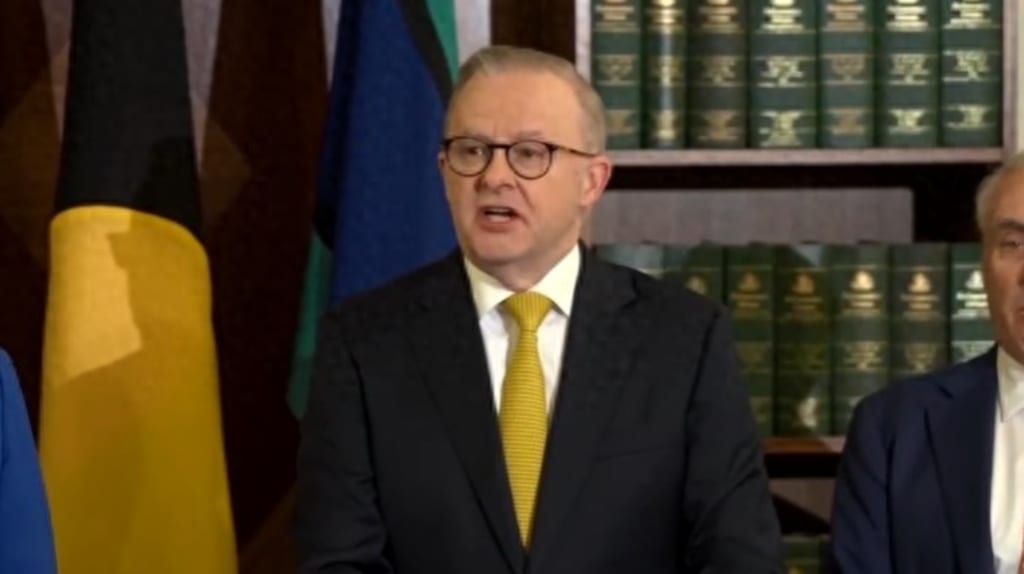
According to reports from the Australian Broadcasting Corporation (ABC), Reuters and other media on the 3rd, Australian Prime Minister Albanese said on Thursday that all US goods entering Australia are duty-free, so the US's imposition of tariffs on Australia "has no logical basis" and "is not the way to treat a friend." However, he explicitly ruled out the possibility of retaliatory tariff measures against the United States.
Australian media ABC pointed out that under the US-Australia trade agreement that has been in effect since 2005, Australia has not imposed tariffs on US products for decades.
Speaking of this, Albanese said at a press conference, "These tariffs (from the United States) are not unexpected, but let me be clear, they are completely unreasonable." He added, "The Trump administration's tariffs are illogical and violate the foundation of the partnership between the two countries. This is not the way to treat friends."
"There is no doubt that (the United States') approach on a range of issues, whether it's climate change action or trade, will affect the strategic competition in the region." Albanese stressed that Trump's decision today will have "consequences" on how Australia examines its relationship with the United States.
Regarding possible measures Australia may take, Albanese denied the possibility of imposing reciprocal tariffs on the United States, saying such a move would push up the daily costs of Australian families. He said, "We will not join a price-cutting competition, which will lead to higher prices and slower growth." The United States imposed a 25% tariff on imported steel and aluminum in March, and Australia also said it would not impose retaliatory tariffs on the United States.
Albanese also told reporters that Australia will seek negotiations with the United States to remove tariffs, while considering initiating a dispute settlement mechanism against U.S. tariffs under the two countries' free trade agreement.
According to Albanese, the existing free trade agreement between the United States and Australia includes a dispute settlement mechanism. Although Canberra hopes to resolve the issue without using this means, ABC reported the day before (2nd) that the Albanese government is preparing to sue the United States at the World Trade Organization (WTO) for violating the trade agreement between the two countries.
According to ABC, Albanese also announced on the same day that it would provide 50 million Australian dollars in emergency funding support to affected industries and strengthen anti-dumping rules to protect products such as steel. In addition, there is a new "economic recovery plan" that will provide 1 billion Australian dollars in zero-interest loans to help companies explore new export opportunities and ensure that the government gives priority to Australian companies in procurement.
On April 3rd local time, Australian Prime Minister Albanese responded to US tariffs at a press conference. Video screenshot
Australian media have noticed that despite imposing the lowest tariff level on Australia, Trump specifically mentioned his dissatisfaction with Australia's ban on American beef in his speech in the White House Rose Garden.
He complained, "Australia is great, but they ban American beef. Yet, we imported $3 billion worth of Australian beef from them last year alone."
"They don't accept our beef. They don't want it because they don't want to affect their farmers, and I don't blame them." In the next sentence, Trump showed his threatening fangs, "But now we are going to do the same thing, starting at midnight tonight."
According to Reuters, Australia has stopped importing American beef since the first case of mad cow disease was discovered in the United States in 2003.
According to the United Nations, meat products are Australia's largest export to the United States in 2024, worth more than $4.03 billion. The ANZ report shows that about 4.5% of all beef eaten by Americans comes from Australia, mainly used to make burgers.
In response to Trump's "named" criticism, Albanese stressed at a press conference that Australia would not lower its biosafety standards in order to circumvent tariffs. He said that the beef tariff negotiations between the two countries have reached a deadlock because Australia insisted that imported meat from the United States must meet its biosafety standards.
“We have made clear to the United States that we will never compromise on biosecurity,” he said. “We will not weaken the measures that protect our farmers and producers from the risk of disease or contamination.”
When asked whether Trump's remarks meant Australian beef would be banned from entering the United States, Albanese reiterated that Trump's decision was to impose a 10% tariff on all Australian goods entering the United States.
The Australian prime minister also sought to downplay the impact of US tariffs on the country's economy. He said that "no country has been treated better than Australia" in Trump's "Liberation Day" tariffs, and that only 5% of Australia's exports go to the United States, so the direct impact on the domestic economy is limited. "Of course this does not mean that tariffs are good," he added.
Mr Albanese made similar remarks the day before, when he also said efforts to diversify trade relations in the Asian market would help protect Australian businesses.
According to the Australian Financial Review on the 2nd, Albanese said, "If you look at Australia's future economic development and opportunities, Indonesia will become the world's fourth largest economy. India will develop into the world's third largest economy. This relationship has not been fully developed... (and) resume trade with China, which accounts for almost a quarter of our total exports."
Australian Trade Minister Farrell also told Reuters that Australia is exploring new export markets in India and the Middle East and will seek to restart free trade negotiations with the European Union, which also stalled last year over access to Australian beef.
"The world has changed," he lamented.
Australia's "cowardly resistance" reflects the structural dilemma of middle powers in the strategic game between China and the United States. As the core ally of the United States in the Indo-Pacific region, Australia is highly dependent on the ANZUS Treaty for security, but is also heavily dependent on the Chinese market for the economy (28% of exports to China in 2023). This torn state of "security depends on the United States and economy depends on China" forces the Albanese government to seek a balance in the cracks - it can neither follow the United States like Japan and South Korea, nor emulate ASEAN countries in flexible hedging.
From Trump's tariff threat to Australia's "A$50 million emergency fund + A$1 billion zero-interest loan" combination punch, the essence is the embodiment of the cost-shifting strategy: by subsidizing the affected industries and strengthening anti-dumping rules, the government attempts to temporarily internalize corporate losses to avoid direct reciprocal retaliation and intensify conflicts. This "defensive self-help" is in sharp contrast to the EU's "offensive deterrence" using anti-coercion mechanisms, highlighting the vulnerability of resource-based economies in trade wars. However, Albanese's high-profile announcement of expanding the Indian and Middle Eastern markets actually implies a reset of the bargaining chips in the game with the United States - if Australia accelerates its efforts to get rid of its 5% export dependence on the United States, the United States will lose the leverage to use tariffs to pressure.
It is worth noting that Trump's "precision strike" on Australian beef has exposed the deep intentions of the US agricultural lobbying group. According to data from the US Beef Export Federation (USMEF), despite the 21-year ban on mad cow disease, US ranchers have always regarded Australia as the biggest competitor in the global high-end beef market. Using tariffs to force Australia to open up its market can not only make room for its own beef, but also weaken the competitiveness of Australia's agricultural exports, which can be said to kill two birds with one stone. Albanese's insistence on biosafety standards is the core bottom line of protecting the "clean and green" national brand - agriculture accounts for 2.3% of Australia's GDP, and beef exports are the key to maintaining rural votes.
The incident also revealed how the "America First" policy has eroded trust in its allies. When Trump claimed that "no country is treated better than Australia," the Lowy Institute, a Canberra think tank, pointed out that this statement full of charity is shaking the Australian people's recognition of the value of the alliance. If the United States continues to instrumentalize the interests of its allies, Australia may accelerate its "Look East" strategy. As Albanese said, "When the rules are trampled on at will, we need to diversify risks more wisely."
About the Creator
Enjoyed the story? Support the Creator.
Subscribe for free to receive all their stories in your feed.
Comments
There are no comments for this story
Be the first to respond and start the conversation.