
Transmission Fluids Market Set for Steady Growth as Automotive Maintenance Demand Rises
From automatic and dual-clutch systems to synthetic lubricants and regional demand shifts, the transmission fluids industry is evolving alongside the global vehicle fleet.

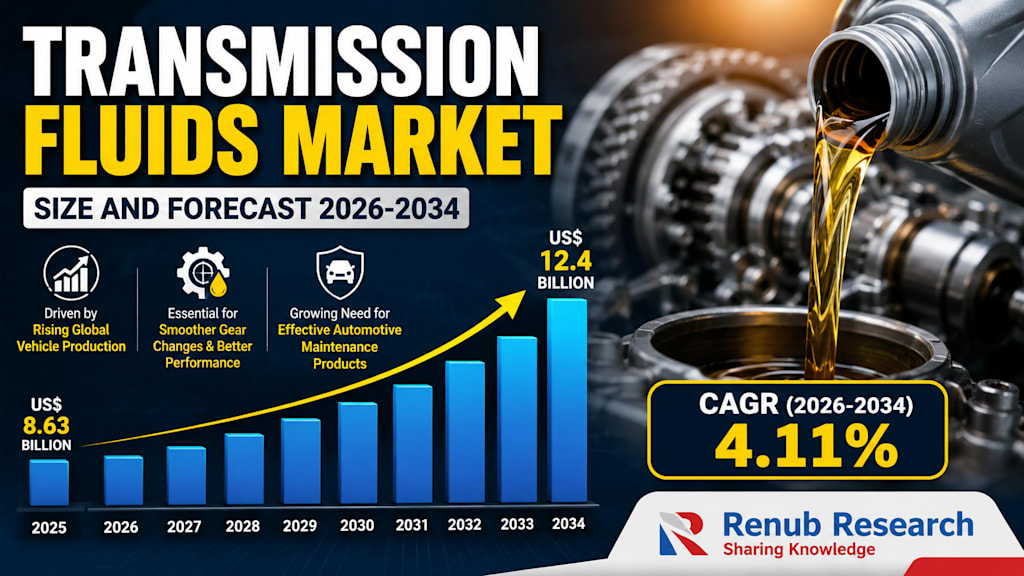
The global transmission fluids market is not the kind of story that makes headlines every day, but it is one of those quietly important industrial markets that keeps modern mobility moving. According to Renub Research, the market is expected to rise from US$ 8.63 billion in 2025 to US$ 12.4 billion by 2034, expanding at a CAGR of 4.11% from 2026 to 2034. That growth is being shaped by rising vehicle production, greater attention to maintenance, and the growing need for fluids that can support advanced transmission systems.
At its core, transmission fluid does much more than lubricate moving parts. It helps reduce friction, cool transmission components, protect against wear and corrosion, and support smooth gear shifting. In practical terms, it is one of the products that helps a vehicle feel reliable, efficient, and durable over time. As the global automotive industry expands and vehicle owners become more aware of preventive maintenance, transmission fluids are becoming more essential rather than less.
Why the market is moving upward
A major driver behind this market is simple: there are more vehicles on the road, and more of them need regular servicing. Renub Research notes that the world produced more than 92 million vehicles in 2024, with China, the United States, and Japan leading vehicle production. That matters because passenger vehicles, commercial vehicles, and heavy trucks all depend on transmission systems that require proper lubrication to work efficiently. Rising ownership levels, higher disposable incomes in countries such as China and India, and the growth of ride-sharing and transport services are all increasing daily vehicle usage and the need for maintenance products.
A second driver is technological change. Modern transmissions are no longer limited to the traditional manual gearboxes that once dominated the market. Automated transmissions, continuously variable transmissions, and dual-clutch transmissions are now widely used in many vehicles, and each type places different demands on transmission fluid. That has pushed vehicle manufacturers and lubricant developers to focus on higher-performance formulations that can handle heat, stress, friction, and shifting requirements more effectively.
Another important factor is the growing automotive aftermarket. Vehicle owners are becoming more aware that transmission fluid replacement is not just a technical recommendation; it is part of protecting the life of the vehicle. Regular servicing helps minimize mechanical failure, avoid expensive transmission repairs, and improve overall vehicle performance and fuel efficiency. As service centers, dealerships, and repair outlets continue to promote preventive maintenance, the market gains a steady and dependable demand base.
The role of transmission fluid in modern vehicles
Transmission fluid is often overlooked by everyday consumers, but the product sits at the center of vehicle health. It reduces friction between gears, keeps the transmission system cooler, supports hydraulic pressure in automatic systems, and helps maintain smooth operation in both light and heavy-duty vehicles. Without the right fluid, transmission systems can become noisy, inefficient, and vulnerable to wear. That is why the market is tied so closely to the health of the broader automotive ecosystem.
The market is also being shaped by the growing preference for high-performance fluids, especially synthetic formulations. Synthetic transmission fluids are valued for their superior lubricating properties, stronger heat resistance, and better oxidation control. They are particularly useful in advanced vehicles and in transmission systems that operate under high mechanical pressure or harsh weather conditions. As automakers focus on extending service intervals and improving shifting performance, synthetic variants are gaining wider acceptance.
Product segments are changing with vehicle technology
Automatic transmission fluid remains one of the most important product categories because automatic vehicles are becoming more popular in both developed and developing markets. These fluids are designed to lubricate moving components while also transferring hydraulic pressure and helping maintain an optimal operating temperature. The result is smoother shifting and better driving comfort, which is especially valuable in congested urban environments where automatic vehicles are in high demand.
Dual-clutch transmission fluid is another segment drawing increasing attention. Dual-clutch transmissions combine the convenience of automatic driving with some of the performance characteristics of manual systems. They allow faster and smoother gear shifts, but they also create higher demands on lubrication because of the stress, temperature, and friction involved. As automakers continue to emphasize performance and driving comfort, demand for specialized DCT fluids is expected to rise alongside it.
Manual transmission fluid still matters too. In many developing markets, manual transmissions remain popular because of their lower purchase price, relative mechanical simplicity, and fuel efficiency. A large existing vehicle fleet also continues to use manual systems, which keeps replacement demand alive. The growth rate may be slower than that of automatic or synthetic products, but manual transmission fluid remains a stable part of the market.
Challenges the industry cannot ignore
The biggest long-term challenge facing the transmission fluids market is the rise of electric vehicles. Many EVs use single-speed transmissions, which reduces the need for the kind of conventional transmission fluids used in traditional multi-speed systems. As governments continue promoting EV adoption through incentives and emissions regulations, the market could see pressure on some traditional product categories.
Environmental regulation is another hurdle. Transmission fluids are petroleum-based products, so their production, use, leakage, and disposal require careful control. Compliance costs are rising as manufacturers are pushed to create more environmentally friendly and biodegradable alternatives. That shift is good for sustainability, but it can also raise production costs and compress margins for traditional suppliers. It also forces companies to invest more heavily in innovation and reformulation.
Still, these challenges do not erase demand. Instead, they are reshaping it. The market is becoming more specialized, more performance-driven, and more environmentally conscious. In many ways, the next phase of growth will belong to companies that can adapt to new vehicle technologies while also meeting modern regulatory expectations.
Regional demand tells a broader story
In the United States, the transmission fluid market is already well established. High vehicle ownership, a large automotive manufacturing base, and millions of passenger and commercial vehicles on the road create steady replacement demand. The country’s strong network of dealerships, repair shops, and service centers also supports routine maintenance habits. With the growing use of high-performance synthetic fluids, the U.S. market is expected to remain stable. Renub Research also highlighted a 2025 product launch by International Lubricants, Inc., showing how the market continues to innovate in response to vehicle needs.
The United Kingdom market is also supported by a mature automotive ecosystem and strong vehicle maintenance awareness. Consumers are increasingly conscious of fuel efficiency, vehicle health, and product quality, which supports demand for premium lubricants. The country has also seen innovation in EV-specific fluids, including Castrol’s 2024 launch of fully synthetic EV transmission fluids for wet e-motor applications. That reflects a broader trend: even as the vehicle landscape changes, fluids are adapting with it.
India is one of the most interesting growth markets in this space. Vehicle ownership is rising, urbanization is expanding, and the automotive sector continues to gain momentum. Manual transmissions still dominate in many parts of the market, but automatic vehicles are becoming more common in urban areas. That creates demand across both traditional and modern transmission fluid categories. Renub Research also notes Brakes India’s 2024 entry into the gear and transmission oil segment under the Revia brand, which shows how local players are responding to the opportunity.
Saudi Arabia presents a different but equally compelling case. High vehicle usage, road transport intensity, and hot climatic conditions make quality transmission fluid especially important. In such environments, thermal stability and product reliability matter more than ever. The market is also benefiting from rising awareness about preventive maintenance, which supports consistent service demand.
Market structure and competitive landscape
Renub Research segments the market by product type, application, base oil, and region. The product categories include automatic transmission fluids, manual transmission fluids, dual-clutch transmission fluids, and continuously variable transmission fluids. Applications span off-road vehicles and automotive use, while base oil categories include synthetic, semi-synthetic, and mineral formulations. The regional coverage spans North America, Europe, Asia Pacific, Latin America, and the Middle East & Africa.
The company coverage in the report also points to a globally competitive market. Major names include BASF SE, BP P.L.C., Chevron Corporation, Exxon Mobil Corporation, Fuchs Petrolub SE, Lukoil, PetroChina Company Limited, Royal Dutch Shell Plc, and Total SE. These players are not just selling fluids; they are competing on formulation quality, performance, durability, brand trust, and innovation. That matters because the market is no longer only about basic lubrication. It is about meeting increasingly specific vehicle requirements.
The bigger picture
The transmission fluids market may not be glamorous, but it is a strong example of how industrial products evolve with technology, consumer behavior, and mobility trends. Its growth is supported by ordinary but powerful forces: more vehicles, longer vehicle lifecycles, a bigger aftermarket, and a greater need for maintenance. At the same time, the industry is being pushed to innovate as electric vehicles, environmental rules, and advanced transmission systems reshape what drivers and manufacturers expect from lubricants.
The story, in other words, is not just about fluid. It is about adaptation. Traditional transmission fluids remain vital today, but the future belongs to products that can serve newer vehicles, perform under more demanding conditions, and align with sustainability goals. That is what makes this market interesting: it is stable, but it is not static.
Final thoughts
The transmission fluids market is likely to stay relevant because vehicles will always need protection, cooling, and smooth operation in some form. What is changing is the mix of products, the types of vehicles driving demand, and the expectations placed on manufacturers. As a result, the market is moving from a traditional maintenance category into a more technical and performance-oriented segment. For buyers, service providers, and manufacturers alike, the message is clear: the future of transmission fluids belongs to those who can combine reliability, innovation, and environmental responsibility.
About the Creator
Enjoyed the story? Support the Creator.
Subscribe for free to receive all their stories in your feed.
Comments
There are no comments for this story
Be the first to respond and start the conversation.