
Translucent Concrete Market Set for Sharp Expansion as Smart Buildings and Green Design Gain Momentum
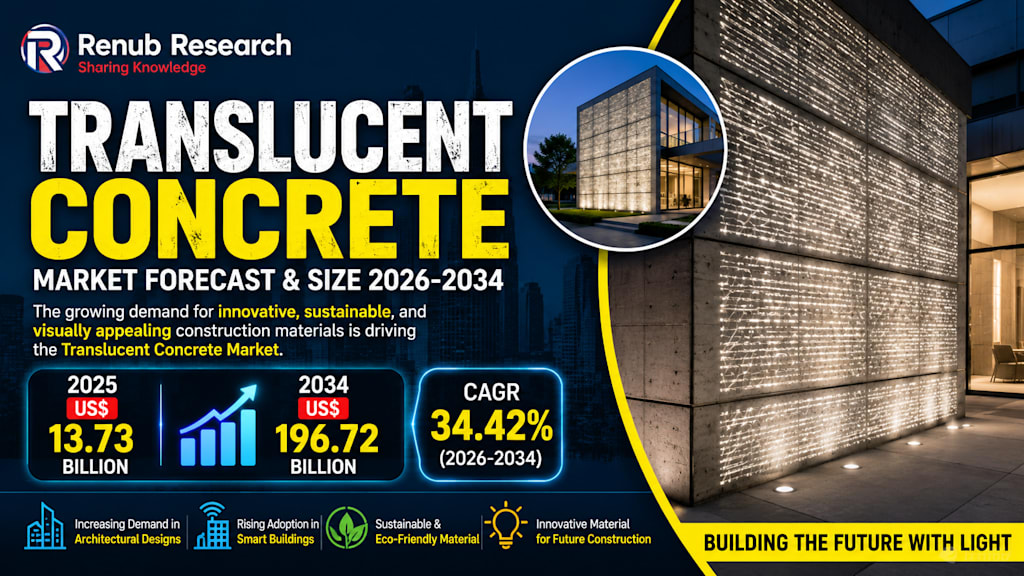
Renub Research expects the market to rise from US$ 13.73 billion in 2025 to US$ 196.72 billion by 2034, expanding at a CAGR of 34.42% during 2026–2034, driven by demand for innovative, sustainable, and energy-efficient construction materials.

Translucent Concrete Is Moving From Niche Idea to Serious Building Material
Translucent concrete is no longer just a futuristic concept that attracts attention for its visual appeal. It is increasingly being recognized as a practical construction material that combines strength, durability, and the ability to allow light to pass through. According to the uploaded Renub Research text, the material is made by incorporating optical fibers into a fine concrete mix, and these fibers transmit light from one end of the block to the other without removing the structural qualities builders expect from concrete. That unique combination is what is helping the market move from novelty into broader architectural use.
The market outlook is striking. Renub Research estimates that the translucent concrete market will grow from US$ 13.73 billion in 2025 to US$ 196.72 billion by 2034, at a CAGR of 34.42% from 2026 to 2034. The report links that growth to rising demand in architectural design and smart buildings, where energy efficiency and visual impact are both becoming important priorities.
Why Architects and Developers Are Paying Attention
One of the biggest reasons translucent concrete is attracting attention is its ability to bring originality into modern construction. The uploaded report describes strong demand for innovative architectural materials, especially in buildings where designers want more than just basic function. Translucent concrete can be used in facades, decorative walls, partitions, and flooring, giving architects a material that looks distinct while still performing like concrete. It is already associated with commercial centers, museums, hotels, and luxury homes, where visual identity matters as much as strength.
The appeal is not only aesthetic. The material also supports sustainable construction because it lets natural light enter buildings and reduces reliance on artificial lighting during the day. That makes it attractive in an era when green building certifications, energy savings, and environmental awareness are shaping buying decisions across the construction value chain. The report ties this trend to broader climate goals, noting that the built environment accounts for over 40% of carbon emissions and that 28 countries joined the Buildings Breakthrough initiative launched at COP28 UAE to help make near-zero emission and resilient buildings the norm by 2030.
Urban growth is another strong support for the market. The report highlights ongoing investment in office buildings, shopping malls, transportation hubs, public spaces, and smart city projects, all of which demand materials that can deliver both performance and design value. In that environment, translucent concrete fits well because it is being used for walkways, decorative walls, and building facades that need to look modern while still meeting structural requirements.
Where the Material Is Finding the Strongest Use
The report breaks translucent concrete into several practical application areas, with wall cladding, roofing, flooring, and other uses all identified as important segments. Wall applications remain central because translucent concrete works especially well in facades, partitions, and decorative architectural features. Roofing is also gaining ground in commercial buildings, airports, malls, and exhibition halls because it can admit natural light and reduce daytime electricity use. Flooring is another growing area, especially in museums, commercial interiors, and luxury homes, where the glowing visual effect created by embedded optical fibers adds a memorable design element.
The material structure itself is an important part of the story. The report also identifies a fibers-based segment, noting that optical fibers are the main component enabling the transmission of light while preserving concrete strength. That makes the material especially suitable for high-end architectural uses such as decorative walls, partitions, lighting features, and modern facades. For builders and designers, the product is valuable not just because it is different, but because it creates a new way to work with light inside structural forms.
The Market Is Growing, But It Is Not Without Friction
Despite the excitement, the report is clear that translucent concrete still faces meaningful barriers. The first is cost. Production and installation are more expensive than standard concrete because the material requires specialized inputs, technical know-how, and skilled labor. Optical fiber integration is not a routine construction process, and ensuring that the transparency effect is preserved during installation adds further complexity. As a result, the material may remain concentrated in high-end architectural projects unless production methods become more efficient and more affordable.
The second challenge is awareness and expertise. The report says translucent concrete is still relatively new, and many builders, contractors, and developers are not yet fully familiar with how to use it. That can slow adoption, especially in regions where technical knowledge is limited. Even when architects understand its potential, practical use still depends on people who can manufacture, handle, and install the product correctly. In other words, adoption is not just a question of demand; it is also a question of capability.
Regional Demand Is Broadening
The United States is presented as a steady-growth market, supported by interest in greener building practices and new construction materials that can improve both appearance and energy efficiency. The report says translucent concrete is being considered for commercial constructions, museums, public areas, and high-end residential projects. It also notes that a major manufacturer introduced a new range of translucent concrete panels in October 2025 to support both energy-efficiency and aesthetic goals.
The United Kingdom is another promising market because of its strong focus on innovative architecture and environmentally friendly building techniques. The report links market development to the country’s renovation and modernization activity, as well as its broader environmental awareness. It also cites a UK government study from July 2023 showing that nearly 86.5% of adults in Great Britain had made some lifestyle change for environmental reasons, which helps explain why sustainable construction materials are gaining traction.
India is still in a developing stage for translucent concrete, but the growth story is strong. Rapid urbanization, rising infrastructure investment, and a shift toward sustainable construction are pushing architects and construction companies to explore new materials. The report also points to growing interest from industry events such as World of Concrete India, which indicates that the broader construction ecosystem is becoming more open to advanced materials.
Saudi Arabia is also emerging as an important market, especially because of large-scale urban development, smart city investment, and the country’s emphasis on energy-efficient construction. The report notes that translucent concrete fits well in facades, decorative walls, and other visually focused infrastructure applications. It also cites the January 2025 NovusCrete project as another sign that the kingdom is actively exploring innovative, eco-friendly concrete solutions in collaboration with major domestic and international partners.
The Competitive Landscape Is Still Taking Shape
The competitive side of the market is being tracked across several dimensions in the report, including overviews, key people, recent developments, SWOT analysis, revenue analysis, and competitive landscape assessment. The companies listed include DuPont, Fapinex LLC, Gravelli s.r.o., Litracon Ltd., Lucem GmbH, and Pan-United Corporation Ltd. That list suggests the market is still building its commercial identity, with a mix of established industrial names and specialized innovators shaping the field.
This is important because translucent concrete is not just a design trend; it is becoming a competitive product category. Companies that can improve production efficiency, reduce costs, and make installation easier are likely to have an advantage as the market grows. At the same time, innovation in concrete mix design and carbon reduction is also becoming more visible across the industry, as shown by the report’s mention of new durable concrete launches and software-based CO2-efficient concrete design tools.
Final Thoughts
Translucent concrete sits at the intersection of design, sustainability, and urban development. Its biggest strength is that it delivers something the construction industry often tries to balance but rarely achieves so elegantly: structure and beauty in the same material. It lets architects create luminous walls, dynamic facades, creative flooring, and distinctive roofing systems while still keeping the durability expected from concrete.
The market’s growth story is being powered by several forces at once: the rise of smart buildings, the push for energy efficiency, demand for green construction, and the broader expansion of modern infrastructure across major regions. At the same time, adoption will depend on whether the industry can overcome high costs and the current shortage of technical familiarity. If those barriers ease, translucent concrete could move far beyond premium projects and become a much more visible part of next-generation construction. Based on the Renub Research outlook, the direction is already clear: this is a market with major long-term momentum.
About the Creator
Enjoyed the story? Support the Creator.
Subscribe for free to receive all their stories in your feed.
Comments
There are no comments for this story
Be the first to respond and start the conversation.