
Transdermal Skin Patches Market 2026–2034: The Rise of Non-Invasive Drug Delivery
Growing chronic disease burden, patient-friendly therapies, and technological innovation are driving the global expansion of transdermal patch systems.

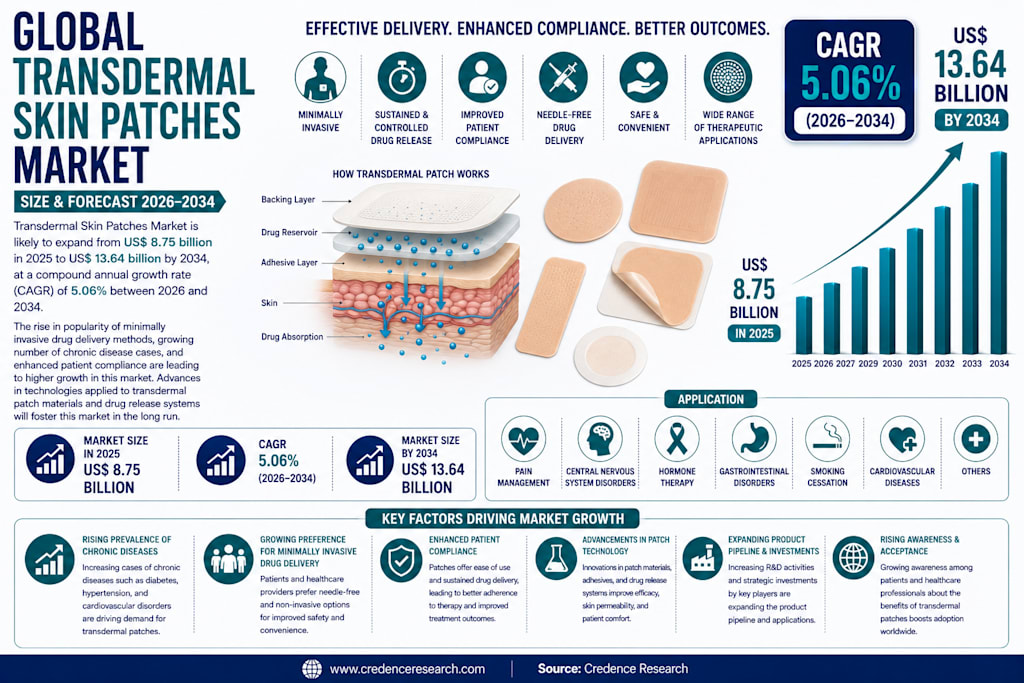
Transdermal Skin Patches Market: A Shift Toward Smarter Drug Delivery
The global healthcare industry is increasingly moving toward patient-friendly and non-invasive treatment solutions, and transdermal skin patches are emerging as a key innovation in this transformation. According to Renub Research, the Transdermal Skin Patches Market is expected to grow from US$ 8.75 billion in 2025 to US$ 13.64 billion by 2034, expanding at a CAGR of 5.06% from 2026 to 2034.
This steady growth reflects a shift in how medications are delivered. Patients and healthcare providers are increasingly favoring solutions that are convenient, safe, and capable of delivering drugs in a controlled manner. Transdermal patches meet these needs by enabling continuous drug absorption through the skin, eliminating the need for injections or frequent oral dosing.
What Are Transdermal Skin Patches?
Transdermal skin patches are advanced drug delivery systems designed to administer medication through the skin and directly into the bloodstream over a controlled period. These patches typically consist of multiple layers, including a drug reservoir or matrix, adhesive layer, backing layer, and release liner.
Their key advantage lies in maintaining a steady concentration of medication in the bloodstream while bypassing the liver’s first-pass metabolism. This leads to improved therapeutic outcomes and reduced side effects.
They are widely used in treating conditions such as:
- Chronic pain
- Hormonal disorders
- Motion sickness
- Cardiovascular conditions
- Neurological disorders
As healthcare moves toward personalized and patient-centric solutions, transdermal systems are gaining broader acceptance worldwide.
Key Growth Drivers Accelerating the Market
Rising Demand for Non-Invasive and Convenient Therapies
One of the most important drivers of this market is the growing demand for non-invasive drug delivery methods. Patients increasingly prefer treatments that avoid injections and reduce discomfort.
Transdermal patches provide a simple, painless, and convenient alternative. They are particularly beneficial for elderly patients or individuals who have difficulty swallowing oral medications.
Healthcare professionals also favor these systems because they reduce dosing errors and ensure consistent drug delivery, improving overall treatment effectiveness.
Increasing Prevalence of Chronic Diseases
The rising incidence of chronic conditions such as cardiovascular disease, diabetes, and neurological disorders is significantly boosting demand for transdermal patches.
Chronic diseases often require long-term medication with stable drug levels in the bloodstream. Transdermal patches are ideal for this purpose, as they provide sustained release of medication over extended periods.
For example, in the United States alone, approximately 129 million people are estimated to have at least one major chronic disease, highlighting the scale of demand for effective and continuous treatment solutions.
Technological Advancements in Patch Design
Innovation is playing a major role in expanding the capabilities of transdermal systems. Advances in material science, adhesive technology, and drug formulation are making patches more efficient and comfortable.
Emerging technologies include:
- Microneedle patches for enhanced drug penetration
- Iontophoresis systems for controlled drug delivery
- Improved polymer matrices for sustained release
These developments are enabling the delivery of more complex drugs through the skin, significantly expanding the potential applications of transdermal patches.
Market Segments Driving Adoption
Matrix Patches: Leading the Market
Matrix-based transdermal patches are among the most widely used designs. In these systems, the drug is uniformly distributed within a polymer matrix, allowing controlled release through diffusion.
These patches are flexible, thin, and comfortable, making them popular among patients and healthcare providers. Their simpler manufacturing process also contributes to cost-effectiveness.
Pain Relief Applications
Pain management is one of the largest application segments for transdermal patches. These patches are widely used for conditions such as arthritis, musculoskeletal disorders, and chronic pain.
They provide targeted drug delivery without the systemic side effects often associated with oral medications. Increasing demand for non-opioid pain management solutions is further driving this segment.
Hormonal Therapy Applications
Transdermal patches are also widely used in hormonal therapy, including menopause management, contraception, and hormone replacement therapy.
These patches offer consistent hormone delivery while avoiding liver metabolism, reducing the risk of certain side effects. Growing awareness of women’s health and personalized treatments is boosting demand in this segment.
Distribution Channels: Expanding Access
Hospital pharmacies remain a major distribution channel, particularly for prescription-based treatments.
At the same time, online pharmacies are rapidly gaining popularity due to convenience, home delivery, and privacy. The rise of telemedicine and digital healthcare platforms is further supporting online sales of transdermal patches.
Regional Insights: Global Market Trends
United States: Leading Adoption and Innovation
The United States is one of the most developed markets for transdermal patches, driven by advanced healthcare infrastructure and high awareness of non-invasive treatments.
Strong research and development activity, along with growing demand for pain management and chronic disease treatment, supports market expansion.
United Kingdom: Patient-Centric Healthcare
The UK market benefits from a strong public healthcare system that promotes patient-friendly treatment options. Transdermal patches are widely used for managing chronic conditions and hormone therapy.
India: Emerging Growth Potential
India’s market is expanding due to rising chronic disease cases, urbanization, and increasing awareness of advanced drug delivery systems.
Affordable manufacturing and growing healthcare infrastructure are helping improve accessibility, although awareness and cost barriers still exist in rural areas.
Saudi Arabia: Expanding Healthcare Investments
Saudi Arabia is witnessing steady growth in the transdermal patch market, supported by government investments in healthcare and rising demand for innovative treatment solutions.
Challenges Limiting Market Growth
Limited Drug Compatibility
Not all drugs are suitable for transdermal delivery. Factors such as molecular size and skin permeability can limit the effectiveness of certain medications when delivered through patches.
Skin Irritation and Regulatory Challenges
Some patients may experience skin irritation or allergic reactions due to adhesives or drug formulations.
Additionally, strict regulatory requirements for safety and efficacy can increase development time and costs for new products.
Competitive Landscape
The market includes major players such as Teva Pharmaceutical Industries Ltd., 3M Company, Nitto Denko Corporation, Johnson & Johnson, Bayer, Novartis AG, Beiersdorf AG, Viatris Inc., and Abbott Laboratories.
These companies are focusing on:
- Advanced patch technologies
- New drug formulations
- Strategic collaborations
- Expansion into emerging markets
Final Thoughts
The transdermal skin patches market is evolving as a key component of modern healthcare. With projections reaching US$ 13.64 billion by 2034, the industry reflects a growing demand for treatments that are not only effective but also convenient and patient-friendly.
As technology continues to advance, transdermal patches are expected to expand into new therapeutic areas, offering innovative solutions for chronic disease management and beyond.
In a healthcare landscape increasingly focused on comfort, compliance, and precision, transdermal systems are proving that sometimes, the best solutions are those that work quietly—right on the surface.
About the Creator
Enjoyed the story? Support the Creator.
Subscribe for free to receive all their stories in your feed.
Comments
There are no comments for this story
Be the first to respond and start the conversation.