
Three Squirrels Is Paying More to Be Seen and Less to Be Chosen
A profit collapse, a price increase, and the snack aisle that moved downstairs.
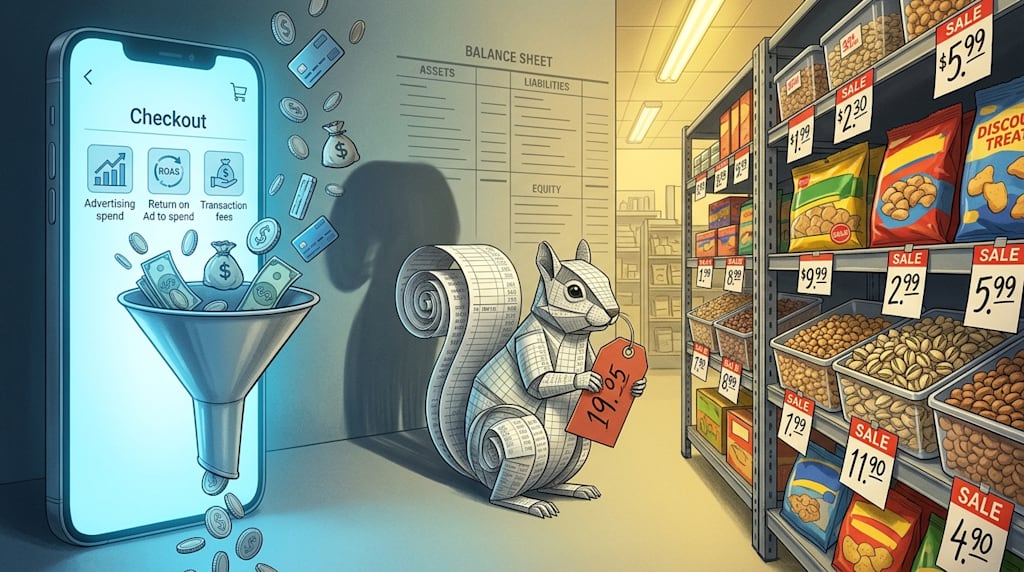
In January 2026, Three Squirrels raised the ex-factory prices of some nut gift products in its offline distribution channel. The products included pistachios, almonds, sunflower seeds, and dried mango. The increase ranged from 0.2 yuan to 10 yuan per item. A regional distributor said two things on the phone: although the increase covered only some New Year products and came with a buffer period, it “could easily cause customer loss”; and “since last year, consumers have not been very willing to pay for high-end products.”
Those two sentences landed in the same week. In that same week, a newly opened Haoxianglai store in a county town hung up an opening banner, and a price tag for bulk pistachios was stuck on the edge of the shelf.
Three Squirrels’ net profit excluding non-recurring items for the first three quarters of 2025 was 57.1371 million yuan. A year earlier, that figure was still in the hundreds of millions. The year-on-year decline was 78.57%. Revenue was 7.759 billion yuan, up 8.22%. Net profit attributable to shareholders was 161 million yuan, down 52.91%. Put the three numbers together: revenue is climbing, profit is sliding, and the profit left after excluding non-recurring items is only a fraction of what it was.
Cash flow is tighter than profit. Net cash flow from operating activities was negative 506 million yuan, down 1,690.52% year on year. Cash and cash equivalents shrank from 866 million yuan at the start of the year to 242 million yuan. Short-term borrowings were 576 million yuan, up nearly 60% from the start of the year. Cash on hand no longer covers short-term borrowings. That is a situation that does not need adjectives.
Where the money went: selling expenses were 1.605 billion yuan, up 24.03% year on year. The company’s explanation was “higher platform and promotion expenses.” In the third quarter alone, the selling expense ratio was 21.33%. For every 100 yuan sold, 21 yuan went to platforms and promotion channels. R&D expenses for the first three quarters were 23.9402 million yuan, or 0.33% of revenue. In 2021, that ratio was still 0.6%. In the third quarter, the R&D expense ratio recovered to 0.60%, but the absolute level remains at the bottom of R&D intensity in the food industry.
A brand that built itself on nuts is spending more than one-fifth of revenue making people see it and three-thousandths of revenue making people want to buy it again. That ratio does not need an extra sentence of commentary.
But a low R&D expense ratio does not mean “it doesn’t taste good anymore” is simply a recipe problem. The more direct mechanism is in the expense structure. When customer acquisition costs keep eating into profit, the resources available for product iteration, supply-chain improvement, and localized flavors get compressed. The consumer perception of “getting worse” may be a slow drift after the product has long ranked low in resource allocation. That judgment needs sell-through data, repurchase rates, and a breakdown of average ticket size to verify. The expense structure only points in a direction.
Value-format snack stores are not simply “cheaper competitors.” Their power lies in the supply-chain structure: factory to terminal, with no layered distributors in between. Prices for well-known branded goods can be pushed more than 20% below traditional supermarkets. Store density then turns “buying snacks” from online search, price comparison, and waiting for delivery into a turn downstairs.
By the end of 2025, Mingming Henmang’s Snack Busy and Zhao Yiming Snacks had 21,948 stores, a net increase of 7,554 in one year. Wanchen Group’s Haoxianglai had 18,314 stores, a net increase of 4,128. Together, the two account for more than 75% of the value-format snack market’s top-two share. The industry had about 56,000 stores and channel scale of 223.4 billion yuan.
Three Squirrels’ offline distribution revenue in 2025 was 2.528 billion yuan, down 4.28%. Offline store business totaled 349 million yuan, down 13.6%. National Snack Stores had a net increase of just 2 for the year. There were 9 Life Stores and 58 Ai Discount stores. Set against a network of more than 20,000 stores, these numbers are not a contest at the same scale.
In the first half of 2025, Three Squirrels’ third-party e-commerce channel accounted for 78.42% of total revenue. Its foundation is still online. Value-format snack stores are in the offline daily business. They move the “grab a pack on the way” scenario from the phone screen to the entrance of the residential compound. Value-format stores are competing by moving the buying moment, not just by cutting prices. When 80% of a brand’s revenue comes from platform distribution, its room to maneuver in the face of an offline channel revolution is inherently limited.
Price increases can temporarily dress up revenue per unit. Three Squirrels’ full-year 2025 revenue was 10.189 billion yuan, down 4.08%. Net profit was 155 million yuan, down 61.9%. Revenue in its core nut category was 4.823 billion yuan, down 10.12%. Core category sales volume is contracting, and the price increase looks more like a passive move under pressure on the income statement. It makes gross profit per unit of revenue look a little better, but it does not answer “why should consumers keep choosing you outside the value-format store shelf.”
Cost pressure exists. In the first half of 2025, nut-producing regions were hit by weather, import tariff adjustments raised costs, and average raw material prices rose 5% to 8% year on year. But the timing is wrong. Value-format snack stores are educating consumers with prices, consumer confidence is low, and demand is concentrating in discount channels. At that moment, a branded snack company’s price increase reads as brand premium covering an efficiency gap. Distributor feedback may not represent all sell-through, but it reveals a mechanism: snacks are a low-threshold, highly substitutable category, and brand premium depends heavily on the subjective judgment that something is “worth it.” Once a price increase becomes linked to a perception of falling value for money, what is lost is not a single SKU but the brand’s default priority on the shelf.
Overall retail sales in leisure snacks grew at a compound annual rate of 1.3% from 2019 to 2025. From 2023 to 2025, the figures hovered at 472.1 billion, 469.6 billion, and 480.4 billion yuan. Total volume barely moved. But the structure is shifting: savory snacks grew at a compound rate of 3.0% over the same period; the value-discount channel grew at a near-78% compound rate over the past five years; penetration of snacks among older consumers is still low, and supply of health-oriented, functional, and age-appropriate products is increasing.
Growth moved rather than disappeared. It has moved from the brand-premium end to the supply-chain-efficiency end, from online search-based consumption to offline immediate consumption, and from a single young consumer group toward age segmentation. Three Squirrels’ nut mindshare and online operating capability have not vanished, but the channels and scenarios those advantages depend on are being repriced.
The January 2026 price-increase notice landed in the distributor’s WeChat. Next door, on the value-format snack store shelf, a price tag for bulk pistachios was stuck on the edge, and a consumer walked away with a bag. Both things happened in the same week. Three Squirrels’ profit excluding non-recurring items had already fallen to 57.1371 million yuan before that week began.
About the Creator
Jin
Writer of reamstories
https://reamstories.com/jin
Enjoyed the story? Support the Creator.
Subscribe for free to receive all their stories in your feed. You could also become a paid subscriber, letting them know you appreciate their work.
Comments
There are no comments for this story
Be the first to respond and start the conversation.