
Thermal Cameras Are Becoming the Eyes of a Smarter and Safer World
Growing Demand for Security, Industrial Automation, and Smart Surveillance Is Accelerating the Global Thermal Camera Market

The ability to see in complete darkness once seemed like something reserved for science fiction. Today, thermal cameras are making that capability a reality across industries ranging from defense and security to healthcare and industrial maintenance. As organizations seek smarter ways to monitor environments, improve safety, and prevent costly failures, thermal imaging technology is emerging as one of the most valuable tools of the modern era.
Unlike conventional cameras that depend on visible light, thermal cameras detect infrared radiation emitted by objects and convert heat signatures into visual images. This unique capability allows them to operate effectively in darkness, fog, smoke, and challenging weather conditions. As a result, thermal cameras have become indispensable in applications where visibility and accuracy are critical.
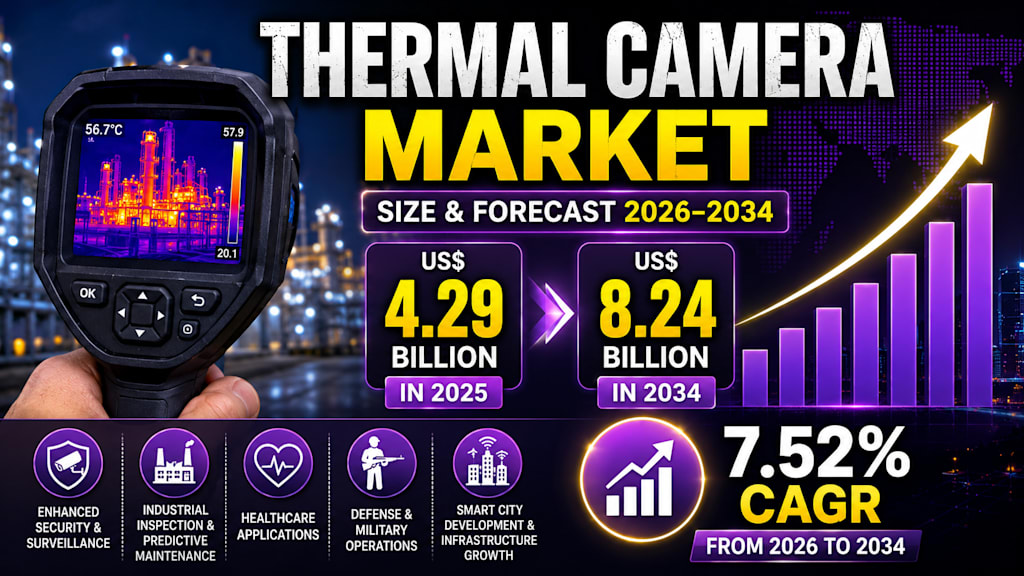
According to Renub Research, the global Thermal Camera Market is projected to grow from US$ 4.29 billion in 2025 to US$ 8.24 billion by 2034, registering a compound annual growth rate (CAGR) of 7.52% between 2026 and 2034. Growth is being driven by increasing adoption in security and surveillance, industrial inspection, healthcare, and smart infrastructure projects. Additionally, advancements in imaging technology and the growing demand for night vision solutions are creating new opportunities across global markets.
As governments, businesses, and consumers become increasingly focused on safety and efficiency, thermal imaging technology is rapidly becoming a cornerstone of modern monitoring systems.
Understanding the Power of Thermal Imaging
Thermal cameras operate differently from standard cameras. Rather than relying on visible light, they detect heat energy emitted by objects and convert temperature variations into detailed images.
Every object with a temperature above absolute zero emits infrared radiation. Thermal cameras capture this radiation and create visual representations based on temperature differences. Warmer objects typically appear brighter, while cooler objects appear darker.
This capability enables thermal cameras to perform tasks that ordinary cameras cannot accomplish. They can identify people in complete darkness, locate overheating machinery, detect hidden electrical faults, and monitor environments where visibility is compromised.
The versatility of thermal imaging has made it valuable across a wide range of industries. From military operations and border security to predictive maintenance and healthcare screening, thermal cameras continue to find new applications as technology evolves.
Security and Surveillance Are Driving Market Growth
One of the strongest growth drivers for the thermal camera market is the increasing demand for advanced security and surveillance systems.
Governments and private organizations worldwide are investing heavily in technologies that improve threat detection and situational awareness. Thermal cameras offer distinct advantages because they can identify heat signatures regardless of lighting conditions.
In military and defense operations, thermal cameras support border surveillance, target detection, reconnaissance missions, and night-time navigation. Their ability to function in darkness and adverse weather conditions makes them essential tools for modern defense strategies.
Law enforcement agencies also use thermal imaging for search-and-rescue operations, suspect tracking, and public safety monitoring. Airports, transportation hubs, and critical infrastructure facilities rely on thermal cameras to enhance security and reduce vulnerabilities.
The growing integration of thermal imaging with artificial intelligence is further expanding its capabilities. AI-powered surveillance systems can automatically identify unusual activity, classify threats, and improve response times.
As security concerns continue to rise globally, thermal cameras are expected to remain an integral part of surveillance infrastructure.
Industrial Applications Are Expanding Rapidly
Beyond security, thermal cameras are becoming increasingly important in industrial and commercial environments.
Industries such as manufacturing, oil and gas, utilities, and energy production use thermal imaging to monitor equipment performance and identify potential failures before they occur. This process, known as predictive maintenance, helps organizations reduce downtime and avoid costly repairs.
Thermal cameras can quickly detect overheating motors, electrical faults, insulation failures, and mechanical abnormalities. Maintenance teams can address issues proactively rather than waiting for equipment breakdowns.
In construction and building inspection, thermal imaging is used to identify heat leaks, moisture intrusion, insulation deficiencies, and structural problems. These capabilities help improve energy efficiency and building performance.
The ability to conduct non-contact inspections makes thermal cameras especially valuable in hazardous environments where direct access may be dangerous or impractical.
As industries continue adopting automation and data-driven maintenance strategies, demand for thermal imaging solutions is expected to increase substantially.
Technology Advancements Are Making Thermal Cameras More Accessible
Historically, thermal cameras were expensive devices primarily used by military organizations and large industrial enterprises. However, technological advancements are changing that reality.
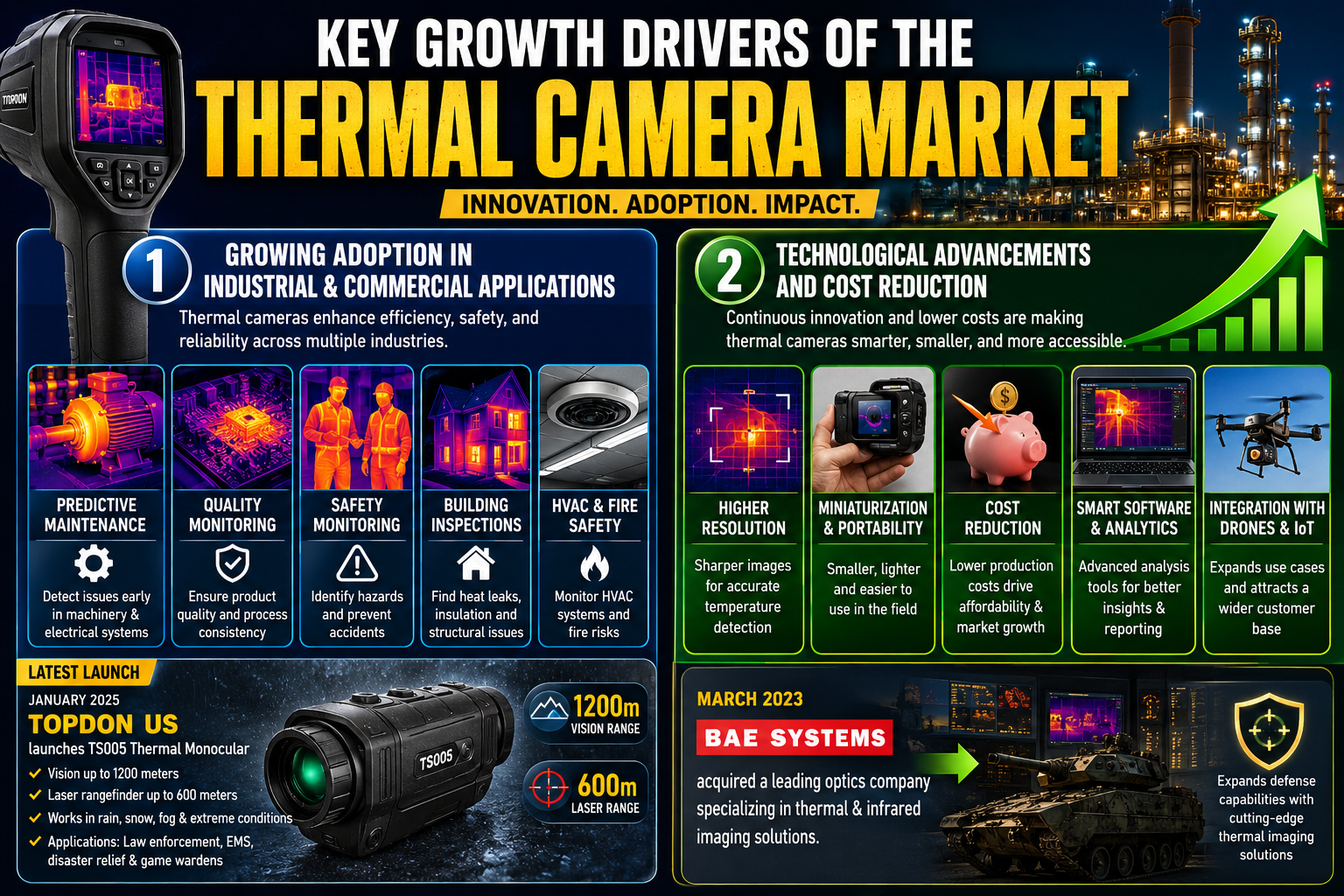
Improvements in sensor technology, image resolution, miniaturization, and manufacturing processes have significantly reduced production costs. As a result, thermal cameras are becoming more affordable and accessible to a broader range of users.
Manufacturers are introducing compact thermal cameras designed for home inspections, outdoor activities, automotive applications, and small business operations. Some smartphones and smart devices now even incorporate thermal imaging capabilities.
Advancements in software are also enhancing usability. Modern thermal cameras feature improved image processing, cloud connectivity, artificial intelligence integration, and real-time analytics.
The growing compatibility of thermal imaging systems with drones, robotics, and Internet of Things (IoT) platforms is creating entirely new opportunities for innovation.
As costs continue to decline and functionality improves, thermal cameras are expected to reach an increasingly diverse customer base.
Smart Cities Are Creating New Opportunities
The rise of smart city initiatives is contributing significantly to thermal camera adoption worldwide.
Cities are investing in intelligent infrastructure designed to improve safety, efficiency, and resource management. Thermal imaging plays a crucial role in many of these systems.
Thermal cameras support traffic monitoring, public safety operations, infrastructure inspection, and emergency response activities. They help authorities detect unusual events, monitor crowded areas, and improve situational awareness.
In transportation networks, thermal imaging enhances visibility during adverse weather conditions and supports automated monitoring systems. Railway operators, airports, and highways increasingly use thermal cameras to improve operational safety.
Smart city projects also emphasize sustainability. Thermal imaging can identify energy losses in buildings and infrastructure, helping municipalities improve efficiency and reduce environmental impact.
As governments continue investing in smart infrastructure, thermal imaging technology is likely to become an essential component of urban development strategies.
Healthcare Applications Continue to Grow
The healthcare industry has emerged as another important market for thermal imaging technology.
Thermal cameras provide non-contact temperature measurement capabilities, making them useful for patient screening and public health monitoring. Their importance became particularly evident during the COVID-19 pandemic when organizations used thermal imaging systems to identify individuals with elevated body temperatures.
Healthcare providers are also exploring additional applications such as inflammation detection, vascular assessments, and diagnostic support.
Because thermal imaging does not require physical contact, it offers a convenient and hygienic method for monitoring temperature-related conditions.
As healthcare facilities continue embracing advanced technologies, thermal imaging is expected to play an increasingly important role in patient care and preventive health measures.
Handheld Thermal Cameras Are Gaining Popularity
Among various product categories, handheld thermal cameras are experiencing strong demand.
These portable devices provide flexibility and convenience for professionals working in construction, electrical maintenance, firefighting, and facility management. Users can perform inspections quickly and efficiently without requiring complex installations.
Handheld thermal cameras enable real-time diagnostics and immediate decision-making. Their portability makes them particularly valuable for field technicians and maintenance teams.
Small and medium-sized enterprises are increasingly adopting handheld thermal imaging solutions because they offer practical functionality at relatively affordable price points.
As awareness of predictive maintenance and workplace safety grows, demand for handheld thermal cameras is expected to increase significantly.
Defense and Aerospace Continue to Lead Premium Demand
While commercial applications are expanding rapidly, defense and aerospace remain among the largest users of advanced thermal imaging systems.
Cooled radiation detector thermal cameras are widely used in military applications because of their exceptional sensitivity and long-range imaging capabilities. These systems can detect minute temperature differences and generate highly detailed images even under challenging conditions.
Military forces rely on thermal imaging for surveillance, target acquisition, navigation, and reconnaissance operations. Aerospace organizations also use thermal cameras for testing, monitoring, and scientific research.
Although these systems are more expensive and require specialized maintenance, their performance capabilities make them indispensable in mission-critical environments.
Government defense spending continues to support innovation within this segment, ensuring ongoing technological advancements.
Challenges Facing the Thermal Camera Market
Despite strong growth prospects, the thermal camera market faces several challenges.
One major obstacle is the relatively high cost of advanced thermal imaging systems. While prices have decreased significantly, premium cameras remain expensive for many small businesses and individual users.
Limited awareness is another challenge, particularly in developing economies where traditional inspection methods continue to dominate. Many organizations are still unfamiliar with the full range of applications and benefits offered by thermal imaging.
Technical limitations also exist. Factors such as reflective surfaces, heavy rain, dense fog, and environmental interference can affect image quality and accuracy.
Furthermore, thermal cameras cannot see through walls or glass, which can sometimes limit their effectiveness depending on the application.
Continued innovation, education, and cost reduction will be critical to overcoming these barriers.
Regional Markets Show Strong Growth Potential
The United States remains one of the most advanced thermal camera markets due to strong demand from defense, industrial, and commercial sectors. Ongoing investments in surveillance systems, smart infrastructure, and automation continue to drive growth.
The United Kingdom is witnessing increasing adoption of thermal imaging across transportation, infrastructure, security, and healthcare sectors. Government initiatives focused on energy efficiency and public safety are supporting market expansion.
India is emerging as one of the fastest-growing markets. Rapid industrialization, smart city development, infrastructure modernization, and growing awareness of advanced technologies are creating significant opportunities for thermal camera manufacturers.
Saudi Arabia is also investing heavily in surveillance, infrastructure, and industrial development. Thermal imaging plays an important role in security operations, oil and gas monitoring, and smart city initiatives throughout the region.
Final Thoughts
Thermal cameras have evolved from specialized military tools into versatile technologies with applications across nearly every major industry. Their ability to detect heat signatures, operate in complete darkness, and provide valuable real-time insights makes them indispensable in today's increasingly connected world.
From protecting borders and monitoring industrial equipment to supporting healthcare screening and enabling smart cities, thermal imaging technology is helping organizations improve safety, efficiency, and decision-making.
According to Renub Research, the Thermal Camera Market is expected to grow from US$ 4.29 billion in 2025 to US$ 8.24 billion by 2034, reflecting strong global demand and continued technological innovation.
As imaging technology becomes more advanced, affordable, and accessible, thermal cameras are likely to become even more deeply integrated into everyday life. In a world where visibility, safety, and data-driven decisions matter more than ever, thermal imaging is proving to be one of the most powerful tools shaping the future.
About the Creator
Enjoyed the story? Support the Creator.
Subscribe for free to receive all their stories in your feed.
Comments
There are no comments for this story
Be the first to respond and start the conversation.