
The Yen’s Last Stand
How Japan lost control of its currency in the "exchange rate war" — and why three decades of addiction to zero‑interest rates have locked the world’s third‑largest economy into a self‑destructive loop from which it cannot escape.
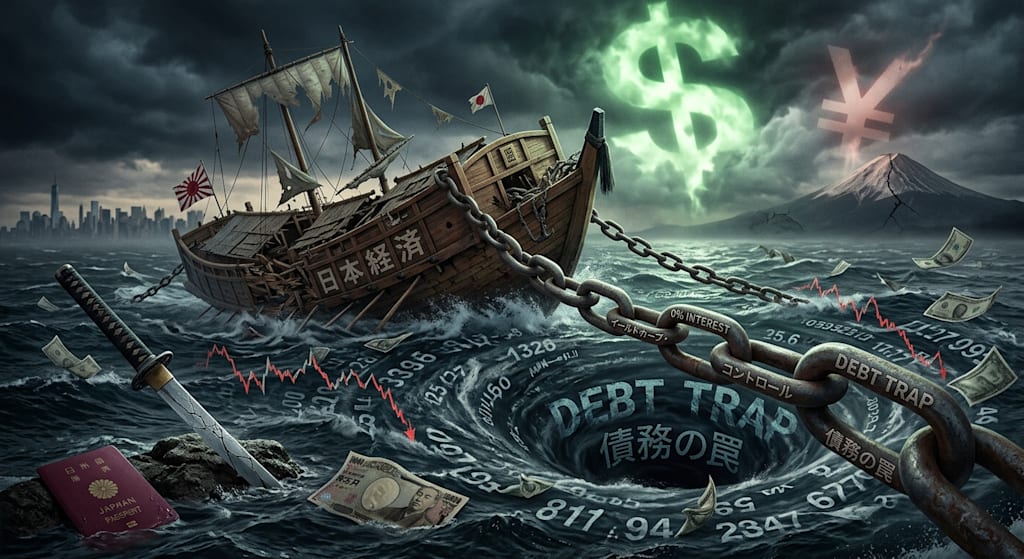
159.5: The Position After a Failed Intervention
On July 29, 2026, the yen touched 163.9 against the dollar. That was its lowest level since 1986.
Japan’s Ministry of Finance stepped in that afternoon. The U.S. Treasury coordinated its own action the next day. It was the first joint currency intervention by the two countries since 1998. Market estimates put Japan’s single‑day sales at roughly $59 billion in reserves, buying yen in return.
By August 3, the yen had risen to 155.2. The intervention window closed.
On August 21, the yen was back at 159.5. All the gains had been erased.
An August 12 Nikkei commentary used a historical photograph of General Douglas MacArthur’s 1945 landing in Japan as its accompanying image. The headline read: “Japan Loses the Currency War.” The defeat did not refer to a single trading loss. It referred to the government’s loss of control over the currency’s directional trend.
Japan still holds the world’s second‑largest foreign exchange reserves. As of June 2026, official reserve assets stood at roughly $1.28 trillion. It is also the largest foreign holder of U.S. Treasuries, with about $1.1 trillion in holdings. These instruments have not failed. But they face a more fundamental opponent under the current structure: the interest rate differential between Japan and the United States, and the institutional inertia that maintains it.
I. The Interest Rate Differential Generates a Persistent Yen Sell‑Order
In August 2026, the Federal Reserve’s target range for the federal funds rate stood at 3.5%–3.75%. The Bank of Japan’s policy rate was 1.0%.
The spread was about 250 basis points.
This created a calculable arbitrage path: borrow yen, swap into dollars at the spot rate, buy six‑month U.S. Treasury bills, and upon maturity, convert back to yen to repay the loan. After hedging costs, annualized returns still ran between 1.8% and 2.2%. Without hedging – on the expectation that the yen would continue to weaken – returns were higher.
This is not speculative activity in a negative sense. Japanese domestic banks, insurance companies, pension funds, and corporate treasury departments all run similar arithmetic. Bank of Japan data show that in the first half of 2026, net outflows of portfolio investment in foreign securities by Japanese institutional investors reached 12.7 trillion yen, up 23% year‑on‑year. Over the same period, yen short positions in retail margin foreign exchange trading held between 72% and 78%.
Every such transaction sells yen and buys dollars in the spot market.
The Ministry of Finance’s intervention works in the opposite direction: selling dollars and buying yen. But intervention does not eliminate the source of the sell orders. As long as the interest rate differential exists, new sell orders are generated every day. Intervention creates a concentrated, localized buy‑side shock, but it does not change the daily direction of fund flows.
The reason the July 29 to August 3 intervention was able to push the yen from 163.9 to 155.2 was not that $59 billion in buying was large enough to reverse the market. It was that a large number of short positions were forced to cover that day. The appreciation triggered stop‑loss orders, and those covers generated additional buying, creating a short‑term positive feedback loop. Once the stop‑loss positions were digested, the market reassessed the underlying conditions, and selling resumed.
On August 21, the yen was back at 159.5, retracing about 85% of the post‑intervention decline.
II. The Cost of Raising Rates Is Beyond What the Fiscal System Can Bear
The most direct way to change the interest rate differential is for the Bank of Japan to raise rates. If the policy rate rose to 3%, the spread would shrink to 50–75 basis points, the profit margin on carry trades would vanish, and yen short positions would contract significantly.
The Bank of Japan has not done so.
The reason is not that the central bank is unwilling to curb depreciation. The impact of higher rates on Japan’s public finances is certain.
As of the end of March 2026, Japan’s government debt balance stood at 1,286 trillion yen, or about 241% of GDP. Of that, central government bonds accounted for roughly 1,065 trillion yen. The weighted average coupon on these bonds was approximately 0.8%, with a remaining average maturity of about 8.2 years.
If the rate on newly issued government bonds rose to 3%, the effects would be layered.
First: new financing. In fiscal 2026, the Japanese government plans to issue about 38 trillion yen in new bonds. If this entire tranche were issued at 3%, annual interest costs would increase by about 1.14 trillion yen, compared with about 304 billion yen at the current 0.8% rate – a difference of roughly 836 billion yen.
Second: refinancing. Approximately 100–120 trillion yen in bonds mature each year and must be rolled over. These refinanced bonds would also be subject to the new rates. The Ministry of Finance estimates that if the refinancing rate on all maturing debt rose from current levels to 3%, annual interest payments would increase by about 4.2 trillion yen within three years.
Third: floating‑rate debt. Although coupons on outstanding bonds are fixed, about 35% of Japanese government bonds are floating‑rate or short‑term discount instruments that reprice quickly with the policy rate. This portion amounts to roughly 370 trillion yen. For every 1 percentage point increase in rates, annual interest costs rise by an additional 3.7 trillion yen.
Aggregating these layers, an internal Ministry of Finance projection submitted in July 2026 showed that if the policy rate rose to 3% and remained there, Japan’s interest payments on government bonds in fiscal 2028 would reach approximately 17.5 trillion yen – 24% of projected tax revenue (about 72 trillion yen), compared with 13.6% in fiscal 2025.
This does not yet include pressures from social security, defense, and local transfers. Ministry of Internal Affairs and Communications data show that Japan’s population aged 65 and older reached 29.8% in 2026. Social security expenditures grow naturally by about 1.2 trillion yen per year. Defense spending in fiscal 2026 is 6.8 trillion yen, 1.7 times its level in 2019. Fiscal rigidity is expanding, not contracting.
Rate increases would also affect financial institutions’ asset sides. The Bank of Japan holds about 540 trillion yen in government bonds, commercial banks hold about 280 trillion yen, and insurers and pension funds hold about 160 trillion yen. Rising bond yields mean the market value of these existing bonds falls. The Bank of Japan had already recorded about 1.7 trillion yen in valuation losses on its bond holdings in its semi‑annual financial statements for the first half of 2026. If the 10‑year JGB yield rose from the current 2.9% to 3.5%, unrealized losses across the domestic banking system would expand to about 7 trillion yen.
These losses would not immediately trigger bankruptcies, but they would compress banks’ lending capacity. The Bank of Japan’s July 2026 Financial System Report noted that if long‑term rates rose another 50 basis points, 12 regional banks would see their regulatory capital adequacy ratios fall below the caution level.
The corporate side is equally sensitive. A second‑quarter 2026 Bank of Japan corporate financing survey found that about 34% of small and medium‑sized enterprises said that “if rates rise above 2%, debt servicing would become difficult.” These firms employ about 68% of Japan’s workforce. Raising rates would directly suppress wages and employment even as it reduced the exchange rate.
The Bank of Japan knows these numbers. The foreign exchange market knows that the Bank of Japan knows these numbers. That is why, every time yen depreciation pressure rises, the market does not fear a large rate hike – the market is certain the central bank does not dare.
III. Low Interest Rates Are No Longer a Policy but an Institution
Japan did not begin relying on low rates in 2022.
In February 1999, the Bank of Japan cut its policy rate to 0%, becoming the first major economy to adopt a zero‑rate policy. In the 26 years since, Japan has had its policy rate below 0.1% for 18 of them. Negative rates ran from January 2016 to March 2024 – a stretch of eight years.
The original justification was to combat deflation. After the asset bubble burst in the 1990s, corporate debt far exceeded assets, and bank bad debts piled up. Japanese companies’ priority shifted from “expansion” to “debt repayment.” Firms cut investment, reduced inventories, and trimmed hiring. Household income fell, consumption declined, and prices began to drop.
From 1998 to 2012, Japan’s core CPI changed at an average annual rate of -0.3%. Households formed the expectation that “prices will not rise.” Companies were reluctant to raise prices and also reluctant to raise wages, because wage increases would force price increases, and price increases would drive away customers. Demand and supply pushed each other downward, forming a deflationary equilibrium.
In that environment, low rates kept the economy from contracting too quickly. Zero rates allowed the government to borrow at extremely low cost for public works and bad‑debt disposal. Companies could maintain working capital at extremely low cost. Banks could obtain liquidity at extremely low cost and did not have to rush to recover non‑performing loans.
The problem is that this arrangement persisted for too long.
In 2013, Shinzo Abe launched “Abenomics,” upgrading monetary easing from a “crisis response” to a policy of deliberately weakening the yen to stimulate exports and inflation. The Bank of Japan embarked on large‑scale government bond purchases and introduced yield curve control, anchoring the 10‑year JGB yield target near 0%.
At the time, the yen was at extremely strong levels of 75–80 against the dollar. A weaker yen did improve export corporate profits. From 2013 to 2018, ordinary profits of listed manufacturing companies rose by about 2.3 times, with the exchange rate contribution accounting for roughly 40% of that increase.
But the improvement in export profits did not translate into domestic investment growth. Cabinet Office data show that from 2013 to 2023, Japanese companies’ domestic fixed investment grew at an average annual rate of 1.7%, while overseas direct investment grew at 8.2%. Companies allocated profits abroad instead of expanding factories at home.
This meant that the weak yen’s boost to domestic employment and wages diminished over time. Manufacturing employment in Japan stood at 10.8 million in 2018 and fell to 10.2 million by 2026. Over the same period, overseas manufacturing employees increased from 4.1 million to 5.6 million.
The dividends of a weak yen stayed in corporate offshore accounts. The costs stayed in domestic households’ expenditure.
IV. A Self‑Locking Loop
Connecting the above mechanisms produces a causal chain:
The Bank of Japan maintains low rates to protect fiscal and financial systems.
Low rates widen the Japan‑U.S. interest rate differential.
The differential drives capital from the yen to the dollar.
The yen depreciates.
Depreciation raises import prices. Japan’s energy self‑sufficiency is about 11%; its calorie‑based food self‑sufficiency is about 38%. Crude oil, LNG, coal, grains, feed, and meat are all heavily import‑dependent.
In the first half of 2026, Japan’s import price index (yen basis) rose 14.2% year‑on‑year, while the export price index rose 3.7%. The deterioration in the terms of trade means Japan must export more physical goods to buy the same volume of imports.
From January to July 2026, Japan’s cumulative trade deficit reached 5.8 trillion yen, 1.6 times the level of the same period a year earlier.
A deficit means sustained “sell yen, buy dollar” real demand pressure in the foreign exchange market. This is not financial speculation; it is dollar buying generated by physical import payments.
Rising import prices feed into domestic consumer prices. In July 2026, Japan’s CPI (excluding fresh food) rose 3.1% year‑on‑year, with energy and food contributing 2.4 percentage points. On the wage side, total cash earnings in the first half of 2026 grew only 1.9% year‑on‑year, and real wages fell 1.2%.
Household real purchasing power declines, and consumption falls. In the second quarter of 2026, Japan’s real consumer spending fell 0.8% quarter‑on‑quarter.
To ease inflationary pressure on households, the Japanese government announced in May 2026 an expansion of gasoline and electricity subsidies and extended a consumption tax reduction on certain foods through March 2027. These measures total about 2.3 trillion yen, all funded by supplementary budget bond issuance.
Fiscal spending increases, and bond issuance increases. The heavier the debt, the more the Bank of Japan dares not raise rates. Rates stay low, the spread persists, capital continues to flow out, and the yen continues to face depreciation pressure.
This is the self‑replicating structure embedded in Japan’s economic operation: low rates generate depreciation, depreciation generates inflation, inflation generates subsidies, subsidies generate new debt, and new debt reinforces low rates.
V. Intervention Is Defense, Not Reversal
Japan’s Ministry of Finance conducted multiple foreign exchange interventions between 2024 and 2026.
From April to May 2024, three interventions together deployed about 9.8 trillion yen. In May 2025, a single‑day intervention used about 3.5 trillion yen. In July 2026, the joint intervention used about 8.7 trillion yen (estimated). The three episodes together total about 22 trillion yen, or roughly $150 billion.
Each intervention followed a similar pattern: it entered after the exchange rate had broken through a certain round‑number level, pushed the yen up by 100–300 pips, and then gave back more than half of those gains within one to two weeks.
The effectiveness of intervention is constrained by a simple fact: while the Ministry of Finance is selling dollars, the Bank of Japan has not tightened yen supply. The policy rate has not changed. Bond purchases have not stopped. The market can still obtain ample low‑cost yen – precisely the raw material required for carry trades.
Market participants treat intervention as a “one‑off shock” rather than a “trend reversal.” After the shock passes, the cost of re‑establishing short positions is merely the bid–ask spread between covering at the intervention highs and reopening lower.
The July 2026 joint intervention was seen as an escalation because the participation of the U.S. Treasury added political weight. But the joint intervention also did not change interest rate conditions. The Fed did not promise to cut rates. The Bank of Japan did not promise to raise them. The supply of dollars in the foreign exchange market temporarily decreased, but the supply of yen remained ample.
What intervention actually does is change the pace of depreciation, not its direction. It turns a rapid slide (5% in a few weeks) into a grinding, volatile weakening (3% over several months), while raising the friction cost of one‑sided yen bets.
As long as the market believes that policy rates will not catch up with the U.S. quickly, intervention cannot reverse long‑term fund flows. The yen’s return to 159.5 on August 21, 2026, confirms that.
VI. Conditions for a Stronger Yen
For the yen to return to 140 or even 130, one of the following conditions would need to hold:
Condition 1: The Fed cuts rates.
If the U.S. economy slows and the Fed enters a rate‑cutting cycle, the Japan‑U.S. spread shrinks from 250 basis points to below 100 basis points, the risk‑free profit from carry trades disappears, and yen short positions will be substantially reduced. Yen appreciation would be driven primarily by dollar weakness, and Japan would not have to bear the cost of rate hikes.
This is the path most desired by the Japanese government. In August 2026, market pricing implied a roughly 45% probability of a 50‑basis‑point Fed cut by December 2026 and a roughly 38% probability of a 75‑basis‑point cut by March 2027. But these probabilities shift monthly with U.S. inflation data and are not certain.
Condition 2: Japan raises rates to a sufficiently high level.
If the Bank of Japan lifted the policy rate to 2.5%–3%, carry profits would disappear and the yen could strengthen into the 135–145 range. But as described above, this would produce explicit losses in the fiscal, financial, and corporate sectors. The Bank of Japan’s public communications still emphasize “gradual adjustment,” and expectations for the remainder of 2026 are for at most a 25‑basis‑point hike.
Condition 3: A sharp yen depreciation triggers a structural policy response.
If the yen breaks 170, domestic political pressures and corporate cost pressures may force unconventional policy reactions. Examples could include restrictions on foreign portfolio investment, a currency‑hedging tax, or mandatory reallocation of pension fund assets to domestic holdings. But these measures would involve capital controls, and as a G7 member, Japan faces a high threshold for implementation.
As of August 2026, none of these three conditions has been met.
VII. The Current Position
On August 21, 2026, USD/JPY closed at 159.5.
Japan’s 10‑year government bond yield stood at 2.92%; the 30‑year yield was at 4.05%.
The Nikkei 225 closed at 38,200, about 9% below its 2024 peak.
The Ministry of Finance has not announced a new round of intervention.
The Bank of Japan’s next policy meeting is scheduled for September 18–19. Market pricing shows a 62% probability of a 10‑basis‑point hike and a 38% probability of no change.
Foreign exchange reserves remain above $1.2 trillion, sufficient for a further intervention.
But the depletion of reserves has not changed the interest rate condition, nor has it changed the fiscal constraint.
Japan’s current state is this: it has the ability to push the yen higher at a given point in time, but it does not have the ability to keep the yen high over a sustained period. What it buys with its reserves is time – time to wait for U.S. rate cuts, time to wait for energy prices to fall, time to wait for wage growth to catch up with inflation.
Whether these waits materialize is not for Japan to decide unilaterally. What Japan can decide is whether, during this waiting period, it allows its interest rates to break free from institutional dependency. So far, it has not made that decision.
About the Creator
Jin
Writer of reamstories
https://reamstories.com/jin
Enjoyed the story? Support the Creator.
Subscribe for free to receive all their stories in your feed. You could also become a paid subscriber, letting them know you appreciate their work.
Comments
There are no comments for this story
Be the first to respond and start the conversation.