
The Web Application Firewall Market Is Expanding Rapidly as Cyber Threats Intensify
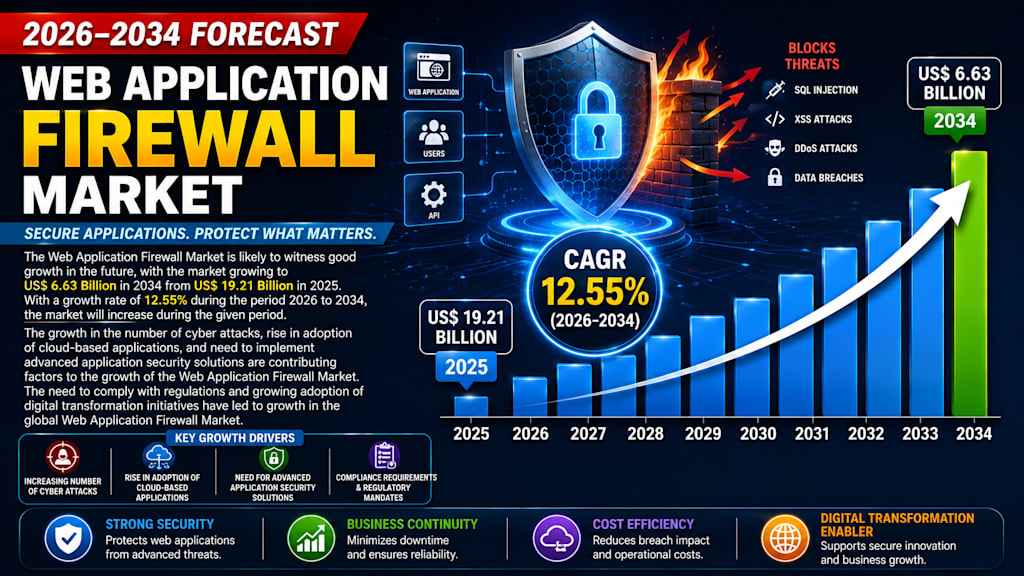
Rising cyberattacks, growing cloud adoption, and stricter data protection regulations are driving strong demand for web application firewall solutions worldwide. According to Renub Research, the global Web Application Firewall (WAF) market is projected to grow significantly through 2034 as businesses prioritize application-level security.

Cybersecurity Has Become a Business Necessity
As businesses increasingly shift operations online, cybersecurity is no longer viewed as an optional IT investment. It has become a core requirement for protecting customer data, maintaining business continuity, and preserving brand trust. Among the technologies gaining significant attention in this evolving digital landscape is the Web Application Firewall, commonly known as WAF.
Web applications are now central to banking, e-commerce, healthcare, government services, and cloud-based operations. However, this growing dependence on web infrastructure has also expanded the attack surface for cybercriminals. Organizations are facing a constant rise in threats such as SQL injection, cross-site scripting, credential stuffing, bot attacks, and ransomware campaigns.
According to Renub Research, the Web Application Firewall market is expected to witness substantial growth over the forecast period, supported by increasing digital transformation initiatives, cloud adoption, and the growing need for advanced application security solutions.
What Is a Web Application Firewall?
A Web Application Firewall is a cybersecurity solution designed to monitor, filter, and block malicious HTTP and HTTPS traffic between users and web applications. Unlike traditional firewalls that mainly protect networks, WAFs specifically defend against application-layer attacks targeting websites and APIs.
WAF systems can be deployed as cloud-based services, hardware appliances, or software solutions depending on organizational requirements. They use rule-based detection, behavioral analysis, and threat intelligence to identify and block suspicious activities in real time.
As organizations expand their digital ecosystems, web applications have become high-value targets for attackers. This has elevated WAF solutions from specialized security tools to essential components of enterprise cybersecurity strategies.
Cyberattacks Are Becoming More Sophisticated
One of the biggest drivers behind the WAF market’s rapid growth is the increasing frequency and sophistication of web-based cyberattacks. Organizations across industries are dealing with highly targeted attacks aimed at exploiting vulnerabilities in web applications and APIs.
The report highlights a major example involving Change Healthcare, where approximately 192.7 million individuals were reportedly affected in what was described as the largest data breach in U.S. healthcare industry history. Incidents like these have intensified awareness about the financial, legal, and reputational consequences of weak application security.
Cybercriminals are increasingly targeting organizations through techniques such as SQL injection, cross-site scripting, bot attacks, credential theft, and zero-day vulnerabilities. Traditional network firewalls are often insufficient against these application-level threats, making WAF solutions increasingly necessary.
As companies continue relying heavily on digital platforms and customer-facing applications, proactive application security is becoming a business-critical priority.
Cloud Computing Is Accelerating WAF Adoption
The rapid growth of cloud computing and digital transformation initiatives is another major factor driving the WAF market. Organizations worldwide are migrating applications and services to cloud environments to improve scalability, flexibility, and operational efficiency.
However, moving applications to the cloud also exposes them more directly to internet-based threats. As a result, businesses increasingly require cloud-compatible security solutions capable of protecting distributed digital infrastructure. Cloud-based WAFs are becoming particularly attractive because they provide scalability, automatic updates, global threat intelligence, and easier deployment compared to traditional on-premise systems.
The rise of e-commerce, online banking, SaaS platforms, APIs, and remote work environments has further accelerated demand for cloud-based application security tools.
The report notes that HCL Technologies was recognized as an Amazon Web Application Firewall Delivery Partner in June 2023, reflecting the increasing importance of cloud-based WAF services within modern IT infrastructure.
Data Protection Regulations Are Increasing Demand
Governments and regulatory authorities around the world are introducing stricter data privacy and cybersecurity regulations, creating additional pressure on organizations to strengthen application security.
Industries such as finance, healthcare, government, and e-commerce handle highly sensitive customer and operational data, making compliance a major concern. Web application firewalls help organizations meet regulatory requirements by providing traffic monitoring, threat detection, activity logging, and security controls that support compliance frameworks.
Failure to comply with data protection laws can result in severe financial penalties, lawsuits, and reputational damage. This is encouraging businesses to invest more aggressively in cybersecurity infrastructure.
The report highlights that India enforced the Digital Personal Data Protection Rules in 2025, further illustrating how governments are tightening cybersecurity and privacy regulations globally.
Complexity of Deployment Remains a Challenge
Despite growing demand, implementing and managing WAF solutions can still be technically challenging for many organizations. Proper deployment often requires specialized cybersecurity expertise and careful configuration to avoid operational issues.
Incorrectly configured WAF systems can generate false positives that block legitimate users, negatively affecting customer experience and business operations. Maintaining and optimizing WAF performance also requires continuous monitoring and updates, which can be resource-intensive for smaller organizations.
For companies with limited cybersecurity expertise, deployment complexity remains one of the major barriers to adoption.
Performance and Cost Concerns Continue
Another challenge affecting the market is the potential performance impact associated with real-time traffic inspection and filtering. High-traffic applications may require advanced optimization to maintain performance while applying security controls.
Advanced WAF features such as behavioral analytics, AI-powered threat detection, and sophisticated bot protection systems can also increase implementation costs. For some small and medium-sized enterprises, these expenses may create affordability concerns.
However, as cyber threats continue evolving, many organizations increasingly view these investments as essential rather than optional.
WAF Solutions Are Becoming More Advanced
The WAF solutions segment is growing rapidly as organizations seek stronger protection at the application layer. Modern WAF platforms offer advanced capabilities beyond simple traffic filtering, including intelligent threat analysis, API protection, bot management, and adaptive security controls.
The expansion of digital services, online commerce, and cloud infrastructure is making dynamic security solutions increasingly important for businesses operating in highly connected environments. Organizations now require security systems capable of adapting quickly to evolving cyber threats.
Large Enterprises Continue Leading Adoption
Large enterprises remain among the biggest users of WAF technologies due to the complexity and scale of their digital ecosystems. These organizations often manage multiple web applications, APIs, customer portals, and cloud-based services simultaneously.
Because they handle large volumes of sensitive customer and operational data, large enterprises are frequent targets for cybercriminals. WAF solutions help them manage risk through centralized visibility, advanced threat detection, and compliance support.
Large organizations also benefit from advanced integration capabilities, analytics, and customizable security settings that support enterprise-wide cybersecurity strategies.
Cloud-Based WAF Solutions Are Growing Fastest
The cloud-based WAF segment is one of the fastest-growing parts of the market. Cloud WAF solutions offer flexibility, scalability, automatic updates, and global threat intelligence without requiring complex hardware deployments.
These solutions are especially valuable for organizations operating e-commerce platforms, SaaS applications, APIs, and remote work environments with fluctuating traffic volumes. As businesses continue adopting hybrid and cloud-first strategies, cloud-based WAF demand is expected to grow further.
Governments and Healthcare Are Major Users
Government organizations are increasingly investing in WAF technologies to protect critical digital infrastructure and citizen data against cyber espionage, ransomware, and other attacks. As governments expand e-services and digital platforms, application security becomes increasingly important.
Healthcare is another rapidly growing sector for WAF adoption. Hospitals, healthcare providers, and telemedicine platforms rely heavily on web applications to manage electronic health records and patient services. These systems contain highly sensitive patient information, making them attractive targets for cybercriminals.
The growing digitization of healthcare is significantly increasing the need for stronger web application protection worldwide.
The United States Remains a Leading Market
The United States continues to dominate the WAF market due to its advanced digital economy and high exposure to cyber threats. Sectors such as finance, healthcare, retail, and technology rely heavily on web applications, making cybersecurity a critical priority.
Cloud computing adoption, strict data protection regulations, and widespread SaaS usage are further supporting strong demand for WAF solutions in the country. In August 2025, Akamai Technologies announced a strategic partnership with a major cloud service provider to enhance its WAF offerings and strengthen threat intelligence capabilities.
India and Saudi Arabia Are Emerging Strongly
India’s WAF market is growing rapidly due to the expansion of digital payments, e-commerce, IT services, and cloud adoption. The increase in startups, online businesses, and mobile internet usage is driving greater awareness of application security solutions.
The report notes that Utho Cloud introduced new Web Application Firewall services in 2025 to support enterprises migrating away from hyperscale cloud providers.
Saudi Arabia is also seeing steady market expansion as government initiatives related to smart cities, digital transformation, and e-government services continue accelerating. Cloud-based WAF solutions are becoming particularly popular due to their scalability and deployment flexibility.
The Future of Application Security
As businesses continue digitizing operations and customer interactions, web applications will remain among the most critical assets requiring protection. At the same time, cyber threats are becoming increasingly automated, intelligent, and financially damaging.
This environment is expected to drive sustained long-term demand for WAF technologies capable of delivering real-time application-layer security. Artificial intelligence, machine learning, automated threat intelligence, and cloud-native security architectures are likely to shape the next generation of WAF solutions.
Final Thoughts
The Web Application Firewall market is becoming increasingly important as organizations face rising cyber threats, stricter regulations, and expanding digital infrastructure. According to Renub Research, the market is expected to witness strong growth through 2034, supported by increasing cloud adoption, digital transformation, and growing awareness of application-level cybersecurity risks.
Although challenges such as deployment complexity and cost considerations remain, the long-term outlook for the industry remains highly positive. Businesses across sectors are recognizing that protecting web applications is no longer optional in an increasingly connected digital economy.
About the Creator
Enjoyed the story? Support the Creator.
Subscribe for free to receive all their stories in your feed.
Comments
There are no comments for this story
Be the first to respond and start the conversation.