
The Truth About Stop-Loss
Why Most Traders Die Halfway There — and the Three Hard Rules That Can Save Your Account
Most people who lose big money don't lose because they read the direction wrong.
On the contrary. They read it right—the direction, the trend, even the key turning point. But they died halfway there. Or put more precisely: they read it wrong, and then used "just hold a little longer" to walk themselves straight into a dead end.
Review any account‑blowing drawdown. Strip away all the indicators and news. The core that remains is always the same move: holding a losing position against the trend.
In the hours before their blow‑up, these traders almost always had a perfect chance to stop out. Price just wobbled near a key level. The unrealized loss wasn't yet catastrophic. One click and they could have walked.
They didn't click.
Ask ten people who've held losers. Nine will tell you: "I knew I shouldn't have held." The tenth will stay silent.
Between knowing and doing lies a gap most people never cross. This article cuts that gap open and shows you what's inside.
Your Fingers Don't Listen to Your Brain
Try a small exercise.
Recall the last time your unrealized loss exceeded 10%. Staring at the screen, did you feel your heartbeat speed up? Palms sweat? Breathing go shallow?
That wasn't your imagination.
Behavioral finance has a concept called loss aversion. The data says: the pain of losing $1,000 takes about $2,500 of gain to offset. The same number weighs two and a half times heavier on the losing side than on the gaining side.
When your paper loss jumps from 5% to 15%, your limbic system, the emotional part of your brain, starts pumping out cortisol and adrenaline. Your heart races, pupils dilate, muscles tighten. You enter a primitive stress state: fight or flight.
In that state, blood flow to your prefrontal cortex, the part responsible for logic and reasoning, gets reduced.
So the finger trying to click the stop‑loss button is controlled by your logical brain, while the voice telling you "wait a little longer" is controlled by your survival brain. In this battle for physiological resources, the logical brain loses from the start.
Then there is sunk cost.
You went long at 3550. Price drops to 3500. You are down 50 points. Deep in your subconscious, an anchor has been set: you have made 3550 your sole benchmark for right and wrong. As long as price hasn't returned to 3550, you tell yourself you haven't lost. You forget that the market has no idea where your entry price is. The market does not even know you exist.
You hold onto that 50‑point loss. In doing so, you miss the chance to re‑enter at 3400 on a fresh structure. You sacrifice the entire future of your account to salvage one mistake.
Skinner's Pigeons
Someone will say: "I had a reason to hold. It came back the last few times. Why not this time?"
Anyone who asks that has fallen into a subtle trap.
Look at the data. In natural fluctuation without external intervention, the market spends about 70% of its time in range‑bound oscillation and only 30% in a trending move.
That means a complete novice with no trading logic, who only knows how to hold and hope, has a 70% chance of "surviving" a losing position.
First time: he holds through a 10‑point drop, price comes back, he exits with 5 points of profit. He breathes a sigh of relief.
Second time: he holds through a 20‑point breakdown, price returns again. He closes the screen and thinks trading is no big deal.
The American psychologist B.F. Skinner ran a famous experiment. Put a pigeon in a box with a button. When the pigeon pecks, food sometimes drops out, sometimes not. This "not‑always" reward makes the pigeon peck obsessively until it drops from exhaustion.
It is called intermittent reinforcement. It is the underlying mechanism of every addictive behavior.
Holding losers works the same way. It occasionally rewards your stubbornness, occasionally punishes your rationality. This "uncertain reward" makes you hold more resolutely each time.
But that 70% range‑bound market is a trap. Its purpose is to cultivate your "hold‑at‑all‑costs" habit, so that when the 30% trend finally arrives, it can take you out in one sweep.
A clean trending move gives you no chance to bounce out. It pierces your first psychological line, your entry cost, then without a pause pierces your second line, your account warning level, and then races toward a price you never dared to imagine.
At that point, "stop‑loss" no longer exists in your system. Only prayer remains.
Stop‑Loss Is Falsification, Not Loss of Money
Holding is dangerous. Stopping out is hard. What do you do?
Upgrade "stop‑loss" from an operational concept to a cognitive framework. Erase the definition "stop‑loss means closing at a loss" from your mind.
Replace it.
Every trade you enter must be tied to a clear logical premise. Your stop‑loss level is not determined by how much you have lost, only by whether that logical premise still holds.
For example: you go long at a certain price because you see a key support level. Your premise is "this support holds, price will bounce here." The lowest point of that support is the Achilles' heel of your logic. Once price breaks below that level, by one point or ten, your premise has been invalidated by the market. You have no reason to stay in.
Under this framework, stop‑loss is no longer "I can't take it anymore, I'm out." It is "the market tells me the structure I expected no longer exists."
When your stop is triggered, you do not feel frustrated. You might even feel relieved: "So this was not the bottom. The market verified it. I can leave."
That unrealized loss number in your eyes stops being "money stolen from you." It becomes the reagent cost you paid to test a hypothesis.
Three Hard Rules
If all of this stays at "I get it intellectually," it is useless. Turn it into rules. Hardcode them into your system. Zero negotiation.
Rule One: Reverse Position Sizing.
First find your defense boundary. Suppose the key support you see is at 3000, and current price is 3020, a 20‑point gap. Your system says the maximum loss per trade is 2% of total capital. If your account is $100,000, 2% is $2,000.
Divide $2,000 by 20 points. That gives you 100.
That is your maximum position size for this trade. Position size is calculated, not guessed.
Once you have done the math, the worst‑case outcome is locked in. Fear has nowhere to attach.
Rule Two: The Defense Boundary Never Moves.
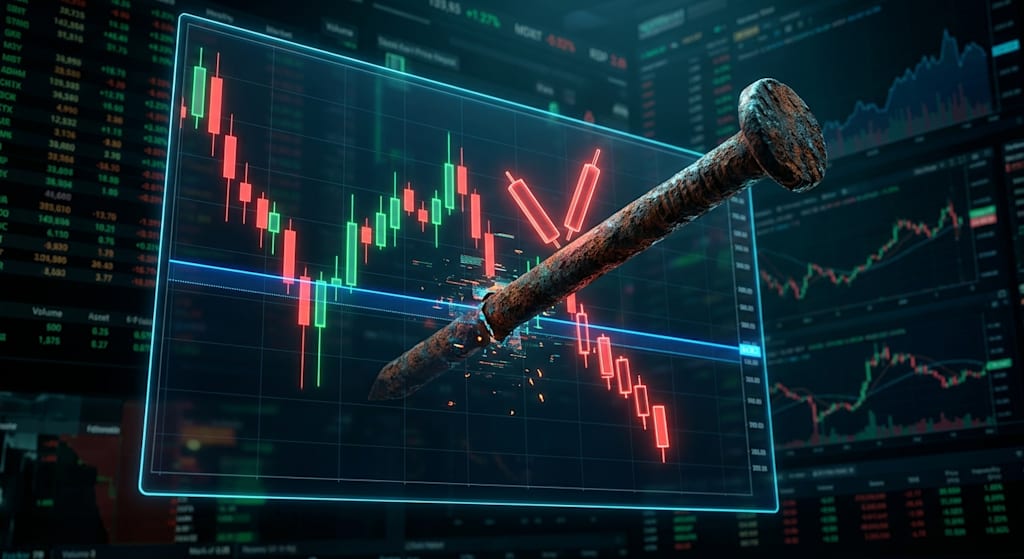
Once your stop‑loss order is placed at 3000, it is a nail driven into the market. No matter how price wobbles between 3020 and 3005, no matter how many times you think "maybe it is a false breakout," that order does not move.
Because the moment you allow yourself to move that boundary, even by 5 points, you have opened the door. Your system degenerates from "logic falsification" back to "subjective wishful thinking." Next time you will move it 10 points, then 20. One lucky escape, and your system is dead.
Rule Three: Adding to a Position Equals Opening a New One.
Many people blow up because they add to a losing position to "average down."
Change your perspective: any add‑on must be treated as an independent new position in your system. It needs its own entry logic, its own defense boundary, and its own position sizing.
If you add only because "price has dropped," what is the logical premise behind that add? "I don't think it will drop further." That itself is emotion, not structure. Once the drop accelerates, your losses grow exponentially.
Are You Waiting for Breakeven, or Waiting for Death?
One final question.
Why do so many people cling to their mouse, white‑knuckled, while their system is on the verge of collapse?
Because they hold a conviction: "As long as I don't close, I haven't lost yet. I will wait until I am back to breakeven and then get out."
The trap: in leveraged trading, breakeven is a crueler piece of math than loss.
You went all‑in long at a high. Price drops 50%. After a 50% drop, you need a 100% rally to get back to even. After a one‑sided decline, markets often face long, grinding consolidations. While you wait for that distant, uncertain breakeven, you have frozen your margin and your opportunity cost.
Over there, a clear long setup appears. You have no bullets left. You do not even have the mental energy to look.
Stop‑loss is not admitting you are wrong. Stop‑loss is actively cutting off the spread of error while you still have a choice.
You use this small, controlled loss to buy back your right to participate in the next trade and your account's right to survive.
That stopped‑out trade is like an amputated gangrenous organ. If you do not cut it off, the gangrene, the unrealized loss, spreads through the blood vessels, your position size, and infects the whole body, your account. The amputation hurts, but you survive.
As long as you survive, as long as there is still capital in your account, when the next system‑qualified trade appears, this current loss is just a sampling error in the running of your system.
But if you hold until the margin warning flashes red, until the broker's liquidation call comes, at that moment the loss is no longer an error. The loss becomes the final outcome.
One last thing.
Your stop‑loss line is your lifeline. They have always been the same line.
Profit is a gift the market gives you. You cannot control it. But loss is something you permit. You must have the final say.
Next time, when you stare at that unrealized loss number, your finger hovering over the mouse—
You are not closing a position.
You are redeeming your next right decision.
About the Creator
Jin
Writer of reamstories
https://reamstories.com/jin
Enjoyed the story? Support the Creator.
Subscribe for free to receive all their stories in your feed. You could also become a paid subscriber, letting them know you appreciate their work.
Comments
There are no comments for this story
Be the first to respond and start the conversation.