
The Split: How Buffett and Munger Paid Different Taxes to the Universe
One man bent down for a fish in a puddle; the other demanded a boiling ocean. Both caught something — and lost something else.
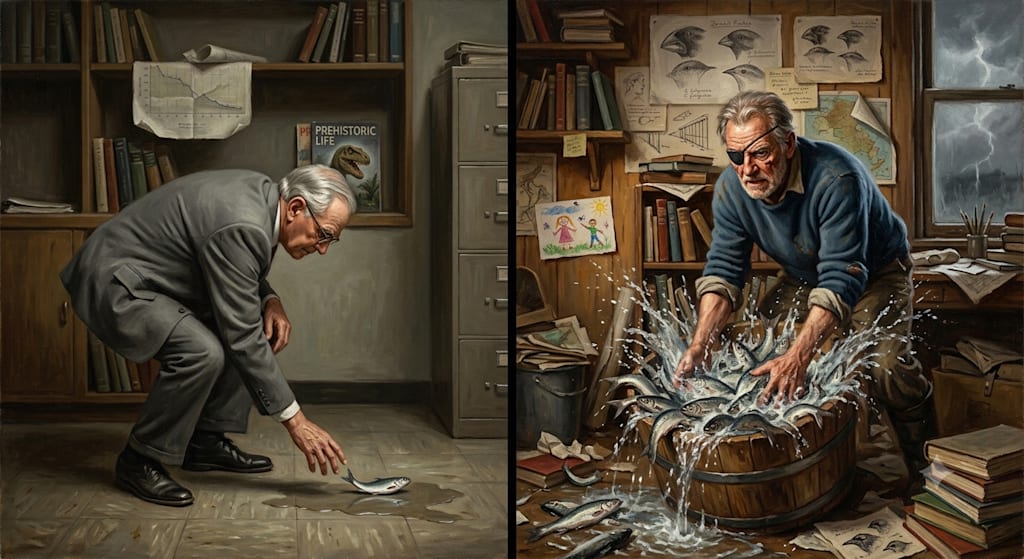
The crack between Buffett and Munger is clearest in a single sentence.
In 1965, Munger was still running his partnership fund. Late one night, he slid a thick stack of papers across the table to his partners, dense with formulas for a leveraged buyout. He said, "Make the bucket bigger. There's oil at the bottom of this well." That year, he pushed the fund's leverage to its limit. Nine years later, the well collapsed. From 1973 to 1974, the market crashed, and his fund's net value fell by seventy-five percent. He tacked a stock chart of Pacific Gas and Electric onto his study wall; the line had dropped to a splinter. Later, Munger tore the chart down, crumpled it, and threw it into the wastebasket. But he did not change buckets.
Buffett never tore up a chart. At the same market bottom in 1974, he sat in a dim office in Omaha's Kiewit Plaza, flipping through the stock tables in The Wall Street Journal the way a housewife flips through supermarket discount flyers. He bought The Washington Post for ten million dollars. At the time, the company was holding that much cash on its books. This required no "place where the fish are." The fish were flopping in the puddle at his feet. He only needed to bend down.
Their real divergence lies in that act of bending down.
Munger cannot abide the fish in the puddle. He needs more water. In 2002, he read a book about a Chinese battery manufacturer called BYD. He called Buffett. "Warren, I've found an Edison. He's going to build cars." On the other end of the line, Buffett was silent for so long that Munger thought the connection had dropped. Then Buffett said, "I don't understand China, and I don't understand batteries." Munger bought. Even after 2018, when Alibaba's stock price was tumbling from the peak all the way down the mountain, he was still adding to his position. He once said, "If there are no fish in your bucket and the pond next door is boiling with fish, standing beside an empty bucket and waiting isn't patience. It's stupidity." He switched ponds. He paid the premium. He broke his leg more than once, but he also landed very large fish.
For sixty years, Buffett has stood beside a single pond. In 1951, he knocked on the door of GEICO in the rain and spent four hours talking to the janitor. After that, he only invested in insurance, railways, consumer goods, banks, and, very occasionally, one or two technology companies that took him fifty years to "see clearly." In the 1990s, the dot-com bubble blasted every fish into the sky, and his pond looked small and dirty. *Barron's* put a dinosaur on its cover with the headline: "What's Wrong, Warren?" He placed the magazine on his shelf, next to the stack of Graham's books. Then he continued to wait. He waited for the bubble to burst, for all those people in scuba gear to blast the fish out of their own ponds, so the fish would come raining down into his puddle.
This difference is not a disagreement about investment strategy. It's a disagreement in the right hemisphere of the brain. It's a completely different understanding of the container that is the self.
When Buffett was thirty-six, his wife, Susan, left him and moved to San Francisco. He could not understand. He wrote Susan letters filled with numbers, filled with future financial plans, filled with assurances that he would ensure she and the children would never want for anything. He believed this was the full evidence of love. Susan never came back. In his entire life, he has only truly spoken one language: the language of certainty. A human life, in his eyes, is a piece of paper that can be folded into a compound-interest curve. He has never once imagined that he could understand rock and roll, or expressionist painting, or a woman who needs her partner to sit beside her on the sofa and talk every night. He says of himself, "I'm a realist. I've never had any illusions about myself." He has said this sentence for fifty years. When he says it, he is not being humble. He is stating a physical law.
Munger is different. After his divorce, he was alone, raising a crowd of children. His house quickly became a kind of noisy academic encampment. He scattered books on architecture, biology, and psychology all over the living room. Any child coming home from school had to be ready to answer an impromptu interrogation about Darwin or Freud. He told everyone that human beings should build a "latticework of mental models." At a shareholder meeting, when an investor asked a "stupid question," he would take off his glasses and spend five minutes explaining a basic concept from cognitive psychology before finally answering the question, when the questioner only wanted to know if Berkshire would repurchase shares the following year. At ninety-two, he was still on video calls with Chinese investors, patiently explaining why "you have to bet heavily when the opportunity comes." All his life, he tried to make the bucket bigger, to fill it with more water, more disciplines, more possibilities. He was not ignorant of the fact that this would cause spillage. He simply thought an empty bucket was too boring.
The fates of these two men therefore grew into entirely different shapes.
From age nine to age ninety-six, Buffett's compounding machine ran for eighty-seven years. Not a single shutdown. Not a single fatal system error. He sidestepped Vietnam and the oil crisis, sidestepped the millennium bubble, and sidestepped the tsunami of 2008. Even in 2020, when the entire airline industry ground to a halt, he simply and quietly sold all his airline stocks, like tossing an expired ticket into the bin. Over eighty-seven years, the god of fate dug countless pits for him. He fell into none of them. He saw through every trap. The price was that he also saw through every feast. His radius of life has never stretched much beyond a few miles of Omaha. He buys breakfast at McDonald's every morning. Before the market opens, he is already at his desk, having read five annual reports. His first wife left. His children maintain a polite, almost diplomatically formal distance from him. In a certain sense, he has defeated fate. He has forced the demon called Randomness to bow its head before him, utterly helpless.
Munger, on the other hand, was pinned to the ground by fate when he divorced at thirty, and was struck with another blow when he lost his eye at fifty-two. His investment record contains a loss that nearly shattered his spine, and his late-life portfolio held a bad debt that could have tarnished his entire legacy. The god of fate, like a cruel screenwriter, kept stuffing new plot twists into Munger's script—making him bankrupt, making him suffer, making him face mockery and doubt in his old age. But this also made his script ten thousand times more compelling than Buffett's dry compounding ledger. At his ninety-second birthday party, someone asked him about the blind left eye. He blinked, and aimed his one remaining eye—still sharp as a blade—at the questioner. "At least it taught me to see the essence of things with a single eye. That's more than most people see with two." He kept talking and talking, like a teacher who refuses to leave the classroom. And fate, from offstage, could only sullenly put away its scythe. It wounded him, countless times, but it never truly broke him. In the end, one month short of his hundredth birthday, he stopped.
These two men. One proved that pure rational discipline can reach the desolation of a god. The other proved the price that talent and flexibility must pay here on mortal earth. Before the god of fate, Buffett paid his tax and traded it for a lifetime of stillness, at the cost of human drought. Munger refused to pay the tax. He was fined until his body was covered with scars, but his life remained scorching hot and rich.
There is no winner or loser here. Only two choices, and two prices that must both be paid.
About the Creator
Jin
Writer of reamstories
https://reamstories.com/jin
Enjoyed the story? Support the Creator.
Subscribe for free to receive all their stories in your feed. You could also become a paid subscriber, letting them know you appreciate their work.
Comments
There are no comments for this story
Be the first to respond and start the conversation.