
The Rise of Non-Invasive Beauty: How Technology Is Redefining Aesthetic Treatments Worldwide
From injectables and laser therapies to AI-powered skin analysis and advanced med-spa services, non-invasive aesthetic treatments are becoming the preferred choice for consumers seeking natural-looking enhancements without surgery.

The global beauty industry is undergoing a profound transformation. For decades, cosmetic enhancement was often associated with surgical procedures, lengthy recovery periods, and significant physical commitment. Today, a new generation of aesthetic treatments is changing that perception entirely.
Consumers increasingly want cosmetic improvements that are effective, convenient, natural-looking, and minimally disruptive to their daily lives. As a result, non-invasive aesthetic treatments have emerged as one of the fastest-growing segments within the global healthcare and beauty sectors.
From wrinkle-reducing injectables and dermal fillers to laser skin rejuvenation, body contouring, hair removal, and energy-based skin tightening procedures, patients now have access to a wide range of options that deliver visible results without surgery.
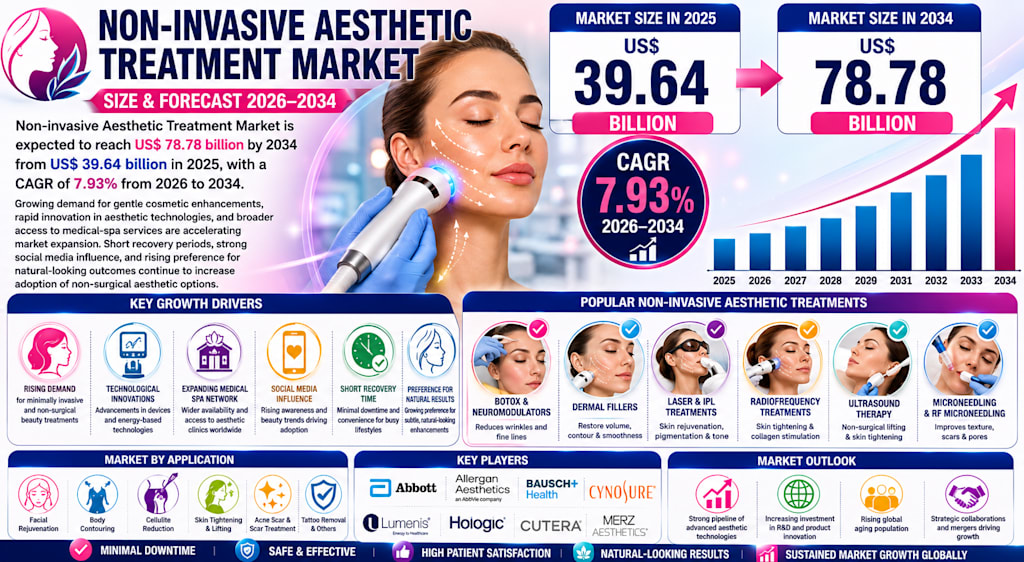
This growing demand is reflected in market projections. According to Renub Research, the Global Non-Invasive Aesthetic Treatment Market is expected to grow from US$ 39.64 billion in 2025 to US$ 78.78 billion by 2034, expanding at a compound annual growth rate (CAGR) of 7.93% between 2026 and 2034. Rising demand for minimally invasive cosmetic enhancements, continuous technological innovation, growing med-spa networks, and increasing social media influence are among the primary factors driving market expansion.
As beauty standards continue evolving toward subtle refinement and personalized enhancement, non-invasive aesthetic treatments are rapidly becoming the preferred solution for millions of consumers worldwide.
Understanding Non-Invasive Aesthetic Treatments
Non-invasive aesthetic treatments are cosmetic procedures performed without surgical incisions, general anesthesia, or extended recovery periods.
These procedures are designed to improve appearance through techniques that target skin quality, facial contours, body shape, hair growth, pigmentation issues, and visible signs of aging.
Unlike traditional cosmetic surgery, non-invasive treatments typically allow patients to return to daily activities almost immediately.
Popular procedures include:
Botulinum toxin injections, hyaluronic acid fillers, chemical peels, laser skin rejuvenation, photo rejuvenation, non-surgical fat reduction, skin tightening, and laser hair removal.
The appeal of these treatments lies in their ability to provide noticeable improvements while minimizing discomfort, risk, and downtime.
As technology continues advancing, the effectiveness of non-invasive procedures has improved dramatically, making them increasingly attractive alternatives to surgery.
Consumers Are Choosing Convenience Over Surgery
One of the strongest drivers of market growth is the growing preference for convenience.
Modern consumers often seek cosmetic improvements that fit into busy lifestyles without requiring lengthy recovery periods.
Traditional cosmetic surgery can involve weeks of healing, postoperative restrictions, and significant lifestyle disruption.
In contrast, many non-invasive treatments can be completed during a lunch break, with patients returning to normal activities immediately afterward.
This convenience has broadened the appeal of aesthetic procedures beyond traditional patient populations.
Working professionals, parents, younger consumers, and first-time aesthetic patients are increasingly exploring non-surgical options.
The ability to achieve gradual, natural-looking enhancements without major commitment continues driving adoption worldwide.
As consumer priorities increasingly focus on efficiency and minimal disruption, non-invasive treatments are expected to gain further momentum.
Social Media Is Transforming Consumer Awareness
Social media platforms have become powerful drivers of aesthetic treatment demand.
Platforms such as Instagram, TikTok, YouTube, and other visual content channels have fundamentally changed how consumers discover, evaluate, and discuss cosmetic procedures.
Influencers, beauty creators, dermatologists, and aesthetic practitioners regularly share treatment experiences, educational content, and before-and-after results.
This transparency has helped reduce uncertainty surrounding cosmetic treatments while increasing awareness among broader audiences.
Consumers now have access to extensive information regarding treatment options, expected outcomes, safety profiles, and recovery experiences.
The growing popularity of subtle enhancements rather than dramatic transformations has also been amplified through social media.
As online engagement continues increasing, digital platforms will remain important drivers of market growth.
Med-Spa Expansion Is Improving Accessibility
The rapid expansion of medical spas and aesthetic clinic networks has significantly improved access to non-invasive treatments.
Large provider networks are increasingly partnering with investors and healthcare organizations to expand service availability across new geographic markets.
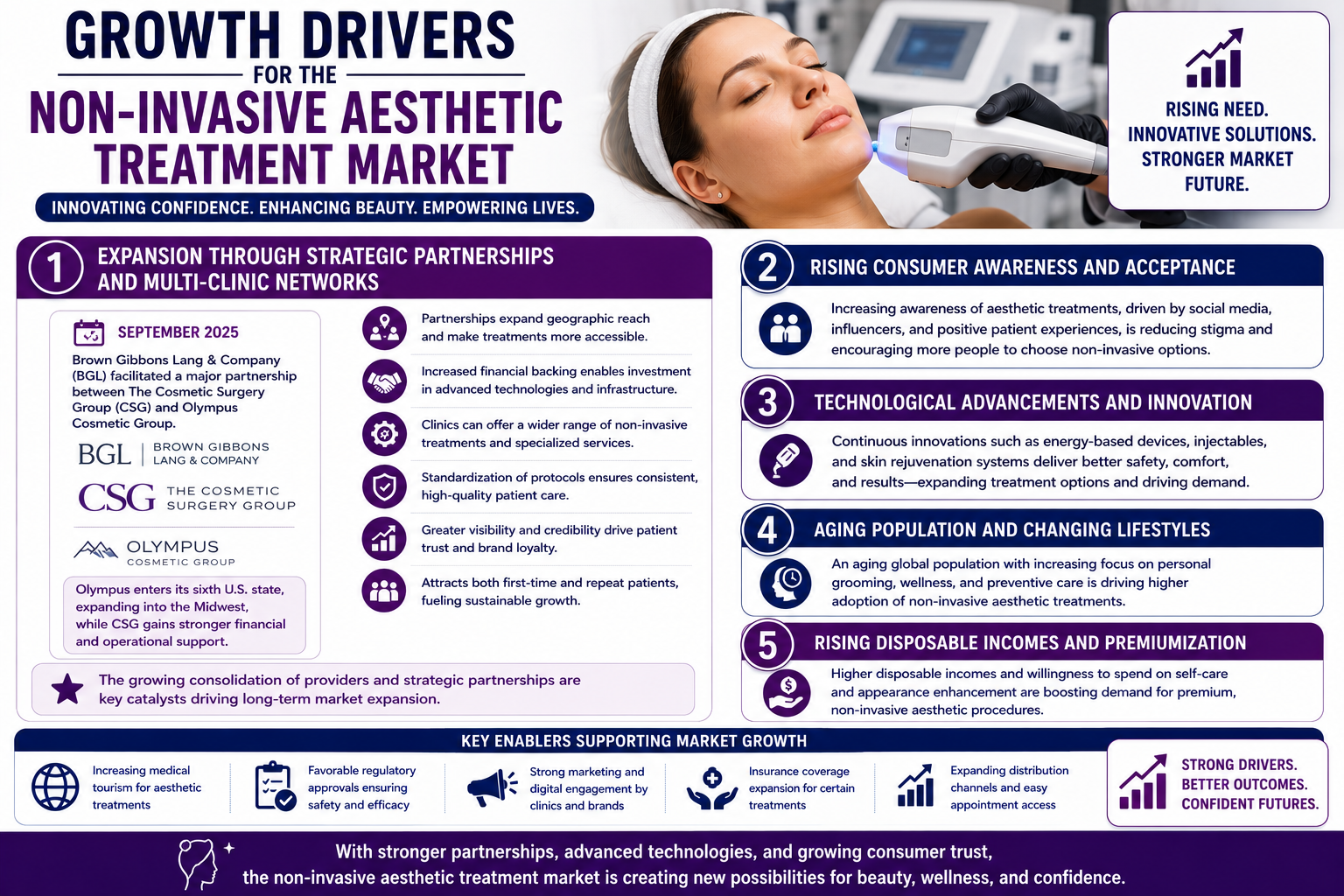
A significant example occurred in September 2025 when Brown Gibbons Lang & Company facilitated a partnership between The Cosmetic Surgery Group and Olympus Cosmetic Group.
The collaboration enabled Olympus to expand into its sixth U.S. state while providing increased operational capacity and broader access to advanced aesthetic services.
These multi-clinic networks help standardize treatment quality, improve access to advanced technologies, and increase public awareness regarding non-surgical cosmetic options.
As more aesthetic providers expand nationally and internationally, consumer access continues improving.
Scar-Free Treatments Are Becoming the New Standard
A major shift within the industry involves growing consumer preference for scarless and minimally disruptive procedures.
Patients increasingly prioritize treatments that provide visible improvements without surgical incisions or permanent marks.
This trend has encouraged clinics to invest heavily in advanced laser systems, radiofrequency devices, ultrasound technologies, and innovative injectable treatments.
In August 2025, Aestiva Plastic Surgery launched a new facility in New Delhi specifically focused on advanced scar-free and incision-less aesthetic procedures.
The center's emphasis on comfort, precision, and rapid recovery reflects broader industry trends toward minimally invasive cosmetic care.
As technology continues improving, non-invasive procedures are increasingly capable of addressing concerns that once required surgery.
This evolution is expanding the range of patients willing to pursue aesthetic treatments.
Innovation and Regulatory Approvals Continue to Drive Growth
Technological innovation remains one of the most powerful forces shaping the market.
Manufacturers continue introducing advanced injectables, dermal fillers, laser platforms, and energy-based devices designed to improve effectiveness while reducing discomfort.
Regulatory approvals play a critical role by increasing practitioner confidence and expanding patient access to innovative treatments.
A notable milestone occurred in February 2025 when Evolus received FDA approval for Evolysse Form and Evolysse Smooth hyaluronic acid gels.
These advanced dermal fillers offer improved tissue integration, enhanced precision, and longer-lasting outcomes, helping Evolus enter the highly competitive U.S. filler market.
Continuous innovation encourages repeat treatment adoption while attracting new patients seeking safer and more effective aesthetic solutions.
Injectables Remain the Largest Market Segment
Injectables continue to dominate the non-invasive aesthetic treatment market.
Botulinum toxin injections remain among the most widely performed cosmetic procedures globally due to their effectiveness in reducing dynamic facial wrinkles.
Dermal fillers based on hyaluronic acid, calcium hydroxylapatite, and poly-L-lactic acid have also experienced substantial growth.
These products help restore facial volume, improve contours, enhance lips, and address age-related volume loss.
Patients appreciate injectables because they provide immediate or near-immediate results with minimal downtime.
Advancements in formulation technology have improved safety, longevity, and treatment customization.
As consumers increasingly seek subtle and natural-looking enhancements, injectables are expected to maintain strong demand.
Facial Rejuvenation Continues to Expand
Facial rejuvenation procedures represent another major growth segment.
Consumers are increasingly interested in maintaining youthful skin quality without undergoing surgery.
Popular treatments include:
Photo rejuvenation, chemical peels, micro-ablative resurfacing, laser therapies, and radiofrequency-based skin tightening procedures.
These treatments address concerns such as fine lines, pigmentation irregularities, acne scars, uneven skin texture, and sun damage.
Continuous improvements in energy-based technologies have enhanced treatment precision while reducing recovery times.
As preventive aesthetics gain popularity among younger demographics, demand for facial rejuvenation services is expected to remain strong.
Non-Surgical Body Contouring Is Attracting New Patients
Body contouring has traditionally been associated with invasive surgical procedures.
Today, non-surgical alternatives are expanding rapidly.
Advanced technologies utilize controlled cooling, radiofrequency energy, ultrasound, and other techniques to reduce localized fat deposits and improve body shape.
These treatments appeal to patients seeking modest improvements without surgical risks or extended recovery periods.
The combination of convenience, comfort, and growing effectiveness has contributed significantly to segment growth.
As obesity rates rise globally and body-image awareness increases, non-surgical body contouring is expected to remain a major market opportunity.
The United States Leads Global Adoption
The United States remains the largest market for non-invasive aesthetic treatments.
Several factors contribute to this leadership position.
High consumer spending power, widespread acceptance of cosmetic procedures, a strong med-spa ecosystem, and continuous product innovation support robust demand.
Dermatologists, plastic surgeons, and aesthetic practitioners actively adopt new technologies and treatment approaches.
Regulatory oversight helps ensure product safety while maintaining public confidence.
The country's strong social media culture and emphasis on personal appearance further contribute to market growth.
As innovation continues accelerating, the United States is expected to maintain its dominant position.
China Emerges as a High-Growth Market
China has become one of the fastest-growing non-invasive aesthetic treatment markets globally.
Rapid urbanization, rising disposable incomes, strong beauty culture, and growing social media influence are driving exceptional demand.
Younger consumers are particularly receptive to injectables, laser therapies, and skin rejuvenation treatments.
The expansion of aesthetic clinics and increasing investment from domestic and international companies continue strengthening market infrastructure.
Technological innovations such as AI-assisted skin analysis and advanced laser systems are becoming increasingly common.
As awareness expands beyond major cities, China is expected to remain a key engine of future market growth.
Challenges Continue to Affect Market Development
Despite strong growth prospects, several challenges remain.
One important concern involves practitioner training and skill variability.
Because many non-invasive procedures can be performed outside traditional surgical settings, treatment quality may vary depending on provider experience and training. Inconsistent standards can affect patient outcomes and confidence.
Cost also remains a challenge.
Advanced energy-based devices, injectables, and treatment platforms require significant investment from providers. These expenses often translate into higher treatment costs for patients, limiting accessibility in certain markets. Small clinics may struggle to acquire the latest technologies, slowing market penetration.
Addressing these issues will be essential for sustaining long-term industry growth.
Final Thoughts
The non-invasive aesthetic treatment market represents one of the most dynamic and rapidly evolving sectors within healthcare and beauty.
Driven by technological innovation, changing consumer preferences, expanding med-spa networks, and growing demand for subtle, natural-looking enhancements, the industry is reshaping how people approach cosmetic care.
Patients increasingly value treatments that offer convenience, safety, and effective results without surgery or lengthy recovery periods.
With the market projected to grow from US$ 39.64 billion in 2025 to US$ 78.78 billion by 2034, opportunities for providers, manufacturers, and investors continue expanding.
As innovation accelerates and aesthetic treatments become more personalized, accessible, and technologically sophisticated, non-invasive procedures are likely to remain at the forefront of the global beauty and wellness industry for many years to come.
About the Creator
Enjoyed the story? Support the Creator.
Subscribe for free to receive all their stories in your feed.
Comments
There are no comments for this story
Be the first to respond and start the conversation.