
The One Sentence That Took Stimulus Off the Table
China’s supply-demand mismatch is structural. That does not make demand support optional.
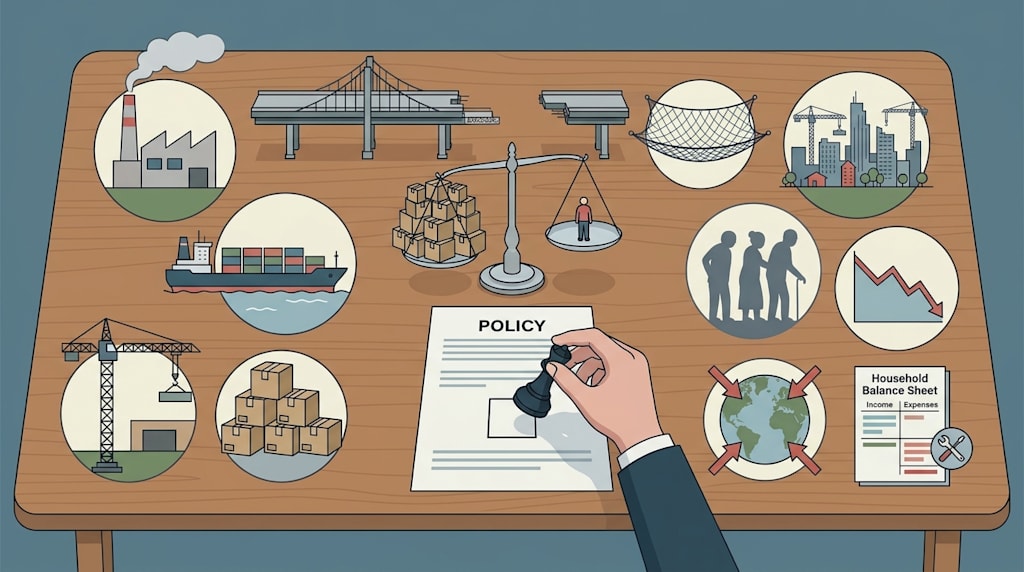
I. What the sentence removed
Early in the article, one sentence sets the boundaries:
“It is not that policy intensity is insufficient; it is that the development stage has already changed.”
The move is easy to miss. The sentence removes policy intensity from the causal story and installs “development stage” as the only explanation that matters. After that, the essay no longer has to ask what policy can still do. It only has to explain why more policy would not help.
That claim has a reasonable core. Strong supply and weak demand is not a simple aggregate imbalance. Excess low-efficiency supply sits alongside too little high-quality supply. Demand backed by purchasing power is underdeveloped. The mismatch runs between supply structure and demand structure, between supply capacity and demand capacity. Traditional broad stimulus has diminishing returns and side effects. The article is right about that.
Then comes the leap. From “traditional stimulus cannot solve this,” the essay moves to “policy intensity no longer matters.” Four features carry the weight: production over distribution, export orientation, investment-driven growth, and scale expansion. All four existed during the high-growth era. All four helped produce it. That makes them poor suspects for a new problem.
II. Four constants cannot explain the change
Export orientation built the industrial base along the coast. Investment-driven growth filled in infrastructure. Scale expansion moved the economy from shortage to availability. Production over distribution made sense when foreign exchange was scarce and goods were in short supply. These features are not new pathologies. They are the old model.
If the old model ran for decades while supply and demand stayed broadly balanced, then the new imbalance needs new variables. The article mentions them, then pushes them into the background:
Urbanization is slowing. In 2023, the urbanization rate of permanent residents was 66.16%, well below the pace of the high-speed period. New city dwellers no longer generate the same incremental demand for housing, infrastructure, and consumption.
Population has peaked. Negative population growth began in 2022. Labor supply, savings, and consumption structure are shifting.
Aging is deepening. People aged 60 and above now exceed 20% of the population. Elderly care and medical spending are rising. Savings motives and willingness to consume are changing.
External demand is contracting. Trade patterns are shifting, supply chains are being reorganized, and major economies are weaker. Capacity built around exports needs new markets.
Housing is in deep adjustment. Household balance sheets, local land finance, and upstream and downstream industries are under pressure at once. This is structural, not a short cycle.
These variables point in one direction. The demand-side expansion mechanism is changing. Slower urbanization lowers incremental demand. Population peak and aging change savings, consumption, and labor supply. Weaker external demand forces capacity reallocation. Housing adjustment pushes households to repair balance sheets, which suppresses consumption and investment.
The essay uses four long-standing features to explain a new contradiction. Constants cannot explain change. The move avoids the marginal variables, and with them the policy question: when demand expansion weakens structurally, demand-side support becomes a condition for a smooth transition.
III. Model transition is a reason, not an agenda
The essay spends a lot of space on model transition. Read closely, transition functions as a reason. It explains why the current situation is not a policy failure, and why stimulus should not be increased. The essay does not say how transition will be carried out, what tools it needs, what it costs, who pays, or how losers are protected.
Transition does not happen by itself.
It needs income distribution reform. Raising labor’s share of income and improving wage-setting mechanisms do not come from the market alone.
It needs stronger social security. If elderly care, health care, education, and child care remain weak, households will keep saving rather than spending. Fixing those gaps takes fiscal policy.
It needs fiscal and tax reform. An indirect-tax-heavy system and local competition measured by GDP push resources toward production. Changing that push takes tax reform and new local government incentives.
It needs an effective investment mechanism. The question is not whether to invest. The question is what to invest in, how to finance it, and whether it pays off. Investment that fills gaps and supports consumption follows a different logic from investment that adds capacity.
It needs a unified domestic market. Local protection, market segmentation, and barriers to factor flows hold back supply upgrading and demand release.
So transition needs policy. It needs a different policy mix. The essay criticizes production-heavy policy for suppressing consumption, but raising wages and improving public services are demand-side policies. It criticizes investment-driven growth for creating capacity, but gap-filling and consumption-supporting investment are effective investment policies. It criticizes scale expansion, but supply upgrading still needs industrial and competition policy.
The useful distinction is between policies that repeat the old model and policies that support transition. Short-term support is not the same as broad stimulus. Demand management is not the same as flooding the system with credit. Income distribution, social security, consumption support, debt resolution, housing expectations, and balance-sheet repair are short-term demand policies and long-term transition policies at the same time. The essay replaces “no traditional stimulus” with “policy intensity no longer matters,” then uses four old features to defend the substitution. The argument does not hold.
IV. Transition costs cannot be skipped
Transition has costs.
At the macro level, the transition period can bring growth losses, balance-sheet repair pressure, and tight local budgets. At the micro level, it can bring job losses, weaker income expectations, cautious consumption, and corporate debt and cash-flow stress.
Those costs land on specific people, industries, and regions.
Export-oriented firms face weaker demand, fewer orders, lower capacity utilization, and pressure on jobs. Investment-heavy industries face capacity clearing, higher debt pressure, and restructuring. Local governments that relied on land and infrastructure face revenue gaps. Households repairing balance sheets after the housing boom spend less and save more.
Without demand support and public safeguards, transition pain can become transition risk. If job pressure lasts, income expectations weaken, and consumption contraction feeds on itself. If corporate debt is exposed all at once, financial risk rises. If local budgets stay tight, public services and livelihood spending suffer.
The essay is right that the crux is model mismatch. It is wrong to treat “accelerate transition” as a complete policy. Transition takes time. Time requires stable demand. Transition creates friction. Friction requires social security and employment policy. Transition changes expectations. Expectations require credible support.
Short-term demand management is part of transition. Without demand support, transition can become a demand contraction that reinforces itself. Without jobs and income support, consumption upgrading and supply upgrading lose their base. Without balance-sheet repair, households and firms cannot carry transition costs.
V. The policy question after stimulus
The essay pushes the reader toward a binary: keep adding stimulus, or accept transition and stop. That binary is false.
The better questions are these.
First, which policies are inefficient stimulus, and which are demand support and structural reform? Large infrastructure and capacity expansion have diminishing returns. Social security, income distribution, consumption conditions, child care, elderly care, health, education, debt resolution, and housing expectations have short-term demand effects and long-term structural effects. Policy discussion should start by separating them.
Second, how should policy intensity match the transition? Transition takes time. Demand support needs continuity and predictability. Policy that swings between strong and weak increases waiting and contraction.
Third, who carries transition costs, and how are they cushioned? Local budgets, corporate debt, household balance sheets, and disadvantaged workers need explicit arrangements. “Accelerate transition” without a safety net pushes costs downward. Push costs onto households and consumption weakens. Push costs onto local governments and public services suffer. Push costs onto firms and jobs and investment weaken.
Fourth, how do we separate effective from ineffective investment? Investment is not the problem. The problem is what to invest in, how to invest, and whether it produces value. Gap-filling, consumption-supporting, efficiency-improving investment needs different approval, financing, and evaluation rules from capacity expansion. Opposing bad investment should not become an excuse to shelve good investment.
China needs a different policy mix: from production and investment alone to supply and demand together; from scale expansion to efficiency and income distribution; from short-term stimulus to short-term support plus long-term reform.
VI. Conclusion
The essay gets half the story right.
The root of strong supply and weak demand is structural. Traditional stimulus cannot cure it. Model transition is the way out. Excess low-efficiency supply and insufficient high-quality supply require supply upgrading and demand capacity. Those claims explain a lot, and they carry policy weight.
The essay misses the other half. Structural transition needs demand support. Support is a condition for transition, not a rival to it. By equating “no traditional stimulus” with “policy intensity no longer matters,” and by using four long-standing features to defend that equation, the essay avoids the new variables and skips the costs and the safety net.
Policy add-ons that repeat the old model are the danger. The debate should not be whether policy has a role. It should be how policy exits the old model and shifts toward income distribution, social security, consumption capacity, effective investment, and expectation repair.
Strong supply and weak demand is not new. The new feature is that the demand-side expansion mechanism is changing structurally. Model transition is the direction. Demand support is the condition. A different policy mix is the path. The three must move together.
Treating transition as a reason to stop supporting demand turns transition into endurance. A responsible debate should accept the need for transition, face its costs, and build support for a smooth passage. The essay asks the right question. Then it removes the policy-intensity option too early. The cleaner the removal, the easier transition costs are underestimated and the harder it becomes to assign responsibility for cushioning them.
About the Creator
Jin
Writer of reamstories
https://reamstories.com/jin
Enjoyed the story? Support the Creator.
Subscribe for free to receive all their stories in your feed. You could also become a paid subscriber, letting them know you appreciate their work.
Comments
There are no comments for this story
Be the first to respond and start the conversation.