
The New Front Line Against Prostate Cancer: How Advanced Diagnostics Are Saving Lives Through Earlier Detection
Artificial intelligence, advanced imaging technologies, biomarker testing, and growing awareness campaigns are transforming prostate cancer diagnosis and creating a rapidly expanding global healthcare market.

Prostate cancer remains one of the most significant health challenges affecting men worldwide. Although advances in treatment have improved survival rates dramatically over the past few decades, experts continue to emphasize one critical factor above all others: early detection.
The earlier prostate cancer is identified, the greater the chances of successful treatment and long-term survival. As a result, healthcare providers, governments, researchers, and diagnostic companies are investing heavily in technologies capable of detecting prostate cancer with greater accuracy and at earlier stages than ever before.
Today, the field of prostate cancer diagnostics is undergoing a remarkable transformation. Traditional screening methods are being supplemented by advanced imaging technologies, artificial intelligence-powered analysis, genomic testing, biomarker-based diagnostics, and minimally invasive procedures that promise more precise and reliable results.
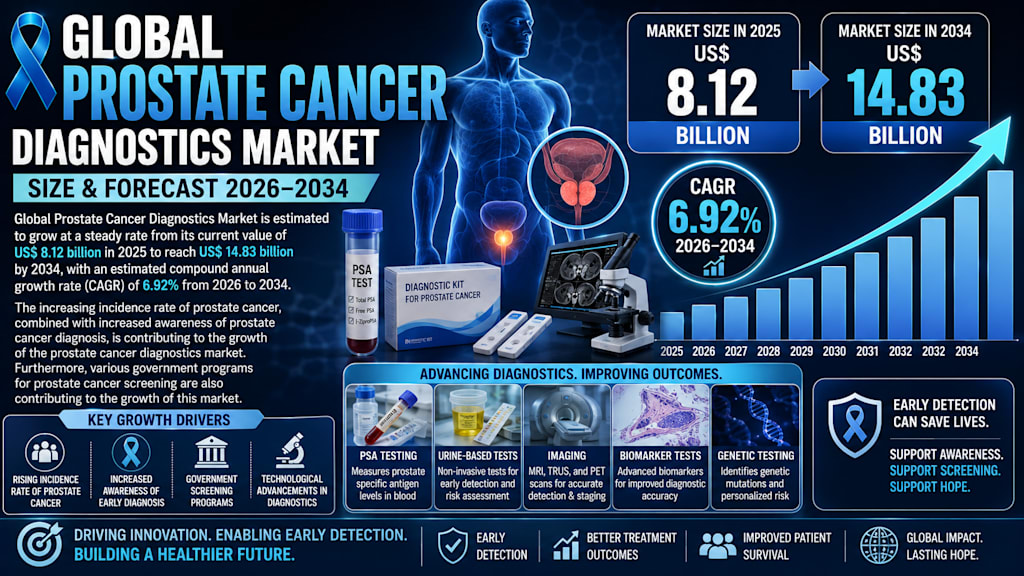
This rapid evolution is fueling substantial market growth. According to Renub Research, the Global Prostate Cancer Diagnostics Market is projected to increase from US$ 8.12 billion in 2025 to US$ 14.83 billion by 2034, expanding at a compound annual growth rate (CAGR) of 6.92% between 2026 and 2034. Rising prostate cancer incidence, increasing awareness of early diagnosis, and expanding government screening initiatives are among the primary factors supporting this growth.
As healthcare systems increasingly prioritize preventive medicine and early intervention, prostate cancer diagnostics are becoming one of the most important segments of modern oncology.
Understanding Prostate Cancer Diagnostics
Prostate cancer diagnostics encompass the various tests, technologies, and procedures used to identify, monitor, and evaluate prostate cancer in men.
The goal of these diagnostic tools is not only to detect cancer but also to determine its severity, progression, and potential treatment options.
Traditionally, prostate cancer diagnosis has relied heavily on Prostate-Specific Antigen (PSA) testing and Digital Rectal Examinations (DRE). While these methods remain important, advances in medical technology have expanded diagnostic capabilities significantly.
Modern approaches now include magnetic resonance imaging (MRI), targeted ultrasound, molecular diagnostics, genomic analysis, biomarker testing, and liquid biopsy technologies.
These innovations are helping physicians make more informed clinical decisions while reducing unnecessary procedures and improving patient outcomes.
As diagnostic accuracy improves, patients benefit from earlier interventions, more personalized treatment plans, and better long-term prognoses.
Rising Prostate Cancer Cases Are Driving Demand
One of the strongest drivers behind the growth of the prostate cancer diagnostics market is the increasing prevalence of prostate cancer worldwide.
Prostate cancer is currently the second most commonly diagnosed cancer among men globally and remains one of the leading causes of cancer-related mortality.
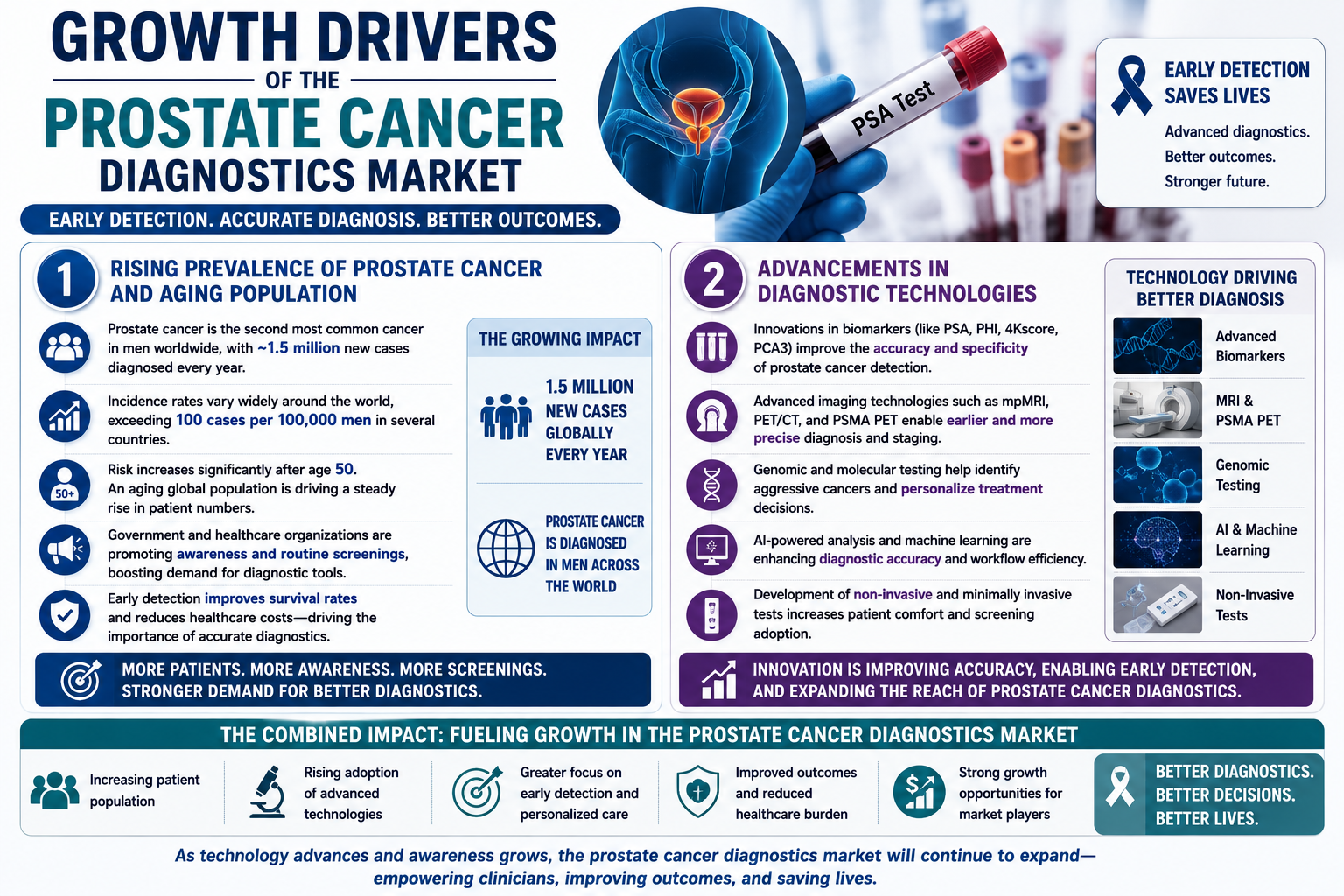
According to data highlighted in the market report, approximately 1.5 million men are diagnosed with prostate cancer each year worldwide. Incidence rates vary significantly by region, ranging from fewer than three cases per 100,000 men in some countries to more than 100 cases per 100,000 men in regions such as Norway, Sweden, Lithuania, Barbados, Martinique, and Guadeloupe.
The primary reason for this increase is demographic change.
As populations age and life expectancy rises, the number of men entering higher-risk age groups continues to expand. Prostate cancer is particularly common among men over the age of 50, making aging populations a significant contributor to future demand for diagnostic services.
The combination of rising disease incidence and growing awareness regarding preventive healthcare is creating strong momentum for diagnostic technologies worldwide.
Technology Is Revolutionizing Detection
Perhaps the most exciting development within the industry is the rapid advancement of diagnostic technologies.
For many years, prostate cancer screening relied primarily on PSA testing and conventional biopsies. While valuable, these methods sometimes lacked the precision necessary to distinguish aggressive cancers from less dangerous conditions.
Today, advanced technologies are changing that reality.
Multiparametric MRI has emerged as one of the most powerful diagnostic tools available. By providing highly detailed images of prostate tissue, MRI enables physicians to identify suspicious lesions more accurately and guide targeted biopsies.
Advanced ultrasound systems are also improving diagnostic precision while reducing patient discomfort.
Meanwhile, molecular diagnostics and genomic testing allow clinicians to analyze genetic and biological markers associated with cancer development and progression.
These technologies provide valuable insights into disease aggressiveness, helping physicians tailor treatment strategies more effectively.
Artificial intelligence is becoming another transformative force.
In December 2024, the University of Texas Medical Branch became the first healthcare system in Texas to integrate an AI-powered pathology tool into routine prostate cancer detection workflows. The system creates digital overlays on prostate biopsy samples, helping pathologists identify cancer more efficiently and accurately.
As AI adoption accelerates, diagnostic accuracy and efficiency are expected to improve even further.
Biomarker Testing Is Enabling Precision Medicine
Biomarker-based diagnostics represent one of the fastest-growing segments of the market.
Traditional screening methods often rely on general indicators that may not provide a complete picture of disease risk. Biomarkers offer a more personalized approach by identifying specific biological signals associated with prostate cancer.
These tests help physicians determine whether cancer is present, assess its aggressiveness, and predict potential treatment responses.
The ability to differentiate between slow-growing and aggressive tumors is particularly important because it reduces the risk of overtreatment while ensuring that high-risk patients receive timely intervention.
As precision medicine becomes increasingly important across oncology, biomarker testing is expected to play a central role in future diagnostic strategies.
Government Initiatives Are Expanding Screening Programs
Public health initiatives have become a major catalyst for market growth.
Governments and healthcare organizations worldwide are actively promoting prostate cancer awareness and encouraging routine screening among high-risk populations.
Educational campaigns emphasize the importance of early detection and regular check-ups, helping reduce stigma and increase participation in screening programs.
Many healthcare systems now provide reimbursement support for diagnostic procedures, making testing more accessible to patients.
These initiatives are particularly effective in developed countries where healthcare infrastructure supports large-scale screening efforts.
Government investment in cancer care extends beyond diagnostics. In March 2022, the U.S. Food and Drug Administration approved 177Lu-PSMA-617, an innovative treatment for metastatic prostate cancer that demonstrated a significant reduction in mortality risk among eligible patients.
Such developments reinforce the importance of early and accurate diagnosis in achieving successful treatment outcomes.
Liquid Biopsies Are Opening New Possibilities
One of the most promising innovations in prostate cancer diagnostics is the emergence of liquid biopsy technology.
Unlike traditional biopsies that require tissue samples, liquid biopsies analyze cancer-related markers found in blood or other bodily fluids.
This approach offers several advantages.
It is minimally invasive, more convenient for patients, and can be repeated over time to monitor disease progression and treatment response.
Researchers believe liquid biopsies could eventually complement or even replace certain invasive diagnostic procedures.
Although still evolving, this technology represents a major step toward more patient-friendly cancer detection strategies.
As research advances, liquid biopsy adoption is expected to increase significantly throughout the forecast period.
Preliminary Testing Remains Essential
Despite technological innovation, preliminary screening tests continue to play a vital role in prostate cancer diagnosis.
PSA testing remains one of the most widely used screening methods globally.
Combined with Digital Rectal Examinations and basic imaging studies, these tests help identify individuals who may require further evaluation.
Their affordability, accessibility, and ease of implementation make them particularly valuable in large-scale screening programs.
Governments and healthcare organizations continue promoting these preliminary tests because they enable earlier detection and encourage preventive healthcare behaviors.
As awareness increases, demand for routine screening services is expected to grow steadily.
Hospitals Continue to Dominate Diagnostic Services
Hospitals remain the largest end-user segment within the prostate cancer diagnostics market.
Their ability to provide comprehensive diagnostic services under one roof makes them the preferred choice for many patients.
Hospitals offer access to advanced imaging systems, pathology laboratories, biopsy procedures, multidisciplinary care teams, and specialized oncology services.
They are particularly important for managing complex and high-risk cases requiring sophisticated diagnostic evaluation.
Ongoing investments in healthcare infrastructure are further strengthening hospital capabilities, ensuring continued dominance within the market.
Diagnostic Centers Are Expanding Their Role
Diagnostic centers are becoming increasingly important as healthcare systems shift toward outpatient and decentralized care models.
These facilities offer specialized diagnostic services with shorter waiting times and lower costs compared to many hospital settings.
Modern diagnostic centers often provide PSA testing, imaging services, biopsies, and laboratory analysis using advanced technologies.
Their growing popularity reflects broader healthcare trends focused on convenience, efficiency, and accessibility.
As demand for outpatient services continues increasing, diagnostic centers are expected to capture a growing share of the market.
Regional Markets Driving Growth
The United States remains one of the largest and most technologically advanced prostate cancer diagnostics markets worldwide.
Strong healthcare infrastructure, widespread awareness, favorable reimbursement policies, and rapid adoption of advanced technologies continue supporting growth. In March 2025, AbbVie announced new oncology research developments at the American Association for Cancer Research meeting, highlighting continued investment in cancer innovation.
The United Kingdom benefits from a strong public healthcare system and National Health Service initiatives that encourage early detection and screening. Government programs promoting cancer awareness continue driving steady market expansion.
India is experiencing rapid growth due to improving healthcare infrastructure, increasing awareness, expanding insurance coverage, and greater availability of advanced diagnostic services in urban areas. Although challenges remain in rural regions, the long-term outlook remains highly positive.
Saudi Arabia is gradually strengthening its diagnostics market through healthcare modernization initiatives, infrastructure investments, and increasing public awareness regarding cancer screening and preventive healthcare.
These diverse regional trends underscore the global nature of market growth.
Challenges Still Need to Be Addressed
Despite significant progress, several challenges continue affecting the industry.
The high cost of advanced diagnostic technologies remains a major concern.
Techniques such as multiparametric MRI, genomic testing, biomarker analysis, and molecular diagnostics often require specialized equipment and highly trained professionals. These factors increase costs and can limit accessibility, particularly in low- and middle-income countries.
Another challenge involves diagnostic accuracy.
Traditional screening methods sometimes generate false-positive results or lead to overdiagnosis. Elevated PSA levels may result from non-cancerous conditions such as prostatitis or benign prostate enlargement, potentially leading to unnecessary procedures and patient anxiety.
Improving specificity and reducing false positives remain important priorities for researchers and healthcare providers.
Final Thoughts
The global prostate cancer diagnostics market is entering a period of remarkable innovation and expansion. Advances in imaging technologies, artificial intelligence, molecular diagnostics, biomarker testing, and liquid biopsies are fundamentally transforming how prostate cancer is detected and managed.
As awareness grows and healthcare systems increasingly emphasize preventive medicine, early diagnosis will continue playing a crucial role in improving survival rates and reducing healthcare burdens.
With the market projected to expand from US$ 8.12 billion in 2025 to US$ 14.83 billion by 2034, opportunities for innovation, investment, and improved patient care are substantial.
The future of prostate cancer care will depend not only on better treatments but also on smarter, faster, and more accurate diagnostic tools. As technology continues advancing, millions of men worldwide stand to benefit from earlier detection, more personalized care, and significantly improved outcomes.
About the Creator
Enjoyed the story? Support the Creator.
Subscribe for free to receive all their stories in your feed.
Comments
There are no comments for this story
Be the first to respond and start the conversation.