
The Growing Fight Against Vision Loss: Why the Age-Related Macular Degeneration Market Is Entering a New Era
As populations age and medical innovation accelerates, the global AMD market is poised for remarkable growth through 2034.

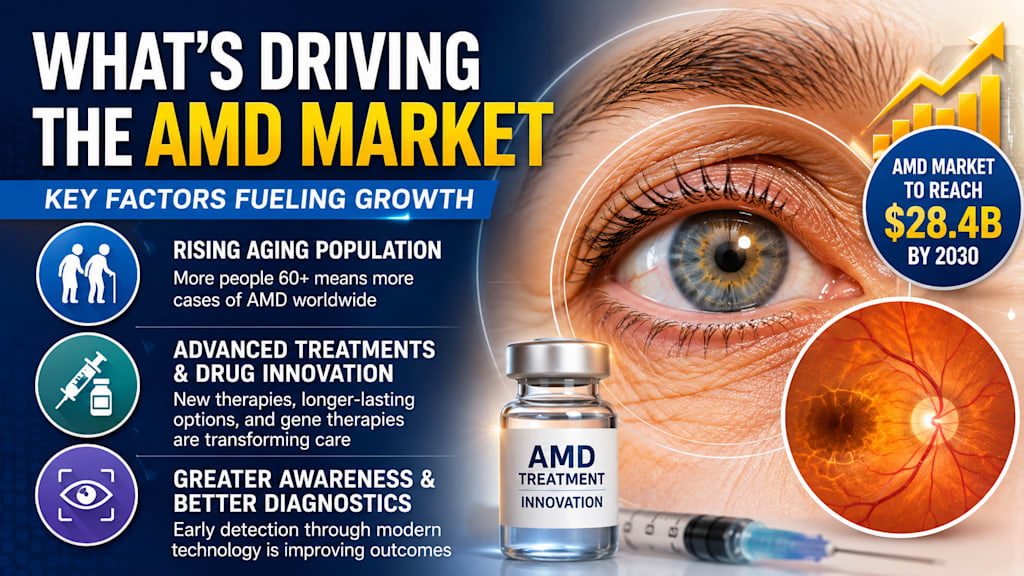
For millions of people around the world, the ability to read a book, recognize a loved one's face, or safely drive a vehicle depends on a tiny area of the eye called the macula. When that crucial part of the retina begins to deteriorate, a condition known as Age-Related Macular Degeneration (AMD) develops, often leading to progressive central vision loss.
Although AMD has long been recognized as one of the leading causes of vision impairment among older adults, it is now gaining even greater attention from healthcare providers, pharmaceutical companies, researchers, and policymakers. The reason is simple: the world is getting older, and age-related diseases are becoming increasingly common.
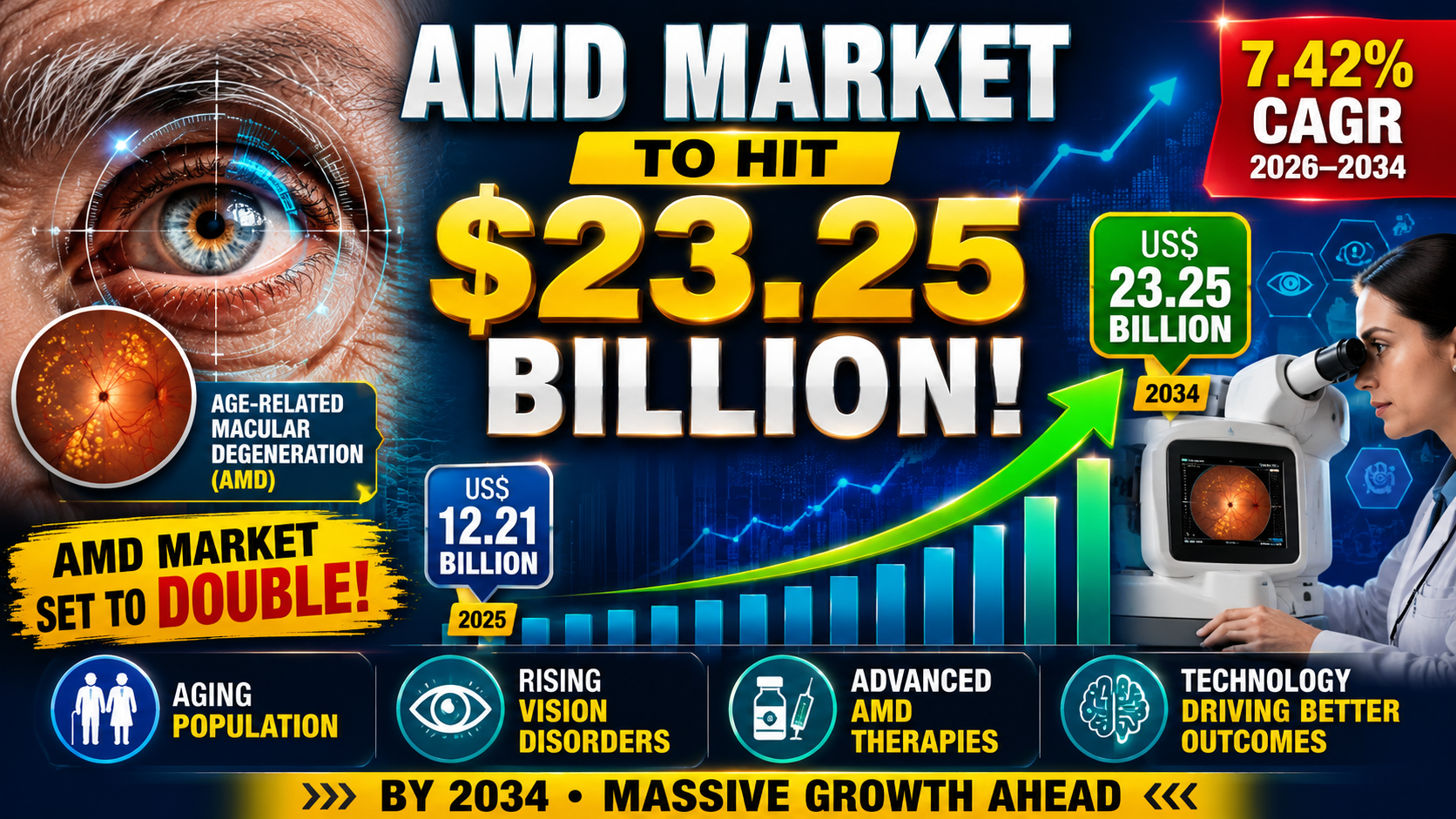
According to Renub Research, the global Age-Related Macular Degeneration market is projected to grow from US$ 12.21 Billion in 2025 to US$ 23.25 Billion by 2034, representing a compound annual growth rate (CAGR) of 7.42% during 2026–2034. This impressive growth reflects not only rising patient numbers but also major advances in diagnosis, treatment, and disease management.
The AMD market is no longer simply about managing vision loss. It is becoming a showcase of how modern medicine can combine innovation, technology, and preventive healthcare to improve quality of life for aging populations.
Understanding AMD and Its Global Impact
Age-Related Macular Degeneration is a progressive eye disease that primarily affects people over the age of 50. It damages the macula, the central portion of the retina responsible for sharp and detailed vision.
Unlike complete blindness, AMD typically affects central vision while leaving peripheral vision intact. However, the impact on daily life can be profound. Activities such as reading, driving, using digital devices, and recognizing faces become increasingly difficult as the disease progresses.
AMD generally appears in two forms:
- Dry AMD, which accounts for the majority of cases and develops gradually.
- Wet AMD, a more aggressive form characterized by abnormal blood vessel growth beneath the retina, often resulting in rapid vision deterioration.
- The scale of the problem is substantial. Global estimates suggest that more than 196 million people are living with AMD, placing it among the most prevalent ophthalmic disorders worldwide.
- As life expectancy continues to rise, experts expect these numbers to grow significantly over the next decade.
Aging Populations Are Driving Market Expansion
One of the most powerful forces behind AMD market growth is demographics.
The global population is aging at an unprecedented pace. Advances in healthcare, nutrition, and living standards have enabled people to live longer than ever before. While this is a positive development, it also increases the prevalence of age-related diseases, including AMD.
Countries with large elderly populations are already experiencing higher AMD incidence rates. Nations such as Japan, Italy, Germany, Portugal, and Finland have some of the world's highest percentages of citizens aged 65 and older. As these populations continue to expand, healthcare systems are preparing for increased demand for eye care services and AMD treatments.
The trend extends beyond developed economies. Emerging markets are also seeing rapid growth in elderly populations, creating new opportunities for healthcare providers and pharmaceutical manufacturers.
Global health organizations estimate that by 2030, one in every six people worldwide will be aged 60 or older. By 2050, the number of people over 60 is expected to exceed two billion. These demographic realities are creating a long-term foundation for sustained AMD market growth.
Innovation Is Transforming Treatment Possibilities
Historically, AMD was often viewed as a condition with limited treatment options. That perception is changing rapidly.
The introduction of anti-VEGF therapies represented a major breakthrough in the treatment of wet AMD. These therapies help prevent abnormal blood vessel growth in the retina and can slow, halt, or even partially reverse vision loss in some patients.
Today, pharmaceutical companies are investing heavily in next-generation therapies designed to improve outcomes while reducing treatment burden.
Researchers are focusing on:
- Longer-lasting drug formulations
- Reduced injection frequency
- Personalized treatment approaches
- Gene therapy solutions
- Sustained-release delivery systems
- Geographic atrophy therapies
One notable example is the FDA's approval of expanded labeling for IZERVAY™ in 2025, broadening treatment possibilities for patients suffering from geographic atrophy associated with AMD. Developments such as these illustrate how rapidly the treatment landscape is evolving.
For patients, these innovations offer more than clinical benefits. They promise greater convenience, better adherence to treatment plans, and potentially improved long-term visual outcomes.
Early Diagnosis Is Becoming a Competitive Advantage
Another important factor supporting market growth is the increasing emphasis on early detection.
Modern diagnostic technologies have significantly improved physicians' ability to identify AMD before severe vision loss occurs. Advanced tools such as Optical Coherence Tomography (OCT), retinal imaging systems, and digital fundus photography allow clinicians to detect subtle retinal changes much earlier than in previous decades.
At the same time, public awareness campaigns are encouraging people to prioritize eye health.
Organizations dedicated to vision care are investing in educational initiatives that highlight the importance of regular eye examinations, especially for older adults. Increased awareness means more patients are seeking professional evaluation before symptoms become severe.
Earlier diagnosis benefits everyone involved. Patients gain access to treatment sooner, healthcare providers can achieve better outcomes, and pharmaceutical companies expand the potential market for therapies.
The Dominance of Dry AMD
While wet AMD often receives significant attention because of its severity, dry AMD remains the largest segment of the market.
Industry estimates suggest that dry AMD accounts for approximately 80–90% of diagnosed cases worldwide. The condition develops gradually as retinal cells deteriorate and deposits known as drusen accumulate within the macula.
For years, treatment options for dry AMD were limited, creating substantial unmet medical need.
Today, however, researchers are pursuing innovative therapies aimed at slowing disease progression and treating geographic atrophy, an advanced stage of dry AMD. This growing research focus is attracting investment and creating new commercial opportunities.
As diagnostic rates improve globally, the number of identified dry AMD patients is expected to increase, further strengthening demand for future therapies.
Key Pharmaceutical Products Shaping Competition
Several major products currently dominate the AMD treatment landscape.
Eylea
Eylea has established itself as one of the most widely used anti-VEGF therapies for wet AMD. Physicians value its effectiveness and relatively extended dosing intervals compared to earlier treatments. The product continues to enjoy strong demand across hospitals and specialized eye clinics worldwide.
Lucentis
Lucentis helped define modern AMD treatment standards and remains a trusted therapy among ophthalmologists. Its extensive clinical history and widespread physician familiarity continue to support its market position despite increasing competition from newer alternatives.
Beovu
As a newer-generation anti-VEGF therapy, Beovu offers the potential advantage of longer treatment intervals. Fewer injections can improve patient convenience and adherence while maintaining effective disease control. Although safety considerations have influenced adoption rates in some regions, the product remains an important competitor within the AMD market.
Competition among these products is encouraging ongoing innovation, ultimately benefiting patients through expanded treatment choices.
The Challenges That Still Remain
Despite impressive progress, significant challenges continue to affect the AMD market.
Perhaps the most important obstacle is cost.
Many AMD therapies require repeated injections over extended periods, creating substantial financial burdens for patients and healthcare systems alike. Treatment expenses can become especially problematic in lower-income regions where insurance coverage is limited.
The cost challenge extends beyond medication. Diagnostic procedures, specialist consultations, follow-up visits, and monitoring programs all contribute to overall healthcare spending.
Another major issue is the absence of a definitive cure.
Current treatments primarily focus on slowing disease progression rather than eliminating the condition entirely. Patients often require lifelong monitoring and ongoing therapy to maintain visual function.
The complexity of AMD biology also complicates drug development. While current therapies have achieved meaningful success, researchers continue searching for solutions capable of delivering more comprehensive and lasting benefits.
Regional Markets Leading Growth
United States
The United States remains one of the world's most important AMD markets. Advanced healthcare infrastructure, strong reimbursement systems, extensive research activity, and widespread access to specialists all contribute to market leadership. Continued pharmaceutical innovation is expected to sustain growth throughout the forecast period.
United Kingdom
The UK market benefits from strong public healthcare support, organized screening programs, and growing awareness of age-related eye diseases. Ongoing efforts to improve patient access and introduce innovative therapies are helping drive market expansion.
India
India represents one of the fastest-growing opportunities in the global AMD landscape. Rising healthcare investment, expanding ophthalmology infrastructure, increasing awareness, and a growing elderly population are all contributing to greater diagnosis and treatment adoption. However, affordability remains a significant challenge for many patients.
Saudi Arabia
Healthcare modernization initiatives and increasing investment in specialized medical services are helping Saudi Arabia strengthen its ophthalmology capabilities. Improved access to advanced diagnostic technologies and anti-VEGF therapies is expected to support continued growth.
Looking Ahead: The Future of AMD Care
The future of AMD treatment appears increasingly promising.
Advances in biotechnology, artificial intelligence-assisted diagnostics, gene therapy, and personalized medicine are creating possibilities that would have seemed unrealistic only a decade ago. As research continues to deepen our understanding of retinal disease mechanisms, entirely new treatment approaches may emerge.
At the same time, healthcare systems worldwide are placing greater emphasis on preventive care and early intervention. This shift is likely to improve patient outcomes while creating additional opportunities across the AMD value chain.
The combination of demographic growth, technological innovation, and rising awareness suggests that AMD will remain one of the most dynamic segments within ophthalmology for years to come.
Final Thoughts
Age-Related Macular Degeneration is more than a medical condition—it is a growing global healthcare challenge tied directly to longer life expectancy and aging populations.
Yet the story is not solely about disease. It is also about progress.
Breakthrough therapies, advanced diagnostic tools, stronger awareness campaigns, and expanding research investments are reshaping the outlook for millions of patients worldwide. With the global AMD market expected to nearly double from US$ 12.21 Billion in 2025 to US$ 23.25 Billion by 2034, the sector stands at the intersection of medical necessity and technological innovation.
For patients, physicians, investors, and healthcare organizations alike, the coming decade could represent one of the most transformative periods in the history of vision care.
About the Creator
Enjoyed the story? Support the Creator.
Subscribe for free to receive all their stories in your feed.
Comments
There are no comments for this story
Be the first to respond and start the conversation.