
The Global Point of Sale Terminal Market Is Booming as Cashless Payments Become the New Standard
Rising digital transactions, cloud-based business solutions, and the rapid growth of retail and hospitality industries are transforming the future of point of sale technology worldwide.

The way businesses process payments has changed dramatically over the past decade. Long gone are the days when a simple cash register was enough to manage customer transactions. Today, businesses operate in an increasingly digital world where consumers expect fast, secure, and seamless payment experiences whether they are shopping in stores, dining at restaurants, booking services online, or purchasing products through mobile applications.
At the center of this transformation is the Point of Sale (POS) terminal. Modern POS systems have evolved far beyond payment processing devices. They now serve as comprehensive business management platforms that help companies track inventory, analyze customer behavior, manage sales data, and integrate multiple payment channels into a single ecosystem.
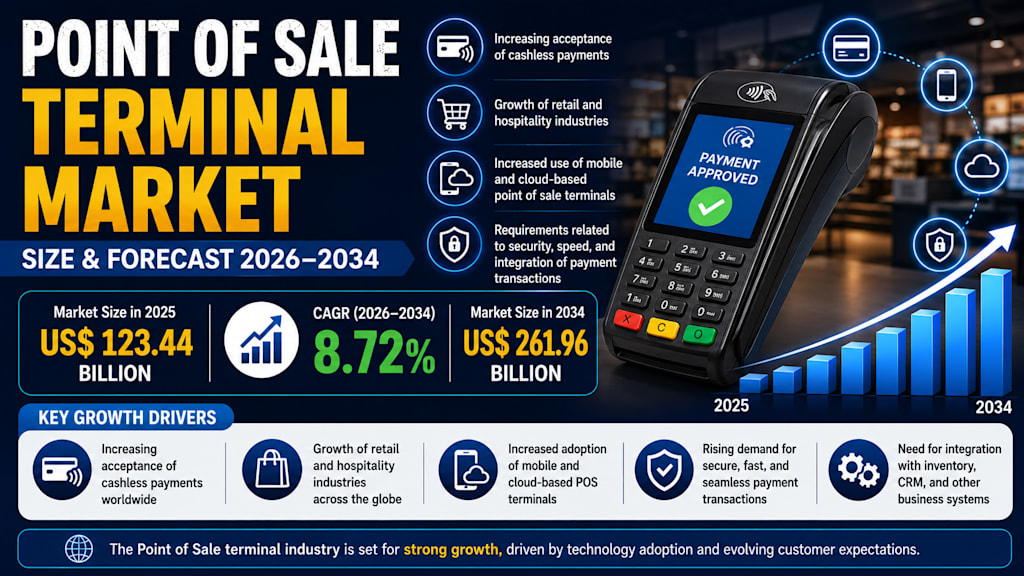
According to Renub Research, the Global Point of Sale Terminal Market is expected to grow from US$ 123.44 billion in 2025 to US$ 261.96 billion by 2034, expanding at a compound annual growth rate (CAGR) of 8.72% between 2026 and 2034. This strong growth reflects the increasing shift toward digital commerce, cashless payments, and intelligent retail technologies.
As businesses across industries continue embracing digital transformation, POS terminals are becoming one of the most important tools for enhancing customer experiences and improving operational efficiency.

Understanding the Modern POS Terminal
A Point of Sale terminal is the combination of hardware and software used to complete customer transactions and manage various business operations.
While processing payments remains its primary function, today's POS systems perform a wide range of tasks beyond accepting cash, credit cards, or digital payments.
Modern systems can manage inventory, generate sales reports, monitor customer purchasing behavior, handle loyalty programs, print receipts, and integrate with accounting software.
Businesses can choose from several types of POS solutions, including fixed terminals, mobile POS devices, tablet-based systems, and cloud-powered platforms. These options allow companies of all sizes to select solutions that best fit their operational requirements.
The increasing versatility of POS technology has transformed it from a transactional tool into a strategic asset for business growth.
The Global Shift Toward Cashless Payments
One of the most powerful drivers of market growth is the worldwide movement toward cashless transactions.
Consumers increasingly prefer payment methods that offer convenience, speed, and security. Credit cards, debit cards, digital wallets, QR codes, and contactless payment solutions have become everyday payment methods in many parts of the world.
The COVID-19 pandemic accelerated this trend by encouraging touch-free transactions and reducing reliance on physical cash. Even after the pandemic, consumer habits continued to favor digital payment methods.
Governments and financial institutions have also actively promoted electronic payments to improve financial inclusion, reduce cash handling costs, and increase transaction transparency.
As cashless economies continue to expand globally, businesses are investing heavily in modern POS terminals capable of supporting multiple payment options.
This transition is expected to remain one of the strongest growth drivers throughout the forecast period.
Contactless Payments Are Reshaping Consumer Expectations
Consumer expectations have evolved rapidly in recent years.
Shoppers increasingly want transactions completed within seconds, without lengthy checkout processes or physical contact. Contactless payment technologies have emerged as a preferred solution because they combine speed, convenience, and security.
Near Field Communication (NFC) technology allows consumers to make purchases simply by tapping cards, smartphones, or wearable devices against POS terminals.
This streamlined experience reduces waiting times and enhances customer satisfaction.
For merchants, contactless payments improve transaction efficiency while reducing congestion during peak business hours.
As smartphone penetration continues to rise and digital wallet adoption expands, demand for NFC-enabled POS terminals is expected to grow significantly.
Cloud-Based POS Systems Are Transforming Business Operations
Cloud technology has become one of the most influential innovations in the POS industry.
Traditional POS systems often required businesses to maintain on-site servers and dedicated IT infrastructure. Managing updates, backups, and system maintenance could be costly and time-consuming.
Cloud-based POS platforms eliminate many of these challenges.
Business owners can access real-time sales data, inventory information, and performance metrics from virtually any location. Automatic software updates, remote management capabilities, and scalable infrastructure provide additional advantages.
Cloud solutions are particularly attractive for businesses operating across multiple locations because they enable centralized management and consistent reporting.
The growing demand for flexibility, mobility, and real-time insights is driving rapid adoption of cloud-based POS systems worldwide.
Mobile POS Solutions Are Gaining Popularity
The rise of mobile commerce and flexible business models has fueled demand for mobile POS solutions.
Unlike traditional fixed terminals, mobile POS systems operate on smartphones, tablets, or portable devices. These solutions provide businesses with greater mobility while reducing hardware costs.
Restaurants, food trucks, retail pop-up stores, delivery services, and small businesses increasingly rely on mobile POS systems to process transactions anywhere.
Mobile solutions also support queue reduction strategies by allowing employees to complete transactions directly on the sales floor rather than directing customers to fixed checkout counters.
As businesses prioritize agility and customer convenience, mobile POS adoption is expected to accelerate further.
Retail Continues to Drive Demand
Retail remains one of the largest users of POS technology globally.
Supermarkets, convenience stores, department stores, specialty retailers, and e-commerce businesses all rely on POS systems to manage transactions and customer interactions.
Modern retailers increasingly operate across multiple channels, combining physical stores, websites, mobile applications, and social commerce platforms.
POS systems help unify these channels by synchronizing inventory data, customer profiles, loyalty programs, and sales information.
Retailers also use POS analytics to gain deeper insights into purchasing behavior, product performance, and customer preferences.
As omnichannel retail strategies become more sophisticated, demand for integrated POS solutions is expected to remain strong.
Restaurants Are Embracing Digital Transformation
The restaurant industry has become one of the fastest-growing markets for POS technology.
Restaurants require systems capable of handling order management, payment processing, kitchen coordination, delivery services, and customer engagement.
Modern restaurant POS platforms integrate all of these functions into a single ecosystem.
Features such as digital menus, mobile ordering, self-service kiosks, and contactless payments have become increasingly important.
Quick-service restaurants and delivery-focused businesses particularly benefit from POS systems that streamline operations and improve efficiency.
As consumer expectations for convenience continue rising, restaurant operators are investing heavily in advanced POS technologies.
Healthcare Is Emerging as an Important Market
Healthcare providers are increasingly adopting POS systems to improve billing accuracy and enhance patient experiences.
Hospitals, clinics, pharmacies, and diagnostic centers use POS technology for appointment payments, insurance co-payments, pharmacy transactions, and administrative functions.
Integrated systems reduce manual errors while improving transaction efficiency and financial transparency.
The broader digital transformation of healthcare is expected to create new opportunities for POS providers serving this sector.
Entertainment and Hospitality Expand Adoption
Entertainment venues and hospitality businesses are also contributing significantly to market growth.
Movie theaters, sports arenas, amusement parks, hotels, and event venues process large volumes of transactions daily.
Modern POS systems enable faster ticket sales, food and beverage purchases, merchandise transactions, and loyalty program management.
Wireless and mobile POS devices are particularly valuable in these environments because they reduce waiting times and improve customer experiences.
As tourism and entertainment industries continue recovering and expanding globally, demand for specialized POS solutions is expected to increase.
Artificial Intelligence Is Enhancing POS Capabilities
Artificial intelligence is becoming increasingly integrated into POS systems.
Rather than simply processing transactions, AI-enabled platforms help businesses analyze customer behavior, predict purchasing trends, optimize inventory levels, and personalize marketing campaigns.
Machine learning algorithms can identify buying patterns and generate recommendations that improve sales performance.
Retailers, restaurants, and service providers are increasingly leveraging AI-driven insights to make smarter business decisions.
As AI technology becomes more accessible, its influence on POS systems is expected to grow substantially.
Challenges Facing the Industry
Despite strong growth prospects, the POS terminal market faces several challenges.
High Initial Investment Costs
Implementing advanced POS systems often requires significant investment in hardware, software, installation, and employee training.
For small businesses with limited budgets, these upfront expenses can be a barrier to adoption.
Ongoing subscription fees, maintenance costs, and software upgrades further contribute to total ownership expenses.
Cybersecurity and Data Privacy Risks
POS systems process sensitive financial and personal information, making them attractive targets for cybercriminals.
Data breaches, payment fraud, and malware attacks can result in significant financial and reputational damage.
Businesses must continuously invest in cybersecurity measures and comply with regulations such as PCI DSS to protect customer information.
Maintaining trust remains essential for long-term success.
Regional Markets Driving Growth
United States
The United States remains one of the world's most advanced POS markets. High adoption of digital payments, cloud technologies, and mobile commerce continues to support innovation and market expansion.
United Kingdom
The UK's strong preference for contactless payments and its increasingly cashless economy have created significant demand for mobile and cloud-based POS solutions.
China
China's massive retail ecosystem and widespread use of digital payments make it one of the most important POS markets globally. Businesses increasingly adopt integrated solutions supporting QR codes, mobile wallets, and omnichannel operations.
Brazil
Brazil's growing retail sector and expanding digital payment infrastructure are driving adoption among small and medium-sized enterprises.
United Arab Emirates
The UAE's commitment to digital transformation, smart cities, and cashless transactions continues to fuel demand for advanced POS technologies across retail, hospitality, and tourism sectors.
The Future of POS Technology
The future of POS terminals will be defined by connectivity, intelligence, and flexibility.
Cloud computing, artificial intelligence, biometric authentication, and advanced analytics will continue enhancing the capabilities of modern POS systems.
Businesses will increasingly rely on POS platforms not only for payment processing but also for customer engagement, inventory optimization, workforce management, and strategic decision-making.
As digital commerce evolves, POS technology will become even more deeply integrated into everyday business operations.
Final Thoughts
The global Point of Sale terminal market is undergoing a significant transformation driven by changing consumer expectations, digital payment adoption, and technological innovation.
With the market projected to grow from US$ 123.44 billion in 2025 to US$ 261.96 billion by 2034, POS systems are becoming essential tools for businesses seeking to improve efficiency, enhance customer experiences, and remain competitive in an increasingly digital economy.
While challenges such as cybersecurity risks and implementation costs remain important considerations, ongoing innovation continues to create new opportunities across industries. As cashless payments, cloud computing, and AI-powered analytics become standard features of modern commerce, POS terminals will remain at the heart of the global retail and service economy for years to come.
About the Creator
Enjoyed the story? Support the Creator.
Subscribe for free to receive all their stories in your feed.
Comments
There are no comments for this story
Be the first to respond and start the conversation.