
The Future Woven Into Fabric: How Smart Textiles Are Transforming Healthcare, Sports, Defense, and Everyday Life
From health-monitoring shirts to self-heating jackets and military uniforms that track vital signs, smart textiles are redefining what clothing can do in the digital age.

For centuries, textiles have played a simple but essential role in human life. They have provided comfort, protection, identity, and style. Yet the fabrics of tomorrow are poised to do far more than simply cover the human body. Thanks to rapid advances in electronics, material science, artificial intelligence, and connectivity, clothing is evolving into a powerful technological platform capable of monitoring health, improving athletic performance, enhancing military operations, and even interacting with its environment.
This emerging category, known as smart textiles, represents one of the most exciting intersections between fashion and technology. Smart textiles, often referred to as intelligent fabrics or e-textiles, incorporate advanced components such as sensors, conductive fibers, microelectronics, and communication systems directly into fabric structures. These innovations allow textiles to detect, measure, and respond to changes in both the human body and surrounding environments.
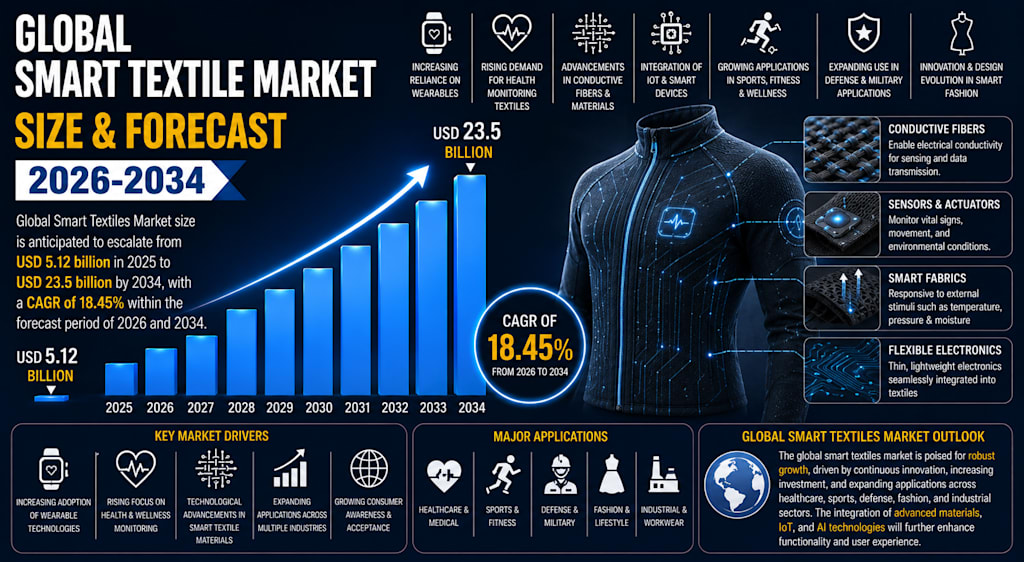
The market opportunity surrounding these innovations is substantial. According to Renub Research, the Global Smart Textile Market is expected to grow from USD 5.12 billion in 2025 to USD 23.5 billion by 2034, expanding at a compound annual growth rate of 18.45% during the forecast period from 2026 to 2034. The rapid expansion is being fueled by increasing demand for wearable technologies, healthcare monitoring solutions, defense applications, sports performance analytics, and advances in conductive materials and flexible electronics.
As industries continue searching for smarter, more connected solutions, intelligent fabrics are moving from research laboratories into everyday life.

Understanding Smart Textiles
At their core, smart textiles are fabrics designed to perform functions beyond traditional clothing. Unlike ordinary garments, these textiles can sense physical, chemical, or environmental conditions and generate useful data or responses.
Smart textiles generally fall into three categories. Passive smart textiles can detect and measure conditions without responding. Active smart textiles can both sense and react to environmental changes. Ultra-smart textiles go a step further by analyzing information and adapting their behavior automatically.
These capabilities allow fabrics to monitor heart rate, body temperature, respiration, movement, moisture levels, pressure, and environmental conditions. The integration of technology into fabrics creates products that are not only comfortable and wearable but also highly functional.
What makes smart textiles particularly attractive is their ability to blend technology seamlessly into everyday life. Unlike traditional wearable devices that often require separate hardware, intelligent fabrics can provide continuous monitoring and interaction without disrupting normal activities.
As consumer expectations evolve, the demand for invisible and effortless technology is expected to drive continued interest in smart textile solutions.
Healthcare Is Leading the Smart Textile Revolution
One of the most significant opportunities for smart textiles lies in healthcare.
Healthcare systems around the world are increasingly shifting toward preventive care and remote patient monitoring. Medical professionals seek ways to gather accurate health information continuously without requiring patients to remain in hospitals or wear bulky equipment.
Smart textiles provide an ideal solution.
By integrating sensors directly into garments, bedding, bandages, and rehabilitation equipment, healthcare providers can continuously monitor vital signs while ensuring comfort for patients.
These intelligent fabrics can track heart rate, breathing patterns, body temperature, physical activity, sleep quality, muscle movement, and other critical health indicators. The ability to collect this information passively and continuously offers a significant advantage over traditional monitoring methods.
For elderly patients, individuals with chronic diseases, and people recovering from surgery, smart textiles can provide real-time insights that support early intervention and improved outcomes.
The growing emphasis on telemedicine and digital healthcare further strengthens the role of smart textiles within modern healthcare ecosystems.
As healthcare providers seek cost-effective methods for improving patient care while reducing hospital visits, demand for health-monitoring textiles is expected to increase significantly.
The Wearable Technology Connection
The growth of smart textiles is closely linked to the rise of wearable technology.
Over the past decade, consumers have embraced devices that help track fitness, monitor health, and improve personal wellness. Smartwatches, fitness trackers, and health-monitoring gadgets have become common accessories for millions of people worldwide.
However, smart textiles offer a more seamless experience.
Instead of wearing a separate device, users can simply wear clothing that performs many of the same functions. Smart garments provide broader body coverage, greater comfort, and more comprehensive data collection than many traditional wearable devices.
This shift aligns with a growing consumer preference for technology that integrates naturally into daily routines.
Health-conscious individuals, fitness enthusiasts, and technology adopters increasingly seek products that deliver actionable information without requiring constant attention or maintenance.
As wearable technology continues to evolve, smart textiles are positioned to become the next major step in connected personal health and lifestyle management.
Advances in Materials and Electronics Are Accelerating Innovation
Recent developments in material science and electronics have dramatically expanded the capabilities of smart textiles.
Conductive fibers can now carry electrical signals while maintaining the flexibility and softness expected from conventional fabrics. Flexible sensors can be woven directly into garments without compromising comfort or appearance.
Miniaturized electronics have made it possible to integrate sophisticated functionality into fabrics without adding excessive weight or bulk.
Wireless communication technologies further enhance performance by allowing smart garments to transmit information to smartphones, cloud platforms, healthcare systems, and other connected devices.
Energy-harvesting technologies are also gaining attention. Researchers are developing textiles capable of generating power from body heat, movement, or environmental sources. These innovations could eventually reduce dependence on traditional batteries and enable self-powered smart garments.
As manufacturing methods continue improving, production costs are expected to decline while performance improves, creating new opportunities for widespread adoption.
Sports and Fitness Applications Continue Expanding
The sports industry has become one of the earliest adopters of smart textile technology.
Athletes and coaches increasingly rely on data to improve performance, reduce injuries, and optimize training programs. Smart textiles provide valuable insights that were previously difficult or impossible to collect during normal activities.
Intelligent sportswear can monitor muscle activity, posture, movement efficiency, fatigue levels, hydration status, and body temperature. By analyzing this information, athletes gain a deeper understanding of their physical performance and recovery needs.
Coaches can use real-time data to adjust training sessions, identify potential injury risks, and improve overall performance strategies.
Beyond professional sports, smart fitness apparel is becoming increasingly attractive to recreational athletes and health-conscious consumers. As public awareness of wellness and fitness continues growing, intelligent sportswear is expected to become a larger segment of the global smart textile market.
The combination of convenience, performance enhancement, and injury prevention makes smart textiles particularly valuable within the fitness industry.
Defense and Military Applications Offer Significant Potential
Defense organizations around the world are investing heavily in smart textile technologies.
Modern military operations require enhanced situational awareness, improved safety, and greater operational efficiency. Smart fabrics provide new ways to support soldiers in challenging environments.
Intelligent military uniforms can monitor vital signs, track fatigue levels, regulate temperature, and detect environmental hazards. Some systems are being developed to incorporate communication capabilities, advanced camouflage features, and protection against chemical or biological threats.
These technologies can improve decision-making, enhance survivability, and provide commanders with valuable real-time information.
Governments view smart textiles as strategic technologies capable of strengthening military effectiveness while improving soldier welfare.
Research collaborations between defense organizations, universities, and technology companies continue driving innovation in this area.
As military modernization programs expand globally, defense applications are expected to remain an important contributor to market growth.
Fashion Is Becoming Smarter
The fashion industry is also embracing intelligent textiles.
Consumers increasingly seek products that combine functionality with personalization and style. Smart textiles provide designers with entirely new creative possibilities.
Interactive garments can incorporate lighting elements, color-changing materials, embedded sensors, and digital connectivity features. These innovations allow clothing to become more responsive and personalized than ever before.
Fashion brands are exploring ways to create products that not only look attractive but also provide meaningful functionality.
Technology-enabled clothing appeals particularly to younger consumers who value innovation and digital experiences.
Although smart fashion remains an emerging segment, it demonstrates how technology can reshape even the most traditional industries.
As costs decline and consumer awareness increases, intelligent fashion products may become increasingly common in everyday wardrobes.
Smart Textiles Beyond Clothing
While apparel receives much of the attention, smart textiles are finding applications in many other sectors.
In transportation, intelligent fabrics are being incorporated into vehicle seats and interior systems capable of monitoring occupant comfort, posture, stress levels, and temperature preferences. These technologies contribute to more personalized and comfortable travel experiences.
In architecture and construction, smart textiles are being used for adaptive curtains, intelligent shading systems, responsive interior furnishings, environmental monitoring fabrics, and energy-efficient building solutions. These applications help improve sustainability while enhancing occupant comfort.
As smart cities and connected infrastructure continue expanding, intelligent textiles may play an increasingly important role in creating adaptive environments capable of responding to changing conditions automatically.
The versatility of smart textiles ensures that their influence will extend far beyond traditional clothing applications.
Challenges Facing the Industry
Despite tremendous growth potential, several challenges continue to affect the smart textile market.
One of the most significant barriers remains cost. Integrating electronics, sensors, and conductive materials into fabrics requires specialized manufacturing processes that increase production expenses. As a result, many smart textile products remain more expensive than traditional alternatives.
Commercial scalability presents another challenge. While prototypes and niche products demonstrate impressive capabilities, achieving mass-market adoption requires manufacturing systems capable of producing smart textiles efficiently and consistently.
Durability and washability also remain critical concerns. Consumers expect clothing to withstand repeated use and laundering without losing functionality. Ensuring long-term reliability continues to be a priority for manufacturers and researchers.
Data privacy introduces additional complexity. Smart textiles often collect sensitive personal information, including biometric and health-related data. Protecting this information from unauthorized access is essential for maintaining consumer trust and regulatory compliance.
Addressing these challenges will be crucial for unlocking the full potential of the industry.
Regional Markets Driving Innovation
Several countries are emerging as leaders in smart textile development and adoption.
The United States remains one of the most advanced markets due to strong investments in research, healthcare innovation, defense technologies, and wearable electronics.
The United Kingdom continues advancing smart textile applications through its expertise in material science, healthcare technologies, and sustainable design initiatives.
India is rapidly becoming an important growth market. The country's strong textile manufacturing base, growing interest in wearable technologies, expanding digital ecosystem, and government support for technical textiles are creating favorable conditions for innovation. Programs focused on research, monitoring, and modernization of the textile industry are expected to further accelerate smart textile development throughout the country.
These regional developments highlight the global nature of the smart textile opportunity.
Final Thoughts
Smart textiles represent a remarkable evolution in the way humans interact with clothing and fabrics.
What was once considered science fiction is becoming an increasingly practical reality. Intelligent garments capable of monitoring health, improving athletic performance, supporting military operations, enhancing comfort, and connecting seamlessly with digital ecosystems are steadily moving into mainstream markets.
Driven by advances in material science, electronics, wearable technology, and artificial intelligence, the industry is poised for substantial growth over the coming decade.
Although challenges related to cost, durability, scalability, and privacy remain, ongoing innovation continues to address these limitations.
With the global smart textile market projected to reach USD 23.5 billion by 2034, the future of fabric is clearly becoming smarter, more connected, and more capable than ever before.
The next generation of clothing will not simply be worn—it will communicate, monitor, adapt, and assist, transforming textiles into one of the most powerful technological platforms of the twenty-first century.
About the Creator
Enjoyed the story? Support the Creator.
Subscribe for free to receive all their stories in your feed.
Comments
There are no comments for this story
Be the first to respond and start the conversation.