
The Future of Urban Mobility: Why the Global Taxi Market Is Racing Toward a $593 Billion Opportunity
From Ride-Hailing Apps to Electric Fleets, the Taxi Industry Is Undergoing Its Biggest Transformation Yet

For decades, taxis have been an essential part of urban transportation. Whether it was hailing a cab on a busy city street or calling a local operator for a ride home, taxi services have connected people with destinations quickly and conveniently. Today, however, the industry looks dramatically different from what it did just a decade ago.
Digital platforms, smartphone applications, electric vehicles, artificial intelligence, and changing consumer expectations are reshaping the global taxi market. What was once a traditional transportation service has evolved into a sophisticated mobility ecosystem that combines technology, sustainability, and customer convenience.
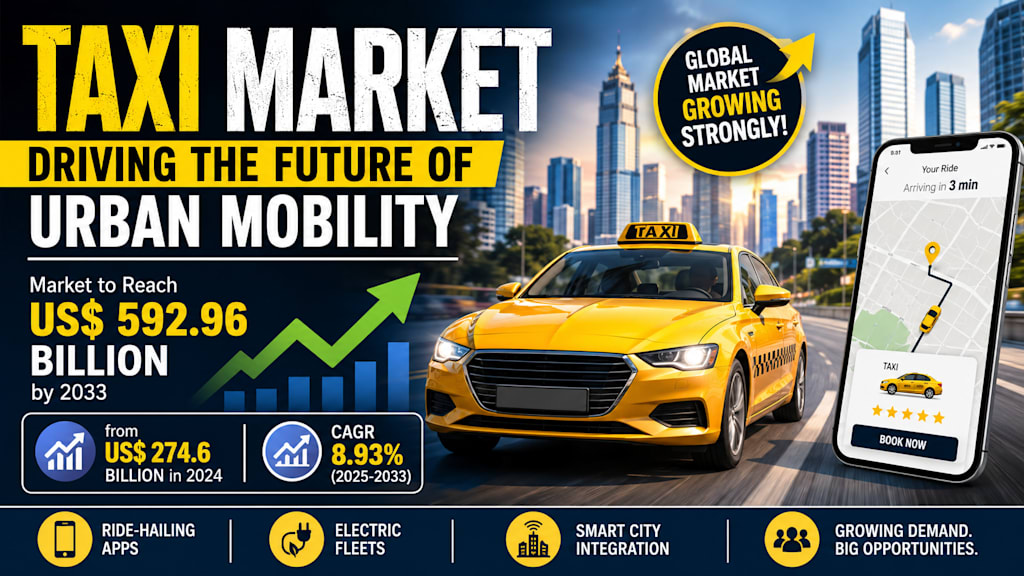
According to Renub Research, the Global Taxi Market is projected to grow from US$ 274.6 billion in 2024 to US$ 592.96 billion by 2033, expanding at a CAGR of 8.93% between 2025 and 2033. This impressive growth reflects the increasing demand for flexible transportation solutions across both developed and emerging economies.
Why the Taxi Industry Continues to Thrive
Despite the expansion of public transportation systems and the popularity of private vehicle ownership in some regions, taxis continue to play a critical role in modern mobility.
Urban residents increasingly prioritize convenience over ownership. Rising fuel costs, expensive vehicle maintenance, parking challenges, and traffic congestion are encouraging many consumers to choose on-demand transportation instead of owning a car.
The taxi industry benefits directly from this shift. Modern customers want transportation services that are reliable, affordable, and instantly accessible through mobile devices. Taxi operators and ride-hailing companies have responded by investing heavily in technology that enhances the customer experience.
Features such as real-time tracking, cashless payments, route optimization, driver ratings, and mobile booking have become standard expectations rather than premium offerings.
As cities become more crowded, taxis are evolving into an indispensable component of urban transportation networks.
Urbanization Is Creating Massive Demand
One of the strongest growth drivers for the global taxi market is rapid urbanization.
The United Nations estimates that a growing percentage of the world's population will live in urban areas over the coming decades. As cities expand, transportation infrastructure often struggles to keep pace with population growth.
This creates significant opportunities for taxi services.
In densely populated metropolitan regions, taxis offer flexibility that public transportation systems cannot always provide. They enable direct, point-to-point travel without requiring passengers to navigate multiple transit connections.
Business professionals, students, tourists, and daily commuters increasingly rely on taxi services to save time and improve convenience.
Emerging economies such as India, Indonesia, Brazil, and several African nations are witnessing especially strong growth in urban populations, creating substantial demand for transportation solutions.
The Smartphone Revolution Changed Everything
Perhaps the biggest transformation in the taxi industry has been the emergence of app-based ride-hailing platforms.
Companies such as Uber, Lyft, Grab, Gojek, Bolt, and DiDi have fundamentally changed how consumers access transportation services.
Instead of standing on a street corner searching for a cab, customers can now book rides within seconds using a smartphone application.
These platforms provide numerous advantages:
Instant booking
Real-time driver tracking
Estimated arrival times
Digital payments
Transparent pricing
Driver reviews and ratings
Enhanced safety features
This level of convenience has significantly increased customer adoption worldwide.
Technology has also improved operational efficiency for drivers and fleet operators. Advanced algorithms help reduce idle time, optimize routes, and improve vehicle utilization, resulting in higher profitability.
The continued growth of smartphone penetration across emerging markets is expected to further accelerate adoption of app-based taxi services.
Tourism and Business Travel Fuel Market Growth
The recovery of global travel is providing another major boost to the taxi industry.
Tourists frequently depend on taxis when visiting unfamiliar destinations. Taxis offer a convenient, safe, and efficient transportation option for airport transfers, sightseeing, hotel transportation, and local travel.
Similarly, business travelers often prioritize reliability and speed, making taxi services a preferred choice.
As international tourism rebounds and business travel activity increases, demand for taxi services is expected to remain strong.
Major tourist destinations across Europe, North America, Asia-Pacific, and the Middle East continue to generate substantial revenue opportunities for taxi operators.
Sustainability Is Reshaping Taxi Fleets
Environmental concerns are becoming increasingly important in transportation planning.
Governments around the world are introducing stricter emissions regulations and promoting cleaner transportation alternatives. As a result, many taxi operators are transitioning toward electric and hybrid vehicles.
Electric taxis offer several advantages:
Lower operating costs
Reduced carbon emissions
Lower maintenance requirements
Improved sustainability credentials
Leading ride-hailing companies have announced ambitious electrification targets.
For example, Lyft expanded its Green Mode option across numerous U.S. cities, enabling riders to specifically request hybrid and electric vehicles. Similar initiatives are emerging globally as operators align with environmental goals and smart-city strategies.
The transition toward electric fleets is expected to become one of the most significant developments influencing the taxi industry during the next decade.
Challenges Facing the Taxi Industry
Despite strong growth prospects, the taxi market faces several challenges.
Driver Shortages
Many regions continue to experience driver shortages following the COVID-19 pandemic.
Drivers increasingly have access to alternative gig-economy opportunities, including food delivery, package transportation, and freelance work.
Taxi companies must compete aggressively for talent by offering better compensation, incentives, and flexible work arrangements.
Rising Operating Costs
Fuel expenses, insurance costs, vehicle maintenance, and regulatory compliance continue to increase operating expenditures for taxi operators.
Balancing profitability while maintaining competitive pricing remains a significant challenge.
Technology Gaps
Traditional taxi operators often struggle to keep pace with technology-focused competitors.
Companies that fail to invest in digital booking systems, mobile applications, cashless payment platforms, and fleet management software risk losing market share.
Digital transformation is no longer optional—it is essential for long-term survival.
Regional Market Insights
United States
The United States remains one of the world's largest taxi markets.
Consumers increasingly prefer app-based transportation services, while operators continue investing in electric vehicles and digital innovations.
Major urban centers such as New York, Chicago, Los Angeles, and San Francisco remain key demand hubs.
United Kingdom
The UK market combines traditional black cab services with rapidly growing private-hire and ride-hailing operators.
Digital booking, contactless payments, and sustainability initiatives are shaping the future of transportation across British cities.
India
India represents one of the fastest-growing taxi markets globally.
Rapid urbanization, rising incomes, widespread smartphone adoption, and increasing demand for affordable transportation continue driving growth.
Cities such as Delhi, Mumbai, Bengaluru, Hyderabad, and Chennai are major centers of taxi demand.
United Arab Emirates
The UAE operates one of the most technologically advanced taxi ecosystems in the world.
Government support for smart mobility initiatives, combined with strong tourism activity and digital infrastructure, positions the UAE as a leader in transportation innovation.
10 Recent Developments from Leading Taxi Industry Companies
1. Uber Technologies Inc.
Uber continues expanding its electric vehicle initiatives globally while investing heavily in autonomous mobility research and sustainable transportation solutions.
2. Lyft Inc.
Lyft expanded its Green Mode service, enabling riders in additional cities to request electric and hybrid vehicles directly through the platform.
3. Grab Holdings Inc.
Grab continues strengthening its Southeast Asian mobility ecosystem through integrated transportation, payments, and delivery services.
4. Gojek Tech
Gojek has expanded digital mobility offerings while enhancing driver support programs and sustainable transportation initiatives.
5. DiDi Chuxing
DiDi continues investing in AI-powered transportation technologies, fleet optimization systems, and smart mobility infrastructure.
6. Bolt Technologies OU
Bolt has accelerated expansion across Europe and Africa while focusing on affordability and electric mobility adoption.
7. BlaBlaCar
BlaBlaCar continues enhancing ride-sharing capabilities and strengthening intercity transportation solutions across multiple regions.
8. FREE NOW
FREE NOW has expanded multimodal transportation services, integrating taxis, ride-sharing, and micromobility options into a single platform.
9. Curb Mobility LLC
Curb continues improving digital taxi booking services across North America while supporting traditional taxi operators through technology modernization.
10. YelowSoft
In January 2024, YelowSoft introduced an in-app wallet system designed to streamline payments, improve security, and strengthen customer retention for ride-hailing businesses.
Emerging Trends That Will Define the Future
Several transformative trends are expected to shape the future of the taxi market:
Expansion of electric vehicle fleets
AI-powered route optimization
Autonomous vehicle development
Smart-city transportation integration
Subscription-based mobility services
Enhanced passenger safety technologies
Multi-modal transportation ecosystems
Advanced fleet analytics
Sustainable transportation initiatives
Contactless customer experiences
Companies capable of adapting to these changes will be best positioned for long-term success.
Final Thoughts
The global taxi industry is experiencing one of the most significant transformations in its history.
Driven by urbanization, digital innovation, sustainability initiatives, and changing consumer preferences, taxi services are evolving far beyond traditional transportation models.
With the market expected to reach US$ 592.96 billion by 2033, opportunities for operators, technology providers, investors, and mobility platforms remain substantial.
As electric vehicles become mainstream, smart-city projects expand, and ride-hailing platforms continue innovating, the future of urban mobility appears increasingly connected, efficient, and environmentally sustainable.
The taxi industry is no longer simply about getting from one place to another. It is becoming a cornerstone of the modern mobility economy—one that will help shape how billions of people move through cities in the years ahead.
About the Creator
Enjoyed the story? Support the Creator.
Subscribe for free to receive all their stories in your feed.
Comments
There are no comments for this story
Be the first to respond and start the conversation.