
The Future of Private Aviation: Why the Business Jet Market Continues to Soar
Rising demand for flexibility, luxury, and time-efficient travel is driving steady growth in the global business jet industry.

In a world where time has become one of the most valuable assets, private aviation is no longer viewed solely as a luxury reserved for billionaires and celebrities. Instead, business jets have evolved into strategic tools that enable corporations, entrepreneurs, government agencies, and high-net-worth individuals to maximize efficiency, improve productivity, and access destinations that commercial airlines often cannot serve conveniently.
As globalization continues to reshape the way organizations operate, the demand for flexible and time-efficient transportation is increasing rapidly. Executives are expected to travel across multiple cities and countries within short timeframes, while business opportunities often require immediate face-to-face interactions. In this environment, business jets offer a compelling alternative to commercial aviation by providing customized schedules, direct routes, enhanced privacy, and unparalleled convenience.
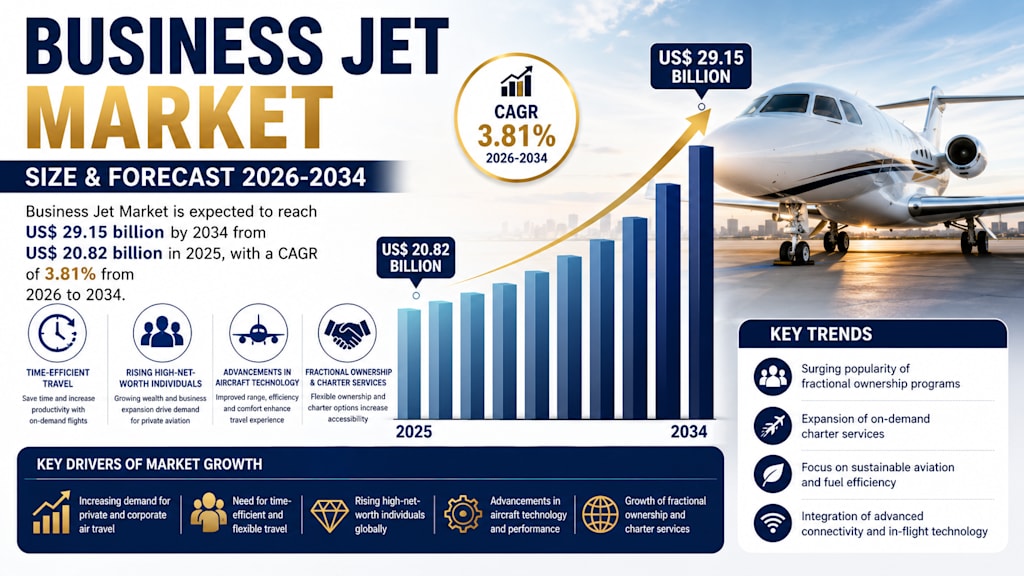
According to Renub Research, the global Business Jet Market is expected to expand from US$ 20.82 billion in 2025 to US$ 29.15 billion by 2034, growing at a CAGR of 3.81% between 2026 and 2034. The steady expansion of the market reflects growing demand for private and corporate air travel, increasing numbers of high-net-worth individuals, technological advancements in aircraft design, and the growing popularity of charter services and fractional ownership models.
The Evolution of Business Aviation
The business jet industry has undergone remarkable transformation over the past several decades. Initially associated primarily with large multinational corporations and ultra-wealthy individuals, private aviation has gradually become more accessible through innovative ownership structures and charter programs.
Business jets are designed to provide flexible transportation solutions that eliminate many of the challenges associated with commercial airline travel. Rather than adhering to fixed schedules and routes, business aviation allows passengers to determine departure times, destinations, and travel itineraries according to their specific needs.
This flexibility has become increasingly valuable as businesses operate across global markets and executives face growing pressure to maximize productivity.
Modern business jets also offer significant advantages beyond transportation. Aircraft cabins now function as mobile offices equipped with high-speed connectivity, advanced communication systems, and comfortable workspaces that allow passengers to remain productive throughout their journeys.
As a result, business aviation has evolved from a luxury service into a practical business solution that supports operational efficiency and strategic decision-making.

Why Time Efficiency Matters More Than Ever
One of the most significant drivers behind the growth of the business jet market is the increasing importance of time-efficient travel.
Commercial aviation serves millions of travelers effectively, but it often presents challenges for executives and organizations operating under tight schedules. Long security lines, flight delays, layovers, and limited route options can create significant inefficiencies.
Business jets address these concerns by enabling travelers to bypass many of the obstacles associated with traditional air travel.
Passengers can arrive shortly before departure, access private terminals, avoid crowded airports, and fly directly to destinations without multiple connections. Additionally, business jets can utilize smaller regional airports that are inaccessible to large commercial aircraft, bringing travelers closer to their final destinations.
For multinational corporations, these advantages can translate into substantial productivity gains, allowing executives to visit multiple locations in a single day and respond quickly to emerging opportunities.
The Growing Influence of High-Net-Worth Individuals
Another major factor contributing to market growth is the increasing global population of wealthy individuals.
As wealth creation accelerates in both developed and emerging economies, more consumers are seeking premium travel experiences that prioritize privacy, convenience, and flexibility.
Business jets offer a level of exclusivity and customization that commercial airlines cannot easily match.
Whether traveling for business, leisure, family vacations, or special events, affluent travelers increasingly prefer private aviation because it allows them to control their schedules and travel experiences.
This trend is particularly noticeable in regions experiencing rapid economic growth, where rising disposable incomes and expanding entrepreneurial activity are creating new demand for private aviation services.
As the number of high-net-worth individuals continues to increase globally, business jet operators and manufacturers are well-positioned to benefit from expanding customer demand.
Technological Innovation Is Reshaping the Industry
Technology remains one of the most powerful forces driving change within the business jet sector.
Modern aircraft are significantly more advanced than previous generations, incorporating sophisticated avionics, fuel-efficient engines, enhanced safety systems, and improved aerodynamics.
These innovations offer numerous benefits.
Aircraft can travel longer distances with greater fuel efficiency, reducing operating costs while expanding route capabilities. Advanced navigation and flight management systems improve safety and operational reliability, while predictive maintenance technologies help reduce downtime and maintenance expenses.
Cabin technology has also advanced considerably.
Passengers now expect seamless internet connectivity, video conferencing capabilities, entertainment systems, and highly customized cabin environments. Manufacturers continue investing in interior design innovations that improve comfort while supporting productivity during flights.
As technology continues to evolve, business jets are becoming increasingly attractive to corporations and private travelers seeking efficient and connected travel solutions.
Sustainability Is Becoming a Strategic Priority
Environmental sustainability has emerged as one of the most important topics within the aviation industry.
Business aviation faces growing scrutiny regarding its environmental impact, particularly concerning carbon emissions and fuel consumption.
In response, aircraft manufacturers and operators are investing heavily in sustainability initiatives.
Sustainable aviation fuels (SAF), hybrid propulsion systems, lightweight materials, and improved engine technologies are becoming key areas of research and development.
Many manufacturers are also exploring advanced aerodynamic designs that reduce fuel consumption and improve environmental performance.
While achieving full sustainability remains a long-term challenge, these initiatives demonstrate the industry's commitment to reducing its environmental footprint while maintaining the operational benefits that make business aviation attractive.
As environmental regulations continue to evolve, sustainability will likely become an increasingly important competitive differentiator within the market.
The Rise of Fractional Ownership and Charter Services
Historically, purchasing a business jet required substantial financial resources, limiting ownership to large corporations and wealthy individuals.
Today, innovative business models are expanding access to private aviation.
Fractional ownership programs allow multiple customers to share ownership costs while enjoying many of the benefits associated with private aircraft access. This model significantly reduces the financial burden of full ownership while providing flexibility and convenience.
Similarly, jet card programs and charter services have transformed how travelers access private aviation.
Instead of purchasing aircraft, customers can simply pay for the flights they need. This approach appeals to businesses and individuals who value flexibility but do not require full-time aircraft ownership.
These models have helped democratize private aviation and broaden the market's customer base.
As awareness of these options continues to grow, charter services and fractional ownership are expected to remain major contributors to market expansion.
Challenges Facing the Business Jet Industry
Despite its positive outlook, the business jet market faces several important challenges.
One of the most significant obstacles is the high cost associated with aircraft ownership and operation.
Purchasing a business jet often requires investments ranging from several million dollars to tens of millions of dollars depending on aircraft type and capabilities.
In addition to acquisition costs, operators must manage ongoing expenses related to fuel, maintenance, crew salaries, insurance, hangar fees, and regulatory compliance.
Fuel price fluctuations can further impact operating budgets, making cost management a critical consideration for owners and operators.
These financial requirements limit market participation and remain one of the industry's most significant barriers to broader adoption.
Regulatory and Environmental Pressures Continue to Increase
Regulatory compliance represents another major challenge for the business aviation sector.
Aircraft manufacturers and operators must comply with strict requirements established by aviation authorities such as the Federal Aviation Administration (FAA), European Union Aviation Safety Agency (EASA), and national aviation regulators worldwide.
Certification processes, safety audits, maintenance requirements, and operational standards require significant resources and ongoing oversight.
Environmental regulations are also becoming more stringent.
Governments and international organizations are implementing policies aimed at reducing aviation emissions and encouraging sustainable operations.
While these regulations support long-term environmental objectives, they also increase development costs and operational complexity for manufacturers and operators.
Successfully navigating these challenges will be essential for sustaining future market growth.
Regional Markets Driving Global Expansion
The United States remains the largest business jet market in the world.
Strong economic activity, a large concentration of corporate headquarters, extensive aviation infrastructure, and a significant population of high-net-worth individuals continue to support demand for private aviation services. Major cities such as New York, Los Angeles, Miami, and Chicago serve as important hubs for business jet operations.
Germany represents one of Europe's most influential business aviation markets. The country's strong industrial base, extensive international business activity, and growing interest in charter services contribute to steady market demand. Frankfurt, Munich, Hamburg, and Berlin remain key centers of business aviation activity.
China continues to emerge as an important market despite experiencing periodic economic and regulatory challenges. Growing corporate globalization, infrastructure development, and increasing demand for flexible mobility solutions are creating opportunities for long-term growth.
Saudi Arabia is rapidly becoming a major player in Middle Eastern business aviation. Supported by Vision 2030 initiatives, luxury tourism development, infrastructure investments, and increasing corporate mobility, the Kingdom is experiencing significant expansion in private aviation activity.
Recent Industry Developments Highlight Market Momentum
Recent developments across the industry demonstrate continued investment in innovation and fleet modernization.
Aircraft manufacturers are introducing next-generation models featuring enhanced performance, improved fuel efficiency, and advanced safety technologies. New aircraft programs from leading manufacturers continue to push the boundaries of range, comfort, and operational efficiency.
Major fleet expansion agreements between operators and manufacturers further indicate confidence in future demand. Investments in new aircraft production facilities, avionics technologies, and advanced maintenance solutions highlight the industry's commitment to long-term growth.
These developments suggest that business aviation will continue evolving to meet changing customer expectations and market requirements.
The Future of Business Aviation
The outlook for the business jet market remains positive.
Several long-term trends are expected to support continued growth, including globalization, rising wealth levels, increasing demand for flexible mobility solutions, technological innovation, and expanding accessibility through charter and fractional ownership programs.
Corporate travel requirements are unlikely to diminish, particularly as organizations continue operating across increasingly global networks. Similarly, affluent travelers will continue seeking personalized experiences that prioritize convenience, privacy, and efficiency.
At the same time, advances in sustainability and digital technologies will help shape the next generation of business aircraft.
Manufacturers that successfully balance performance, environmental responsibility, and customer experience will likely emerge as market leaders.
Final Thoughts
Business aviation is no longer simply about luxury travel. It has become an essential tool for organizations and individuals who value efficiency, flexibility, and productivity.
The ability to travel according to personalized schedules, access remote destinations, maintain privacy, and maximize productive time has made business jets increasingly relevant in today's fast-paced global economy.
Although challenges related to costs, regulations, and sustainability remain, the industry's commitment to innovation and evolving business models continues to create new opportunities.
With the global market projected to reach US$29.15 billion by 2034, business aviation is positioned for sustained growth and transformation. As technology advances and accessibility expands, business jets will continue playing a critical role in shaping the future of corporate and private air travel.
About the Creator
Enjoyed the story? Support the Creator.
Subscribe for free to receive all their stories in your feed.
Comments
There are no comments for this story
Be the first to respond and start the conversation.