
The Future of Farming Is Here: Why the United States Hydroponics Market Is Growing Faster Than Ever
Hydroponic farming is reshaping American agriculture with higher yields, lower water consumption, and year-round food production as the market is projected to reach US$6.34 billion by 2034.

The Future of Agriculture Is No Longer Underground
For generations, healthy crops have depended on fertile soil, predictable weather, and vast farmland. Today, however, agriculture is entering an entirely new era—one where plants can thrive without soil, harvests can continue regardless of climate, and food can be produced closer to consumers than ever before.
This transformation is being driven by hydroponics, an innovative cultivation method that replaces traditional soil with nutrient-rich water solutions. What once appeared to be an experimental farming technique has rapidly evolved into a commercially viable agricultural system used by large-scale growers, urban farms, restaurants, grocery suppliers, and even households.
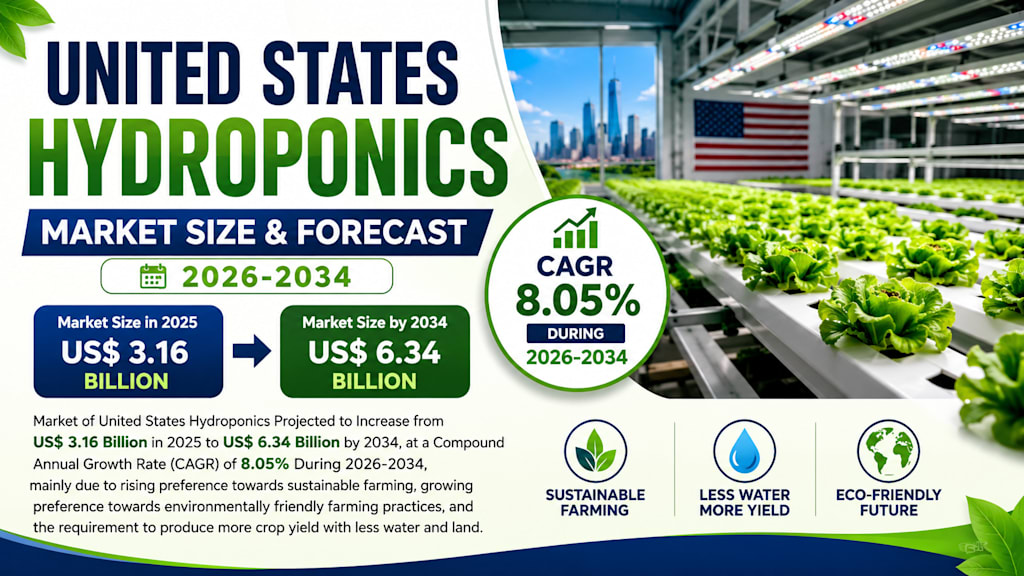
According to the market report, the United States Hydroponics Market is expected to grow from US$3.16 billion in 2025 to US$6.34 billion by 2034, expanding at a compound annual growth rate (CAGR) of 8.05% during 2026–2034. This remarkable growth reflects increasing demand for sustainable food production, resource-efficient farming practices, and technological innovation across the agricultural sector.
The market's momentum is not simply the result of new farming equipment. Instead, it represents a larger shift toward climate-resilient agriculture capable of producing fresh food while conserving natural resources.

Understanding Hydroponics
Hydroponics is a cultivation technique in which plants grow without soil. Instead, their roots receive carefully balanced nutrients through water while being supported by growing media such as coco coir, perlite, or rock wool.
Because every aspect of the growing environment—including temperature, humidity, nutrients, lighting, and water—is precisely controlled, hydroponic systems often deliver faster growth, healthier plants, and significantly higher yields than conventional farming methods.
Perhaps even more impressive is water efficiency. Hydroponic systems can dramatically reduce water usage compared with traditional farming, making them particularly attractive in regions facing drought and water scarcity.
Sustainability Is Driving the Market Forward
Environmental sustainability has become one of the strongest growth drivers for hydroponic farming.
Conventional agriculture consumes enormous amounts of land and water while remaining vulnerable to changing weather conditions. Hydroponics offers an alternative that minimizes water consumption, reduces chemical usage, and enables food production in locations where conventional farming is difficult or impossible.
As climate change continues to affect agricultural productivity, governments, businesses, and consumers are investing more heavily in farming methods that improve resource efficiency.
The growing interest in sustainable agriculture is helping hydroponics move from a niche technology into mainstream food production.
Urban Agriculture Is Becoming a Reality
Urbanization has dramatically changed how food reaches consumers.
Large cities continue expanding while farmland near metropolitan areas becomes increasingly scarce. Hydroponics addresses this challenge by enabling crops to grow inside warehouses, rooftops, greenhouses, and vertical farming facilities located close to consumers.
This proximity shortens transportation distances, preserves freshness, reduces food waste, and lowers carbon emissions associated with long-distance shipping.
Restaurants, supermarkets, and meal delivery companies increasingly prefer locally grown vegetables because they offer better quality and more reliable supply chains.
As cities continue growing, hydroponic farming is expected to become an important component of urban food security.
Technology Is Revolutionizing Modern Farming
Hydroponics is no longer just about growing plants without soil. Today's systems combine advanced agricultural science with cutting-edge technology.
Modern farms utilize automated irrigation, LED grow lights, environmental sensors, artificial intelligence, and real-time monitoring software to optimize plant growth.
These technologies continuously measure nutrient concentration, temperature, humidity, pH levels, and water quality while automatically adjusting growing conditions to maximize productivity.
Automation reduces labor requirements, improves consistency, and enables commercial growers to produce high-quality crops throughout the year regardless of outdoor weather conditions.
As agritech innovation continues accelerating, hydroponic farming is becoming increasingly efficient, scalable, and economically attractive.
Industry Investments Continue to Expand
Several companies have recently announced major investments that demonstrate growing confidence in the hydroponics industry.
Plantaform introduced its Smart Indoor Garden to the United States in January 2025 after receiving recognition at CES for its innovative fog-based growing technology.
AeroFarms announced plans to expand with a new vertical farming facility in Virginia.
Plenty Unlimited partnered with Albertsons Companies to distribute hydroponically grown leafy greens across more than 2,000 grocery stores nationwide.
BrightFarms launched sustainability initiatives focused on reducing greenhouse gas emissions, while Gotham Greens expanded operations into the Midwest with a new Chicago facility.
Freight Farms also introduced new hydroponic systems designed for home food production, highlighting growing consumer interest in indoor agriculture.
Popular Crops Continue to Diversify
Leafy greens remain among the most widely cultivated hydroponic crops, but the industry has expanded far beyond lettuce.
Tomatoes represent one of the largest commercial hydroponic categories because consumers demand consistent quality and year-round availability.
Hydroponic systems also support herbs such as basil, parsley, cilantro, and mint, providing restaurants and grocery retailers with dependable supplies regardless of seasonal conditions.
Additional crops including cucumbers, peppers, and strawberries continue gaining popularity as growers optimize cultivation techniques for different varieties.
Aggregate Systems Remain Highly Popular
Among different hydroponic production methods, aggregate systems continue attracting widespread adoption.
These systems utilize solid growing media such as rock wool, perlite, vermiculite, and coconut fibers to support plant roots while delivering nutrient-rich water.
Growers value aggregate systems because they provide excellent root aeration, improve moisture retention, reduce waterborne disease risks, and simplify nutrient management.
Their flexibility makes them suitable for both small indoor farms and large commercial greenhouse operations.
HVAC and Irrigation Technologies Are Essential
Controlled-environment agriculture depends on more than nutrient solutions.
HVAC systems regulate temperature, humidity, and airflow to maintain ideal growing conditions throughout every season.
Likewise, advanced irrigation technologies—including drip irrigation, nutrient film techniques, and ebb-and-flow systems—deliver precise nutrient quantities while minimizing waste.
Smart automation further enhances these systems by allowing growers to monitor operations remotely and respond quickly to changing plant requirements.
Regional Growth Across the United States
California continues leading the hydroponics industry thanks to its advanced agricultural sector, technology ecosystem, and emphasis on water conservation.
Texas is emerging as another important market because of population growth, favorable investment conditions, and increasing demand for locally produced vegetables.
New York has embraced vertical farming to overcome limited agricultural land while supplying fresh produce to urban consumers.
Florida also represents a growing opportunity as greenhouse hydroponics helps producers overcome weather-related farming challenges and supply both local and export markets.
Challenges Still Need Attention
Despite strong growth prospects, hydroponics faces several obstacles.
High startup costs remain one of the largest barriers to adoption. Commercial hydroponic facilities require significant investments in lighting, climate control, irrigation systems, automation, and infrastructure.
Operational expenses—including electricity, maintenance, and skilled labor—can also affect profitability.
In addition, hydroponic farming requires specialized technical knowledge. Growers must carefully manage nutrients, water chemistry, lighting schedules, and environmental conditions to maintain healthy crops.
As education, automation, and technology continue improving, many of these challenges are expected to become easier to overcome.
Looking Ahead
Hydroponics is redefining what modern agriculture can achieve.
Growing environmental concerns, increasing urban populations, technological innovation, and demand for locally produced food are creating ideal conditions for long-term market expansion.
Rather than replacing traditional farming entirely, hydroponics is becoming an essential complement that improves food security while reducing environmental impact.
As investment continues flowing into automation, smart farming technologies, and controlled-environment agriculture, hydroponic farming is likely to play a central role in feeding future generations.
Final Thoughts
The projected growth of the United States Hydroponics Market from US$3.16 billion in 2025 to US$6.34 billion by 2034 illustrates far more than market expansion—it reflects a transformation in how food is grown, distributed, and consumed.
Hydroponics offers practical solutions to some of agriculture's greatest challenges, including water scarcity, climate uncertainty, land limitations, and increasing food demand. With continuous innovation, supportive investments, and rising consumer awareness, the industry is well positioned to shape the future of sustainable farming in America for years to come.
About the Creator
Enjoyed the story? Support the Creator.
Subscribe for free to receive all their stories in your feed.
Comments
There are no comments for this story
Be the first to respond and start the conversation.