
The Black Leather Jacket Is Still on the Rack
Jensen Huang left Nvidia in four days. The harder question is who makes the next bet.
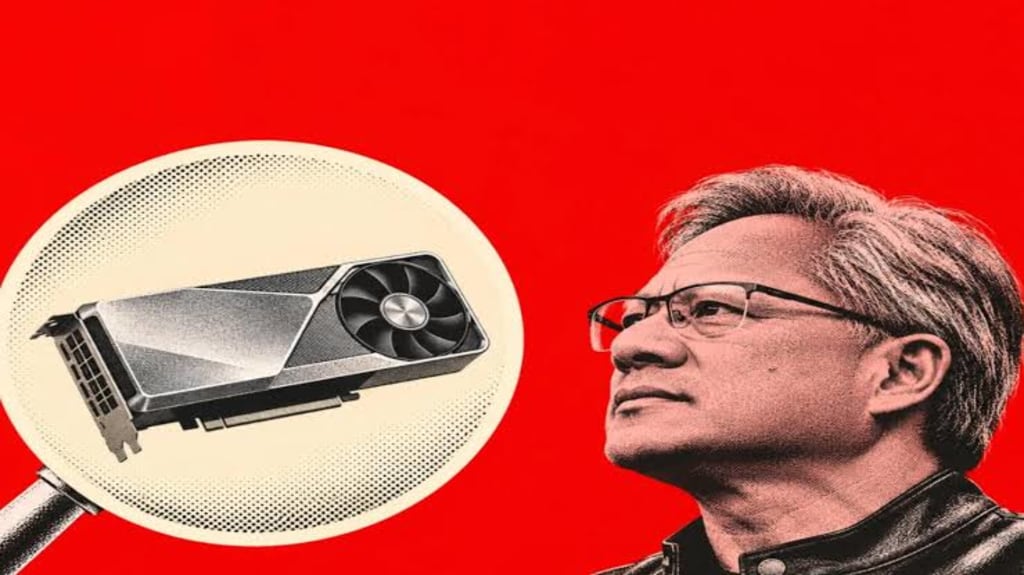
The black leather jacket still hangs on the rack in Jensen Huang’s office. At nine tomorrow morning, when the board meets, someone else will sit in the chair.
On November 12, 2026, Nvidia said Huang had resigned as president, CEO, and board member, effective immediately. CFO Colette Kress became interim CEO and kept the CFO job. The board also named Harvey Jones as its first chairman.
Nvidia opened down 14% that day. Its market value fell below $4 trillion. More than $500 billion disappeared in one session. The Nasdaq fell 1.5%.
I. Four days
On November 8, Huang sent an internal letter to employees and admitted he had been unfaithful to his wife. If the story had stopped there, the board would have opened an investigation, Huang would have stayed on and cooperated, and the storm would have faded in a few weeks. Silicon Valley knows that script.
The name of the other woman changed the story. Multiple outlets reported that U.S. intelligence agencies had concluded that Alice Huang, a former executive at Singapore data-center company Megaspeed, was an intelligence asset recruited by China’s Ministry of State Security. Megaspeed was already under federal investigation over suspected transshipment of export-controlled Nvidia chips to China. Huang had also been touched by U.S. electronic surveillance earlier in the year. While monitoring Alice Huang, investigators used an identity-reveal procedure to confirm that the U.S. citizen she contacted often was Nvidia’s CEO.
On November 11, The New York Times reported a second relationship, with Kimberly Powell, vice president of Nvidia’s healthcare business and a direct report to Huang. The board met overnight.
On November 12, the resignation went out.
The board hired Wachtell, Lipton, Rosen & Katz for an independent investigation. The question was not Huang’s private life. The board wanted to know whether he had hidden the relationship, whether he had a conflict of interest, and whether the company had misled investors in earlier responses to reporters. CNN quoted former SEC Chairman Gary Gensler: if the investigation found that Huang had deliberately misled the board, he could be removed. After the second relationship surfaced, the board did not wait for the finding.
The company still says it has “no reason to believe” that commercial secrets or substantive national-security material leaked. But Huang controlled core U.S. AI capacity. He was also entangled with a suspected foreign intelligence asset, a sensitive chip-transshipment node, and a Congress already moving toward tighter export controls. That combination was enough. The board, Congress, and the intelligence community lost patience at the same time.
II. The board took more than the CEO title
The resignation came with a new arrangement for Nvidia: a chairman, filled by Harvey Jones. Nvidia had not had one in thirty years.
Jones joined the board in 1993, before Nvidia went public. He sat on the audit and governance committees. He had previously run Synopsys, an electronic-design-automation company, and taken it public. A thirty-three-year board veteran becoming the first chairman sent a clear signal. The board took institutional power back from the founder.
Under Huang, Nvidia ran on the strongest version of the Silicon Valley founder model. He was CEO and chairman. Every other director was independent. Major decisions came from one man. The management layer was flat. In the years when Huang bet on the right direction, that structure gave Nvidia a strong advantage. The cost was redundancy. When the single decision point becomes the source of risk, the system has no built-in correction.
The chairman role supplies that correction. It also sets a rule: Nvidia will not build a second Jensen Huang. Operating power goes to management. Oversight goes to the board. That line was drawn the moment the founder left.
Colette Kress, the interim CEO, fits the same logic. She joined Nvidia as CFO in 2013 after nearly 25 years in technology finance at Microsoft and Cisco. She saw the whole transformation from graphics cards to AI infrastructure. Huang interviewed 22 candidates before choosing her. He once said, “for as long as we shall live and death do us part.” The marriage worked because Kress was not a copy of Huang. She anchors finance and operations. She does not bet on technology roadmaps. The board wanted hands that could hold the wheel in a storm, not another black leather jacket.
III. What the 14% priced
Nvidia’s valuation was never only a price for current products. It carried a trust premium. Investors believed Huang would make the right bet at every technology turn, even when the consensus went the other way. Gaming GPUs to CUDA. CUDA to data centers. Data centers to generative AI.
Saxo Markets chief investment strategist Charu Chanana put it plainly: part of Nvidia’s premium “comes from investors believing Jensen Huang has the ability to set the direction for the AI industry.” Analyst Dan Gallagher was blunter: “Without him, no one knows how to value Nvidia.”
In the short term, Nvidia’s moat is physical. As of 2026, the company holds an AI-chip backlog covering 2025 and 2026. The Rubin platform is ramping. The global data-center capex cycle has not paused because one man resigned. Customers buy GPU performance, CUDA lock-in, and delivery capacity. They do not buy affection for Huang. CUDA will not vanish because the CEO changes. Data centers will not return orders en masse. Downstream compute buying is chain-linked. The first company to walk away hurts itself.
The certainty that vanished sits two years out. AI-chip competition is not about milking current products. Every architecture choice, including process, packaging, interconnect, memory bandwidth, and fit with new workloads, is a bet placed two or three years ahead. Huang’s rarest skill was making a series of correct directional bets with incomplete information. That skill does not fit in a handover document. A board appointment cannot copy it.
Kress inherits different terrain. CUDA’s lock-in is loosening. Microsoft has tools that translate CUDA models to AMD’s ROCm architecture. Google’s TorchTPU effort lowers the barrier to moving workloads to PyTorch. Anthropic showed it could port Claude to AMD chips in three days. None of this means CUDA is collapsing. It does mean the next CEO has less room for a wrong roadmap choice and less time to prove the choice right.
The 14% drop priced a simple judgment. Nvidia lost a CEO who had repeatedly made the right calls under uncertainty. Until the market finds and tests the next person with that record, part of the forward expectation comes off the price.
IV. Washington lost a buffer
The resignation landed at an awkward political moment. Democrats had just won the midterms on a promise of stronger AI regulation. They retook the Senate and the House.
Huang’s role went beyond Nvidia. He advised Trump on AI. He was one of the few people who could stand between tough China controls and U.S. industrial interests. He persuaded the Trump administration to allow some H200 sales to China under conditions. He also lobbied Congress to relax limits. For a Democratic Congress preparing to tighten rules, Huang was a partner with weight, reach, and a difficult streak.
That buffer is gone. The interim CEO and the first chairman have two priorities: governance compliance and business continuity. They do not have a mandate to win political space in Washington for Nvidia’s China business. Analysts expect the same direction. A Democratic majority, plus the political heat from Huang’s scandal, will speed up tighter chip controls. The tools are familiar: close third-party transshipment routes, track chip flows, and squeeze the gray market for special-supply chips. The spy allegation may or may not be proven. The political reaction alone can drive new legislation.
Nvidia now fights on two fronts. Inside the company, it must keep its technology roadmap right without the founder’s betting record. Outside, it must face a less friendly Congress and a tighter export-control net without its best lobbyist. Neither front has a quick fix.
The black leather jacket still hangs on the rack. CUDA code still compiles on millions of developers’ machines. Rubin samples still move through TSMC’s lines. Data centers are still being built. The company will not stop because one man left.
The source of certainty has changed. Nvidia’s certainty used to sit in one man’s judgment. Now it sits in the board, interim management, the order backlog, and an untested successor. The market put a first price on that shift: 14%. The next price comes when the next technology fork arrives.
About the Creator
Jin
Writer of reamstories
https://reamstories.com/jin
Enjoyed the story? Support the Creator.
Subscribe for free to receive all their stories in your feed. You could also become a paid subscriber, letting them know you appreciate their work.
Comments
There are no comments for this story
Be the first to respond and start the conversation.