
The Battle for Every Breath: How Innovation Is Transforming Acute Respiratory Distress Syndrome Treatment
Advances in critical care, regenerative medicine, targeted therapies, and intensive care technologies are reshaping the future of Acute Respiratory Distress Syndrome treatment worldwide.

Few medical emergencies challenge healthcare systems as intensely as Acute Respiratory Distress Syndrome (ARDS). Often developing suddenly and progressing rapidly, ARDS remains one of the most serious respiratory conditions treated in intensive care units worldwide.
The syndrome can transform an otherwise manageable illness into a life-threatening emergency within hours. Patients suffering from severe pneumonia, sepsis, trauma, or other critical conditions may experience widespread inflammation in the lungs, making it extremely difficult for oxygen to reach the bloodstream.
For decades, treatment options have focused largely on supportive care rather than directly targeting the underlying disease process. However, recent advances in critical care technologies, regenerative medicine, biologic therapies, and precision medicine are beginning to change that reality.
As innovation accelerates and healthcare systems invest heavily in respiratory care infrastructure, the Acute Respiratory Distress Syndrome market is entering a period of significant transformation.
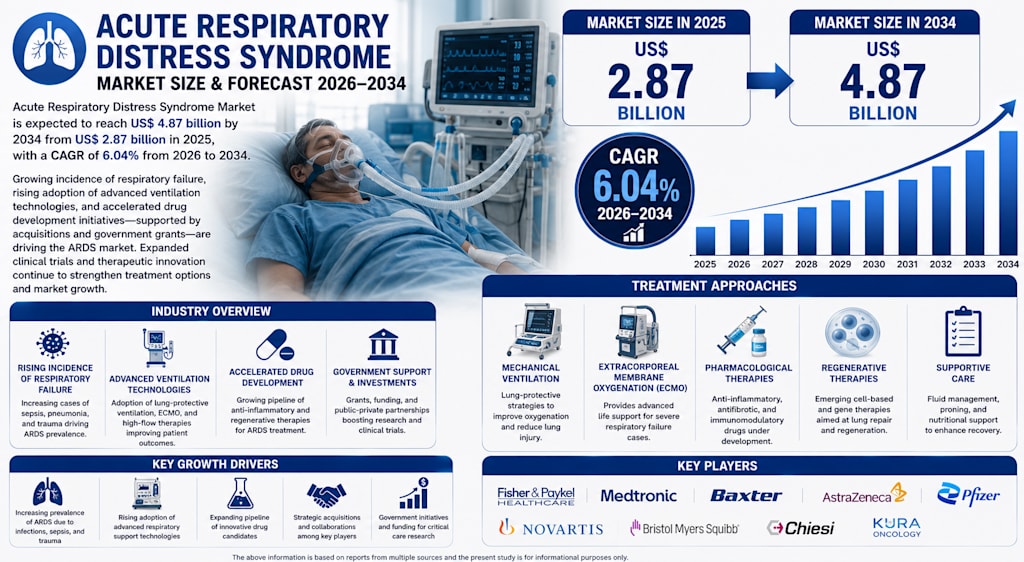
According to Renub Research, the Global Acute Respiratory Distress Syndrome (ARDS) Market is expected to grow from US$ 2.87 billion in 2025 to US$ 4.87 billion by 2034, expanding at a compound annual growth rate (CAGR) of 6.04% between 2026 and 2034. Rising rates of respiratory failure, growing adoption of advanced ventilation technologies, expanding clinical research, and accelerated drug development initiatives are among the key factors driving market growth.
As healthcare providers seek better ways to improve survival and long-term outcomes, ARDS treatment is rapidly evolving from supportive management toward more targeted and innovative therapeutic approaches.

Understanding Acute Respiratory Distress Syndrome
Acute Respiratory Distress Syndrome is a severe inflammatory condition that affects the lungs and significantly impairs oxygen exchange.
The syndrome develops when inflammation causes fluid leakage into the tiny air sacs of the lungs, preventing adequate oxygen from entering the bloodstream.
ARDS is not a disease itself but rather a complication arising from various underlying conditions, including:
Pneumonia, sepsis, severe infections, trauma, burns, inhalation injuries, pancreatitis, and major surgical complications.
Patients often require immediate hospitalization and intensive care support.
Traditional ARDS management primarily relies on supportive interventions such as mechanical ventilation, oxygen therapy, fluid management, and, in severe cases, extracorporeal membrane oxygenation (ECMO).
Despite improvements in critical care practices, ARDS continues to be associated with significant mortality rates and long-term health complications.
These challenges have fueled extensive research into more effective treatment strategies.
Rising Respiratory Disease Burden Is Driving Demand
One of the strongest drivers of ARDS market growth is the increasing global burden of respiratory illnesses.
Respiratory infections remain among the leading causes of hospitalization worldwide. Conditions such as pneumonia, influenza, sepsis-related complications, and severe viral infections continue to contribute substantially to ARDS incidence.
In addition, environmental factors including air pollution, smoking, occupational exposures, and chronic lung diseases increase susceptibility to respiratory failure.
The growing prevalence of chronic diseases such as diabetes, cardiovascular disorders, and obesity further elevates patient risk.
As populations age globally, healthcare systems are encountering larger numbers of patients vulnerable to severe respiratory complications.
This combination of demographic and health trends is contributing to rising ICU admissions and increasing demand for advanced respiratory care technologies.
Healthcare providers are therefore investing heavily in equipment, therapies, and treatment protocols designed to improve outcomes for critically ill patients.
Technological Innovation Is Reshaping Critical Care
Technological advancement has become one of the most influential forces driving progress within the ARDS market.
Modern intensive care units now utilize highly sophisticated respiratory support systems capable of delivering more precise and personalized treatment.
Advanced mechanical ventilators feature intelligent monitoring capabilities, adaptive ventilation modes, and improved lung-protective strategies designed to minimize ventilator-induced lung injury.
Digital monitoring systems continuously assess patient status, enabling clinicians to respond rapidly to changes in respiratory function.
Extracorporeal membrane oxygenation (ECMO) technology has also become increasingly important for patients with severe respiratory failure who do not respond adequately to conventional ventilation.
These innovations have significantly improved survival rates and expanded treatment options for critically ill patients.
As hospitals continue modernizing intensive care capabilities, adoption of advanced respiratory technologies is expected to accelerate further.
Strategic Acquisitions Are Expanding Critical Care Capabilities
Industry consolidation has emerged as another important growth driver.
Healthcare technology companies are increasingly pursuing acquisitions to strengthen their positions within critical care markets and broaden their product portfolios.
A notable example occurred in September 2024 when Getinge AB completed its acquisition of Paragonix Technologies, a company specializing in organ preservation technologies.
The acquisition enhanced Getinge's capabilities within high-acuity care environments and strengthened its ability to provide integrated solutions for critically ill patients, including those suffering from ARDS.
Such strategic transactions help companies accelerate innovation, improve global distribution networks, and expand access to advanced critical care technologies.
As competition intensifies, acquisitions are expected to remain an important mechanism for market growth and technological advancement.
Government Funding Is Accelerating Drug Development
Government support is playing an increasingly important role in advancing ARDS treatment innovation.
Historically, ARDS drug development has been challenging due to the complexity of the condition and the high costs associated with clinical research.
Public-sector funding programs are helping overcome these barriers.
In October 2023, GEn1E Lifesciences secured a contract from the U.S. Department of Health and Human Services through the Biomedical Advanced Research and Development Authority (BARDA) to advance development of its investigational ARDS therapy, GEn-1124.
Such initiatives reduce development risk and encourage greater investment from pharmaceutical and biotechnology companies.
Government-backed funding also helps accelerate clinical trials, regulatory pathways, and commercialization efforts.
As awareness of respiratory health continues increasing, public investment in ARDS research is expected to remain strong.
Regenerative Medicine Offers New Hope
Perhaps the most exciting area of innovation within the ARDS market involves regenerative medicine.
Traditional treatments primarily focus on supporting respiratory function while the body heals itself.
Regenerative therapies aim to address the underlying lung damage directly.
Researchers are exploring a variety of approaches, including:
Stem-cell therapies, extracellular vesicle treatments, exosome-based interventions, biologic therapies, and tissue-repair technologies.
These treatments have the potential to reduce inflammation, promote tissue regeneration, and improve lung recovery.
A significant milestone occurred in April 2023 when Direct Biologics received FDA approval to expand its Phase 3 EXTINGUISH ARDS clinical trial evaluating ExoFlo, an extracellular vesicle therapy designed for patients with moderate-to-severe ARDS.
The expansion reflects growing confidence in regenerative medicine's potential to transform ARDS treatment.
As clinical evidence continues accumulating, regenerative therapies could redefine standards of care within critical care medicine.
Expanded Clinical Research Is Strengthening the Pipeline
The ARDS treatment landscape is becoming increasingly diverse as clinical research activity expands globally.
Historically, therapeutic development in ARDS was limited by scientific complexity and inconsistent clinical outcomes.
Today, researchers are pursuing a wide range of innovative approaches.
Anti-inflammatory biologics, immunomodulators, regenerative therapies, precision medicine strategies, and targeted respiratory interventions are all being investigated.
Expanded clinical trials provide critical data regarding safety, efficacy, and long-term outcomes.
They also attract investment, encourage collaboration, and accelerate regulatory progress.
This growing pipeline of investigational therapies is creating optimism that future treatment options may extend beyond supportive care alone.
As clinical programs mature, healthcare providers could soon gain access to a broader range of evidence-based interventions.
Hospitals Remain the Core of ARDS Treatment
Hospitals continue to represent the largest end-user segment within the ARDS market.
Managing ARDS typically requires intensive monitoring, specialized equipment, multidisciplinary expertise, and continuous respiratory support.
Modern hospitals provide access to advanced technologies such as:
Mechanical ventilators, ECMO systems, oxygen delivery equipment, critical care monitoring platforms, and specialized respiratory therapy services.
Highly trained teams of intensivists, pulmonologists, respiratory therapists, nurses, and critical care specialists work together to manage complex cases.
Because ARDS often develops suddenly and progresses rapidly, hospital-based intensive care remains essential for achieving optimal outcomes.
As healthcare infrastructure expands globally, hospital demand for advanced ARDS technologies is expected to remain strong.
The United States Leads Innovation
The United States remains one of the most important ARDS markets globally.
Its leadership position is supported by extensive ICU infrastructure, strong government funding, advanced research capabilities, and widespread adoption of innovative respiratory technologies.
The country benefits from active collaboration between academic institutions, biotechnology companies, pharmaceutical firms, and healthcare providers.
Recent developments further illustrate this momentum.
In April 2025, BioAegis Therapeutics announced that the FDA granted Fast Track designation to recombinant human plasma gelsolin for ARDS treatment, potentially accelerating development and regulatory review.
Additionally, in February 2025, CytoVance Biologics received accelerated FDA approval for Avelumab-X, a monoclonal antibody developed for sepsis-induced ARDS following encouraging clinical trial results.
These developments highlight the growing pace of innovation within the U.S. market.
Emerging Markets Are Expanding Rapidly
China and Saudi Arabia represent important growth opportunities within the global ARDS market.
China is investing heavily in hospital modernization, critical care infrastructure, and respiratory care technologies.
Rising rates of respiratory diseases, urbanization, and healthcare reform initiatives continue supporting market expansion.
Saudi Arabia is strengthening intensive care capabilities through healthcare modernization efforts aligned with Vision 2030.
Investments in advanced ventilation systems, ECMO technologies, specialized critical care units, and healthcare workforce development are improving treatment access and quality.
These investments position both countries as increasingly important contributors to future market growth.
Challenges Continue to Limit Progress
Despite encouraging advances, significant challenges remain.
One of the most pressing concerns is the limited availability of targeted therapies.
Most ARDS treatment strategies still focus on supportive care rather than directly addressing disease mechanisms.
Drug development remains difficult because ARDS involves complex biological pathways and highly variable patient responses. High clinical trial failure rates continue to discourage some investment.
Cost is another major challenge.
ARDS management often requires resource-intensive interventions, including prolonged ICU stays, mechanical ventilation, ECMO support, and continuous monitoring.
These treatments place significant financial burdens on healthcare systems, particularly in low- and middle-income countries. Limited ICU capacity and shortages of specialized healthcare personnel further complicate access to advanced care.
Addressing these barriers will be essential for improving global treatment access.
Final Thoughts
Acute Respiratory Distress Syndrome remains one of the most challenging conditions in critical care medicine. Yet the field is entering an exciting period of innovation driven by advances in technology, regenerative medicine, biologic therapies, and government-supported research.
Healthcare providers are gaining access to increasingly sophisticated tools capable of improving diagnosis, monitoring, and treatment outcomes.
With the global ARDS market projected to grow from US$ 2.87 billion in 2025 to US$ 4.87 billion by 2034, opportunities for innovation and investment continue expanding.
As clinical research advances and targeted therapies move closer to commercialization, the future of ARDS treatment appears more promising than ever before. For patients facing life-threatening respiratory failure, these innovations represent not only scientific progress but also renewed hope for survival and recovery.
About the Creator
Enjoyed the story? Support the Creator.
Subscribe for free to receive all their stories in your feed.
Comments
There are no comments for this story
Be the first to respond and start the conversation.