
The A2P Messaging Market Is Expanding as Businesses Prioritize Secure Digital Communication
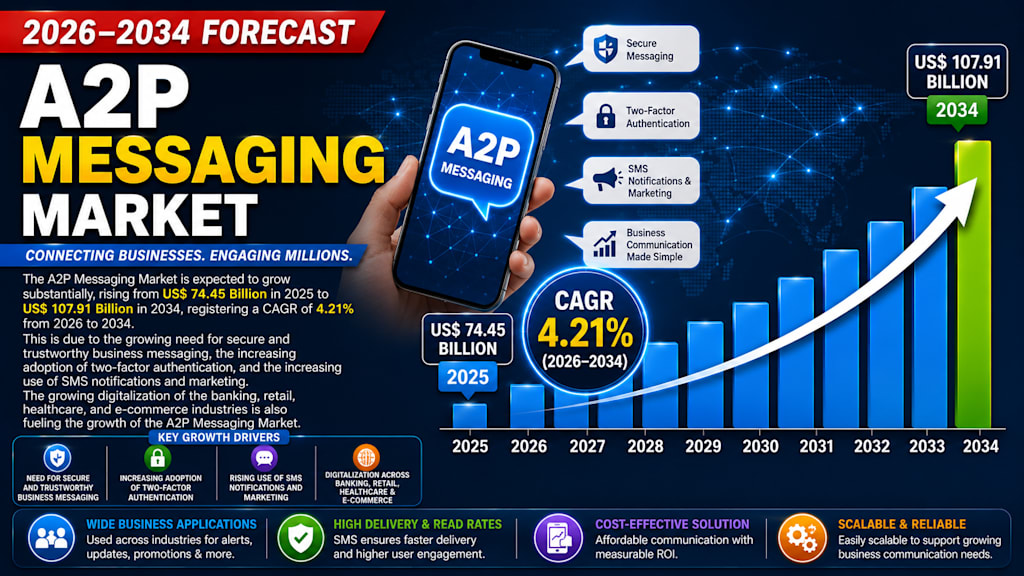
Rising demand for secure authentication, growing digital services, and the increasing use of real-time customer communication are driving strong growth in the global A2P messaging industry. According to Renub Research, the market is expected to grow from US$ 74.45 Billion in 2025 to US$ 107.91 Billion in 2034, registering a CAGR of 4.21% from 2026 to 2034.

Businesses Are Relying More on Instant Mobile Communication
In today’s digital economy, businesses need communication channels that are fast, reliable, and secure. Whether it is a banking transaction alert, a one-time password for login verification, a delivery notification, or an appointment reminder, customers increasingly expect instant communication directly on their mobile devices. This growing demand is fueling rapid expansion in the Application-to-Person (A2P) messaging market.
A2P messaging refers to automated messages sent from applications, platforms, or systems directly to users’ mobile phones. Unlike person-to-person messaging, A2P communication is designed for business use cases such as authentication, service notifications, marketing campaigns, customer engagement, and transactional updates.
According to Renub Research, the global A2P messaging market is projected to rise from US$ 74.45 Billion in 2025 to US$ 107.91 Billion in 2034, growing at a compound annual growth rate of 4.21% between 2026 and 2034.
The market’s steady expansion reflects the growing importance of secure, scalable, and reliable communication in an increasingly mobile-first digital environment.
Why A2P Messaging Has Become So Important
A2P messaging is widely used because it provides immediate reach and high reliability across virtually all mobile devices. Unlike app notifications, A2P SMS messages do not require internet connectivity or app installation, making them highly accessible across both developed and emerging markets.
Businesses across banking, retail, healthcare, travel, e-commerce, and government sectors depend heavily on A2P messaging for customer communication. Common use cases include transaction confirmations, one-time passwords (OTPs), appointment reminders, delivery tracking updates, account notifications, and promotional offers.
As digital transformation accelerates globally, enterprises increasingly require communication systems that can operate instantly, securely, and at large scale. A2P messaging fulfills these requirements while maintaining high delivery success rates and strong customer engagement.
Secure Authentication Is Driving Strong Demand
One of the biggest drivers of the A2P messaging market is the rising need for secure authentication and fraud prevention. Cybercrime, identity theft, phishing, and online fraud have increased dramatically, pushing businesses to strengthen security measures for digital transactions and customer accounts.
Banks, financial institutions, e-commerce platforms, and online service providers rely heavily on OTPs and verification codes sent through A2P messaging to secure customer interactions. SMS-based authentication remains highly effective because it works across all mobile devices, even without internet access.
The report highlights a partnership between VOX Solutions and Orange Burkina Faso launched in July 2024 to improve secure A2P messaging delivery and combat messaging fraud and artificial traffic inflation. Such collaborations demonstrate how telecom operators and technology providers are working together to improve trust and security in mobile communication systems.
As governments and regulators continue introducing stronger customer authentication requirements, demand for reliable A2P messaging services is expected to rise further.
Mobile-First Digital Services Are Expanding the Market
The rapid growth of mobile-centric business models and digital services is another major factor driving the A2P messaging industry. Businesses increasingly operate through websites, mobile applications, cloud services, and digital platforms that require continuous customer communication.
Industries such as e-commerce, online banking, food delivery, travel booking, ride-sharing, and healthcare rely on A2P messaging for transaction confirmations, service notifications, order tracking, and appointment reminders. Emerging markets, where smartphones are often the primary gateway to digital services, are contributing significantly to message volume growth.
A2P messaging helps businesses improve customer experience, maintain real-time engagement, and increase operational efficiency. As mobile-first ecosystems continue expanding globally, the importance of A2P communication is becoming even more central to digital business operations.
The report notes that Route Mobile partnered with Billeasy in February 2024 to launch a ticket purchase service using Rich Communication Services (RCS) messaging for Maha Metro Pune, reflecting growing innovation in mobile-based customer interactions.
SMS Remains One of the Most Reliable Communication Channels
Despite the rise of messaging apps and internet-based communication platforms, SMS continues to maintain one major advantage: reliability. SMS messages typically achieve extremely high open rates and are often read within minutes of delivery.
This reliability makes A2P messaging especially valuable for time-sensitive communication such as security alerts, OTP verification, appointment reminders, and critical service notifications. Unlike emails or app notifications that may go unread, SMS offers direct and immediate engagement.
A2P messaging also functions effectively in regions with poor internet connectivity, giving businesses a dependable communication method across a wide range of network environments and device types.
In March 2025, Globe Teleservices signed a multi-year agreement with CelcomDigi in Malaysia to deploy advanced A2P SMS firewall and traffic solutions focused on fraud prevention and authenticated messaging.
Rising Costs Are Creating Challenges
Although the market outlook remains strong, pricing pressure is one of the major challenges affecting the A2P messaging industry. Telecommunications operators generally charge higher rates for A2P traffic compared to person-to-person messaging.
For businesses sending millions of OTPs, alerts, and transactional messages, messaging costs can become substantial. Regulatory charges, international messaging fees, and telecom operator pricing structures further increase expenses.
Small and medium-sized enterprises may face difficulties managing these costs, potentially limiting adoption in some markets. As a result, some businesses are exploring alternative communication channels to reduce expenses.
Spam and Fraud Remain Industry Concerns
Spam messaging, phishing attacks, and fraudulent SMS activities continue to pose serious challenges for the A2P messaging ecosystem. Unsolicited commercial messages and “smishing” attacks can reduce consumer trust and damage brand reputation.
Governments and telecom regulators worldwide are implementing stricter rules regarding message content, sender verification, and consumer consent. Failure to comply with these regulations can lead to fines, message blocking, or service restrictions.
Managing regulatory compliance across multiple countries is particularly challenging for global enterprises and messaging providers operating internationally.
Cloud-Based Messaging Platforms Are Growing Rapidly
The cloud A2P messaging segment is one of the fastest-growing areas of the market. Cloud-based platforms offer scalability, flexibility, and cost-efficiency while eliminating the need for expensive infrastructure investments.
Cloud messaging services support real-time communication, API integration, automatic updates, and global accessibility. They are especially valuable for businesses operating across multiple regions and handling large message volumes.
The rise of remote work, cloud-native applications, and digital business operations continues to strengthen demand for cloud-based messaging platforms.
Large Enterprises Are Leading Adoption
Large enterprises remain among the biggest users of A2P messaging services because they manage massive volumes of customer interactions and mission-critical communication workflows.
Banks, telecom companies, retailers, healthcare providers, and global corporations rely on A2P messaging for authentication, service updates, account notifications, customer engagement, and security alerts. Large organizations also require advanced analytics, compliance tools, and integration with enterprise systems such as CRM and billing platforms.
As enterprises continue expanding digital operations, dependable messaging infrastructure remains essential.
Travel, Retail, and Government Sectors Are Expanding Usage
The travel and tourism sector is increasingly adopting A2P messaging to improve customer experience through booking confirmations, flight alerts, check-in reminders, and emergency notifications. Real-time messaging improves operational efficiency and enhances traveler convenience.
Retailers and media companies are also using pushed content services to deliver promotions, subscription updates, personalized offers, and customer engagement campaigns. High open rates make A2P messaging particularly effective for marketing communication.
Governments and public service providers use A2P messaging for citizen alerts, service notifications, and authentication services, further broadening the market’s application base.
The United States Remains a Mature Market
The United States continues to lead the global A2P messaging market due to widespread digitalization across banking, retail, healthcare, and e-commerce industries. Enterprises in the U.S. rely heavily on A2P messaging for OTPs, transaction notifications, appointment reminders, and customer communication.
Cloud-based A2P solutions are especially popular due to scalability and integration capabilities. The report also notes that Infobip launched A2P RCS Messaging in North America in June 2024, highlighting ongoing innovation in business messaging technologies.
India Is Emerging as a Major Growth Market
India’s A2P messaging market is growing rapidly because of massive mobile penetration, expanding digital services, and rising internet adoption. Digital payments, e-commerce, banking, government services, and online platforms heavily depend on OTPs and transactional messaging.
The country’s large mobile user base creates enormous messaging volume, making India one of the fastest-growing A2P markets globally. The report highlights that BSNL launched its Bulk Push SMS A2P Platform in January 2025 as part of India’s digital transformation efforts.
Saudi Arabia Is Expanding Through Digitalization
Saudi Arabia’s A2P messaging market is also growing steadily due to rapid digital transformation, e-government services, digital banking, and increasing mobile connectivity.
Banks, telecom companies, government agencies, and retailers increasingly use A2P messaging for secure communication and customer engagement. High smartphone penetration and modern telecom infrastructure are supporting efficient message delivery across the country.
The Future of A2P Messaging Looks Strong
As digital services continue expanding globally, the need for reliable and secure customer communication is expected to grow steadily. Businesses increasingly require instant engagement channels capable of supporting authentication, service delivery, customer support, and marketing communication at scale.
While messaging apps and internet-based communication platforms continue evolving, SMS-based A2P messaging remains highly valuable because of its universal compatibility, reliability, and direct reach.
Final Thoughts
The global A2P messaging market is becoming increasingly important in a mobile-first digital economy. According to Renub Research, the market is expected to grow from US$ 74.45 Billion in 2025 to US$ 107.91 Billion in 2034, supported by rising demand for secure authentication, customer engagement, and real-time communication services.
Although challenges such as pricing pressure, spam, and regulatory compliance remain significant, the overall market outlook remains positive. Businesses across industries continue to rely on A2P messaging because it offers trusted, scalable, and highly effective communication with customers.
As digital transformation accelerates worldwide, A2P messaging is expected to remain one of the most critical technologies supporting secure and efficient business communication.
About the Creator
Enjoyed the story? Support the Creator.
Subscribe for free to receive all their stories in your feed.
Comments
There are no comments for this story
Be the first to respond and start the conversation.